
Non-FictionInformativeEducational
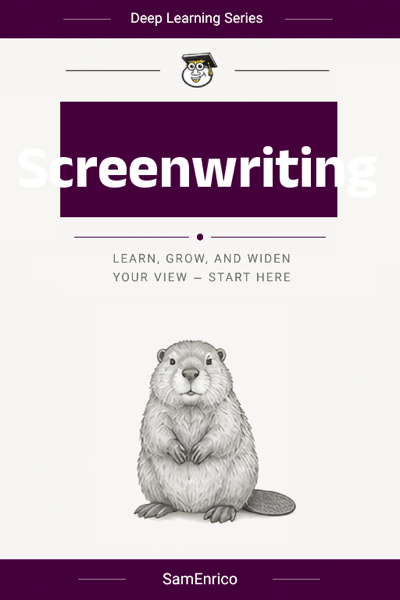
Screenwriting eBook
A Coursebook on Screenwriting
by Condon Pia
A Coursebook on Screenwriting
Formats
Free sample
Chapter 1: The Blueprint Lie...--So you want to write a screenplay. Let me stop you right there.You’ve probably heard it a hundred times: “A screenplay is a blueprint for a film.” It’s the first line of every screenwriting book, the mantra of every professor, the Linked In post of every development executive who has never actually written a page of dialogue. And it is, technically, true. A screenplay does function as a blueprint. It tells the director where to point the camera (sort of), the actors what to say (exactly), and the set designer when to build a collapsing bridge (preferably before the actors arrive).But here’s what no one tells you, and what this entire book exists to correct: a screenplay is not a blueprint for a building.
It is a blueprint for an emotion.You cannot frame a wall with a feeling. You cannot pour a foundation of sadness. And yet, that is precisely what screenwriting asks you to do. Every scene you write is an instruction manual for manufacturing a specific emotional response in a dark room full of strangers. The director will interpret it.
The actors will betray it (in ways both wonderful and terrible). The editor will rearrange it. And through all of that chaos, if you have done your job correctly, the audience will feel something that you alone orchestrated.This chapter is not about formatting. It is not about three-act structure (though that’s coming). It is not about “show, don’t tell” as a religious commandment.
This chapter is about unlearning the lie that screenwriting is a mechanical process, and replacing it with a more useful truth: screenwriting is the craft of translating internal experience into external action.Or, as the great William Goldman once said, “Screenplay is structure. And structure is the least interesting thing about movies and the most important thing to learn.” Note that he didn’t say structure is the point. He said it’s what you have to learn so you can stop thinking about it. The same way a pianist practices scales so that when they play Chopin, they are thinking about heartbreak, not finger placement.This chapter will teach you the scales. But it will never let you forget the heartbreak.The Fundamental Difference Between Prose and Screenwriting If you are coming to screenwriting from short stories, novels, or even long-form journalism, the first thing you will notice is how naked a screenplay feels.
Prose allows you to live inside a character’s skull. You can write: “He thought about his mother, about the last time he saw her, about the way she had smiled while lying, and he felt a grief so total it seemed less like an emotion than a new law of physics.”That sentence works on the page. It is beautiful, actually. And it is completely useless in a screenplay because no camera can film a thought and no actor can perform a new law of physics.Here is how you would have to rewrite that moment for the screen:He stares at an empty chair. His hand moves to his chest.
Closes into a fist. Opens again.That is it. Two sentences. No interiority. No metaphor that cannot be physically performed.
That is the cruelty and the liberation of screenwriting: you cannot tell us what a character feels. You can only show us what they do when they feel it.This is why the cardinal rule of screenwriting is “Show, Don’t Tell” – but let us be precise about what that actually means. It does not mean “avoid dialogue” (though bad dialogue is a plague). It does not mean “every emotion must be a close-up of a tear” (please, no). It means: the audience must infer internal states from external evidence.In prose, the narrator is a guide.
In screenwriting, the audience is a detective.Let me give you an example that will stick with you. Consider two versions of the same moment:Version A (Prose) – "John was furious at his father for missing his birthday again. He had felt this way for years, a slow-building resentment that now threatened to consume him. 'You always do this,' he said, his voice trembling with rage."Version B (Screenplay) – "John sits at a dining table. A single cupcake with a candle.
The wax has hardened into a white puddle. His father’s chair is empty. John looks at the empty chair. Then he picks up the cupcake, walks to the trash, and drops it in. He returns to the table, sits down, and flips the empty chair onto its back.
He does not say a word."Which version makes you feel something? Which version requires you, the audience, to do the work of interpretation? Which version haunts?Version B, obviously. And it does so precisely because it withholds the internal state. We do not know if John is furious or heartbroken or relieved or performing for an imagined audience.
We only know what he does. And because we only know what he does, we lean forward. We try to solve him. We become complicit in the storytelling.That complicity is the secret currency of cinema. A novel hands you meaning on a platter.
A screenplay hides meaning in the closet and dares you to find it.When to Break “Show, Don’t Tell” (Because You Will)Every rule in screenwriting exists to be broken. The trick is knowing why the rule exists in the first place so that when you break it, you are not breaking it out of ignorance or laziness but out of artistic necessity.The rule “Show, Don’t Tell” exists to prevent two deadly sins:Exposition as dialogue – Characters saying things they already know for the benefit of the audience. “As you know, Bob, we’ve been partners for fifteen years and your drinking problem has cost us three major cases.” No human has ever spoken this way.Voice-over as narration – A disembodied voice explaining what the audience can already see. “Little did I know that the man in the grey suit would change my life forever.” This is not cinema; it is audiobook with pictures.But there are legitimate, powerful uses of telling. The most common is voice-over that creates irony.
Consider the opening of Goodfellas:“As far back as I can remember, I always wanted to be a gangster.”Ray Liotta speaks this line over a shot of a trunk opening to reveal a bleeding body wrapped in a sheet. The voice-over does not describe the image. It contradicts the image. It tells us that the narrator romanticizes violence even as we see its ugly reality. That gap – between what we see and what we hear – is irony.
And irony is cinema.Compare that to the theatrical cut of Blade Runner, where Harrison Ford’s voice-over explains, “I was tired. Tired of the rain. Tired of the city.” The image already shows a man looking tired in the rain in the city. No gap. No irony.
Just redundancy. That is bad voice-over.The decision tree for voice-over is simple:Does the voice-over tell us something we cannot see? (Good)Does the voice-over contradict what…
This is the end of the free sample. Get the eBook to keep going. Buy now
About this book
Details
- Author
- Condon Pia
- Publisher
- SamEnrico
- Language
- English
- Genre
- Non-Fiction, Informative, Educational
- Released
- 2026-05-11
- Pages (approx.)
- 142
- Available as
- eBook, Audiobook

Read better in the ZLOADR app
Your eBooks on your phone or tablet. Sign in with your SamEnrico account and start reading.
More by Condon Pia
 Burnout Prevention Work PacingCondon Pia$11.99
 The Arthritis Pregnancy GuideCondon Pia$11.99
 Remote Company Retreats Conflict ResolutionCondon Pia$11.99
 Chunking Philosophical ArgumentsCondon Pia$11.99
 The Memory Nutrition HandbookCondon Pia$11.99
 The Rio Grande Gold Heist: The Untold Story of Latin America's Greatest Casino RobberyCondon Pia$11.99
 Understanding Sheehan SyndromeCondon Pia$17.99
 How to Become a Polysomnographic TechnicianCondon Pia$11.99
 Korean Scholarship Eligibility GuideCondon Pia$12.99
 Shea Value Addition GuideCondon Pia$12.99
You may also like
 Hong Kong Handover 1997Dunn Johnnie$11.99
 Zumba For Postnatal Recovery CourseNeal Christian$11.99
 Zumba for BeginnersLadner Nikia$11.99
 YouTube Comment Mining GuideHumes Pandora$12.99
 Worry Box MeditationCarlin Rudy$11.99
 Workplace Stress MeditationNguyen Lynn$11.99
 Workplace Stress and Sleep RepairHawley Ivory$11.99
 Workplace Perfectionism CureDelaney Jeffry$11.99
 Workplace Injustice Anger GuideWallen Isabelle$11.99
 Work Addiction and Burnout LinkGreenwood Ester$11.99
 Women in Yoga and WellnessBeattie Galina$11.99
 Women in Stand Up ComedyChun Evangeline$11.99