
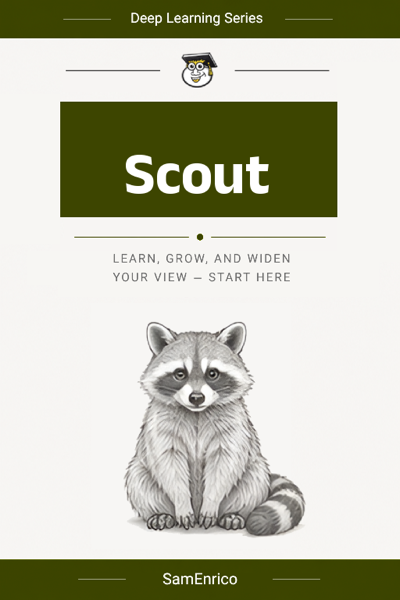
Non-FictionInformativeEducational
Scout eBook
A Coursebook on Scout
by Bruns Toney
A Coursebook on Scout
Formats
Free sample
Chapter 1: The Awkward Age--–- The boy stood at the edge of the parking lot, clutching his mother's hand as if she were a life raft. He was twelve years old, tall for his age but slumped as if trying to disappear into his own hoodie. His name was Marcus, and he had spent the last six months in his bedroom, emerging only for school and meals. His grades had fallen from Bs to Ds. His friends had stopped calling.
His mother had tried everything – therapy, tutors, a stern lecture from his father – but nothing reached him. Desperate, she had signed him up for Scouting. Now they stood outside a church basement where a Troop met every Tuesday night. Marcus did not want to go. He was certain the other boys would laugh at him.
He was certain he would fail at whatever they asked him to do. He was certain that this, like everything else, would end in disappointment. His mother squeezed his hand. "Just one meeting," she said. "If you hate it, you never have to come back." Marcus took a breath and walked through the door.That was eighteen months ago.
Today, Marcus is the Patrol Leader of the Wolverines, a team of seven boys who look up to him. He leads hikes, teaches knots, and mediates disputes. His grades have returned to Bs. He has friends again. And last weekend, when a younger Scout froze halfway up a climbing wall, Marcus climbed up beside him and talked him down, step by step, until the boy reached the top.
Marcus did not become a different person. He became the person he always was – but Scouting gave him the container to grow into it.This chapter is about that container. It is about the strange, turbulent, extraordinary years between childhood and adulthood – the ages of 11 to 15 – and why Scouting is uniquely designed to catch young people at exactly this moment and help them become who they are meant to be. If you are a leader, this chapter will help you understand the young people in your Troop: why they alternate between bravado and insecurity, why they crave responsibility but fear failure, why they need you to step back and step in at exactly the right moments. If you are a parent, this chapter will help you see what Scouting offers that school and sports do not.
And if you are a young person reading this book, this chapter will help you understand yourself – the chaos, the confusion, and the incredible potential that lives inside you.The Science of the Awkward Age Let us start with the uncomfortable truth: early adolescence is a mess. Between the ages of 11 and 15, the human brain undergoes a remodeling as dramatic as the first three years of life. The prefrontal cortex – the part of the brain responsible for impulse control, planning, and decision-making – is under construction. Meanwhile, the limbic system – the part responsible for emotion, reward-seeking, and risk-taking – is in overdrive. This is why a 13-year-old can make a brilliant plan one moment and do something breathtakingly stupid the next.
Their brain is not broken. It is being rewired.Physically, these years bring a flood of hormones – testosterone in boys, estrogen in girls – that trigger growth spurts, voice changes, and the development of secondary sexual characteristics. Some young people mature early, towering over their peers and developing adult bodies while still thinking like children. Others mature late, watching their friends shoot up while they wait, frustrated, for their turn. The range of normal is wide: an 11-year-old can look like a fourth-grader or a high school freshman.
This physical diversity creates social chaos, as young people compare themselves to each other and find themselves wanting.Socially, early adolescence marks the shift from family-centered to peer-centered identity. The approval of parents, once all-important, is replaced by the approval of friends. This is developmentally necessary – young people must learn to navigate social hierarchies independent of their families – but it is also terrifying. The fear of exclusion, of being laughed at, of being the last one picked, becomes consuming. Cliques form and shift.
Loyalty is tested. And beneath it all, every young person is asking the same question: "Do I belong?"What 11-to-15-Year-Olds Actually Need If you ask a young person what they want, they might say "a new phone" or "to be left alone." But if you watch them carefully, you will see three deeper needs that they cannot articulate:The Need for Autonomy – They need to make their own decisions, even bad ones. Every time an adult swoops in to solve a problem, they send a message: "You are not capable." Young people need opportunities to plan, to execute, and to fail – safely. They need to experience the consequences of their choices without those consequences being catastrophic. They need to hear "You decide" more often than "Do this."The Need for Belonging – They need to be part of something larger than themselves.
Not a family (that is given) but a chosen tribe. A Patrol of six to eight peers who know their name, notice when they are absent, and care whether they succeed. This tribe must have rituals, traditions, and symbols that mark the boundary between "us" and "them." The uniform, the Patrol flag, the secret handshake – these are not silly. They are the architecture of belonging.The Need for Mastery – They need to be good at something. Not "good for their age" but genuinely competent.
They need to tie a knot that holds, build a fire that lights, navigate a trail that ends at the right lake. They need to experience the satisfaction of a skill earned through struggle. This is why video game achievements are so addictive – they provide artificial mastery. Scouting provides the real thing.Why Scouting Works at This Age Scouting was not designed by committee. It was designed by a man who watched young people carefully and built a system around what they actually needed.
Robert Baden-Powell, the founder of Scouting, was a British army officer who noticed something surprising: when young people were given responsibility, structure, and a clear code of conduct, they rose to the occasion. They did not become undisciplined. They became self-disciplined.The genius of Scouting is that it aligns perfectly with the three needs described above:Autonomy is built into the Patrol system, where young people elect their own leaders, plan their own activities, and run their own meetings. The adult's job is to set boundaries and then get out of the way.Belonging is built into the symbolic framework – the uniform, the Promise, the Patrol flag, the investiture ceremony. These symbols create an identity that is chosen, not assigned.
A young person may not choose their family, but they choose to be a Scout.Mastery is built into the progressive badge system. Skills are broken down into achievable steps. A young person starts with the basics (lighting a match, tying a knot) and works up to advanced competencies (planning a week-long expedition, leading a Patrol). Each badge is a milestone, visible proof of growth.The Bridge from Cubs to Scouts If you are coming from the Cub Pack (ages 8-10), you will notice a…
This is the end of the free sample. Get the eBook to keep going. Buy now
About this book
Details
- Author
- Bruns Toney
- Publisher
- SamEnrico
- Language
- English
- Genre
- Non-Fiction, Informative, Educational
- Released
- 2026-06-02
- Pages (approx.)
- 128
- Available as
- eBook, Audiobook

Read better in the ZLOADR app
Your eBooks on your phone or tablet. Sign in with your SamEnrico account and start reading.
More by Bruns Toney
 Angel Investor Pitch GuideBruns Toney$12.99
 Jenkins CI/CD Outage ProtocolBruns Toney$11.99
 TM For Test TakingBruns Toney$11.99
 Stop Binge Eating WorkbookBruns Toney$11.99
 Sexual Intimacy Stress GuideBruns Toney$11.99
 The Couple Grief After Child LossBruns Toney$11.99
 The Last Voyage of the Mary Celeste: Ghost Ship or Human Mystery?Bruns Toney$11.99
 Understanding Wandering SpleenBruns Toney$17.99
 How to Start a Bath Preparations Business (Beginners Guide)Bruns Toney$11.99
 ARIPO Examination GuideBruns Toney$12.99Angel Investor Pitch GuideBruns Toney$12.99
You may also like
 Hong Kong Handover 1997Dunn Johnnie$11.99
 Zumba For Postnatal Recovery CourseNeal Christian$11.99
 Zumba for BeginnersLadner Nikia$11.99
 YouTube Comment Mining GuideHumes Pandora$12.99
 Worry Box MeditationCarlin Rudy$11.99
 Workplace Stress MeditationNguyen Lynn$11.99
 Workplace Stress and Sleep RepairHawley Ivory$11.99
 Workplace Perfectionism CureDelaney Jeffry$11.99
 Workplace Injustice Anger GuideWallen Isabelle$11.99
 Work Addiction and Burnout LinkGreenwood Ester$11.99
 Women in Yoga and WellnessBeattie Galina$11.99
 Women in Stand Up ComedyChun Evangeline$11.99