
Non-FictionStudent's ShortcutEvidence Synthesis
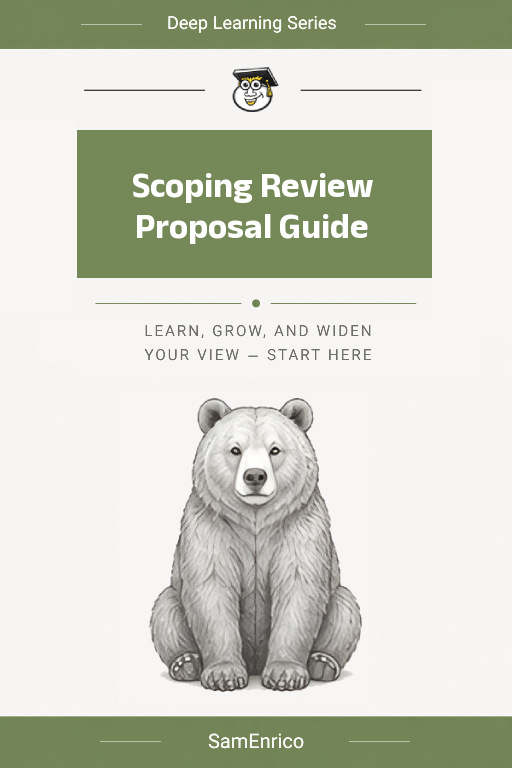
Scoping Review Proposal Guide
Propose scoping reviews as standalone grad researc
Propose scoping reviews as standalone grad research projects. Map literature, identify evidence clusters, and justify scoping over systematic review approach.
Formats
About this book
Free sample
Chapter 1: The Cartographer's Pivot-- Every graduate student remembers the moment their comfortable understanding of a literature review collapsed. For some, it happens during a committee meeting when a professor asks, "But how is your review different from a dissertation chapter?" For others, it comes while reading a methods paper that casually mentions "PRISMA flow diagrams" and "risk of bias assessments" as if these were common knowledge. And for many, it arrives in the middle of the night, staring at a spreadsheet of 3,000 article titles, realizing that summarizing each one individually would take longer than writing the actual thesis.That moment of collapse is not a failure. It is an invitation.The traditional graduate education model treats the literature review as a rite of passage—something you endure before getting to the "real" research. You read broadly, take notes, organize by theme, and produce a chapter that demonstrates your familiarity with the field.
Your advisor reads it, nods, and says, "Good foundation. Now what's your research question?" The review itself is never the destination. It is the bus you take to get there.But what if the review could be the destination? What if mapping what is known—not judging it, not aggregating it, but simply charting its contours—was a contribution worthy of a thesis, a publication, and a career?This book argues that it is. And the key to unlocking that argument is what I call the cartographer's pivot: the shift from asking "What works?" to asking "What is the shape of what we know?"The Two Traps That Catch Every Graduate Student Before we can understand why the scoping review is revolutionary, we must understand the traps that literature-based graduate projects fall into.
I have seen these traps consume months of student time, derail dissertations, and produce work that satisfies no one—not the student, not the committee, not the field.Trap One: The Kitchen Sink The kitchen sink literature review is the most common failure mode in the humanities and social sciences. Here is how it happens. You choose a topic—say, "resilience in healthcare workers during crises." You search…
This is the end of the free sample. Get the eBook to keep going. Buy now
Contents
- Chapter 1
- Chapter 2
- Chapter 3
- Chapter 4
- Chapter 5
- Chapter 6
- Chapter 7
- Chapter 8
- Chapter 9
- Chapter 10
- Chapter 11
- Chapter 12
Details
- Author
- Mcclintock Santana
- Publisher
- SamEnrico
- Language
- English
- Genre
- Non-Fiction, Student's Shortcut, Evidence Synthesis
- Released
- 2026-06-01
- Pages (approx.)
- 149
- Available as
- eBook, Audiobook

Read better in the ZLOADR app
Your eBooks on your phone or tablet. Sign in with your SamEnrico account and start reading.
More by Mcclintock Santana
 The Dry Cleaning GuideMcclintock Santana$11.99
 Restaurant Nonverbal GuideMcclintock Santana$11.99
 Harvard Extension School Transfer CreditsMcclintock Santana$11.99
 Burnout and Therapy SeekingMcclintock Santana$11.99
 Rana Pratap's Last Stand: The Siege of Chittorgarh (1568)Mcclintock Santana$11.99
 Real Estate Valuation AnalystMcclintock Santana$11.99
 How to Produce Bicycle DerailleursMcclintock Santana$11.99
 How to Start a Noils (woollen Industry) Business (Beginners Guide)Mcclintock Santana$11.99
You may also like
 Hong Kong Handover 1997Dunn Johnnie$11.99
 Zumba For Postnatal Recovery CourseNeal Christian$11.99
 Zumba for BeginnersLadner Nikia$11.99
 YouTube Comment Mining GuideHumes Pandora$12.99
 Worry Box MeditationCarlin Rudy$11.99
 Workplace Stress MeditationNguyen Lynn$11.99
 Workplace Stress and Sleep RepairHawley Ivory$11.99
 Workplace Perfectionism CureDelaney Jeffry$11.99
 Workplace Injustice Anger GuideWallen Isabelle$11.99
 Work Addiction and Burnout LinkGreenwood Ester$11.99
 Women in Yoga and WellnessBeattie Galina$11.99
 Women in Stand Up ComedyChun Evangeline$11.99