
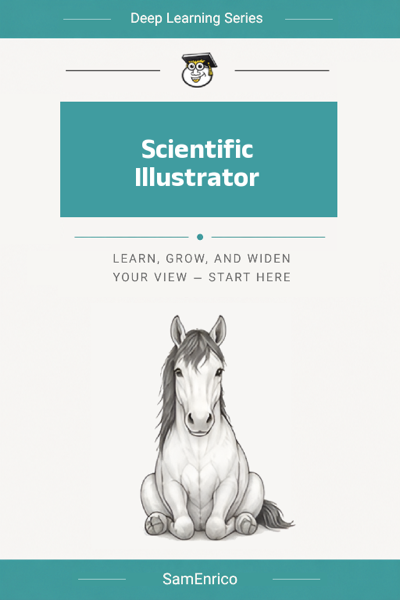
Non-FictionInformativeEducational
Scientific Illustrator eBook
A Coursebook on Scientific Illustrator
by Stull Dodie
A Coursebook on Scientific Illustrator
Formats
Free sample
Chapter 1: The Negotiated Eye...--The specimen lies motionless on the dissecting scope, no larger than a grain of rice. It is a weevil, collected from a remote cloud forest, and it carries on its back a pattern of scales that no human eye has ever fully described. To a biologist, this beetle is data—a set of coordinates, a DNA sequence, a potential new species. To a photographer, it is too small, too reflective, too alive in its death. But to a scientific illustrator, this weevil is a conversation waiting to happen.
The question is not simply "What does it look like?" but rather "What does it need to look like for science to understand it?"That question—the negotiation between what is seen, what is known, and what can be communicated—defines the entire field of scientific illustration. It is not a passive act of transcription. You do not hold a mirror up to nature and trace the reflection. Instead, you become a translator, a filter, an advocate for clarity. You decide which lines matter and which details can recede.
You choose whether to show the torn wing, the parasitic mite, the developmental anomaly—or to present the idealized, undamaged version that belongs in a textbook. Both choices are scientific. Both carry ethical weight. And neither is obvious.If you came to this book hoping for a simple formula—draw what you see, and you will be a scientific illustrator—you will be disappointed. The real work is far stranger and far more rewarding.
Scientific illustration is not realism. It is strategic realism: a deliberate, informed, and often collaborative construction of an image that serves a specific research or educational goal. The weevil on the scope is not just a weevil. It is a type specimen, a holotype, the single individual that defines an entire species. Every scale you draw or omit changes how future scientists will identify every other weevil in that genus.
That is the weight of this profession.What This Chapter Is and What It Is Not This chapter is the foundation of everything that follows. It will not teach you how to hold a pencil, mix a color, or use a software program. Those skills come later, in the hands-on chapters of this coursebook. Instead, this chapter answers three essential questions that too many technical books ignore. First, what is scientific illustration—not as a dictionary definition but as a living practice with boundaries, overlaps, and contested territories?
Second, why does it matter in an age of high-resolution photography, 3D scanning, and artificial intelligence? And third, who are you in relation to this field—what careers exist, what habits of mind you must cultivate, and what kind of work you will be asked to produce?By the end of this chapter, you will have a map of the territory. You will understand why a scientific illustration of a virus looks different from a medical illustration of a heart, and why both differ from a nature journal sketch. You will have met the ancestors of this field—Leonardo da Vinci, Maria Sibylla Merian, Ernst Haeckel—and you will see how their solutions to centuries-old problems echo in the work of today's digital pioneers. Most importantly, you will learn to look at a published scientific figure not as a passive reader but as a critical practitioner.
You will see the choices behind the image: the cropping, the color palette, the lighting direction, the presence or absence of a scale bar. And you will begin to ask the question that defines this profession: What was the illustrator trying to make me see—and what did they choose to hide?This is not a chapter for passive reading. It is an invitation to change how you see every scientific image you encounter from this day forward.Defining the Undefinable: What Scientific Illustration Actually Is The simplest definition is also the most misleading: scientific illustration is the visual communication of scientific information. This statement is true but useless. It describes everything from a Nobel laureate's chalkboard doodle to a full-color CT scan reconstruction.
To understand what scientific illustration is, we must first understand what it is not.Scientific Illustration vs. Medical Illustration The most common confusion in the field is between scientific illustration and medical illustration. Both require accuracy. Both serve professional audiences. But they differ in subject matter, training pathways, and professional standards.Medical illustration focuses exclusively on human anatomy, surgical procedures, pathological conditions, and clinical education.
Medical illustrators typically complete a rigorous master's degree program accredited by the Commission on Accreditation of Allied Health Education Programs (CAAHEP). They study human cadaver dissection alongside surgeons. They learn to render tissues, organs, and disease processes for textbooks, patient education materials, and legal exhibits. Their work is governed by strict anatomical conventions and the Health Insurance Portability and Accountability Act (HIPAA). A medical illustrator who misplaces a coronary artery has not just made an aesthetic error—they have potentially endangered a patient.Scientific illustration encompasses everything else.
Botany, entomology, marine biology, paleontology, geology, astrophysics, molecular biology, ecology, and countless other fields fall under this broader umbrella. Scientific illustrators may specialize in a single domain or work across many. They may hold a bachelor's degree in fine arts with a minor in biology, or a master's degree from one of the few dedicated scientific illustration programs (such as the University of California Santa Cruz or the University of Washington). Their work appears in research journals, museum exhibits, field guides, textbooks, and public outreach materials. A scientific illustrator who draws a fossil with the wrong number of vertebrae has damaged scientific discourse—but not directly endangered a human life.This distinction matters because the ethical obligations, professional networks, and client expectations differ significantly.
If your passion is the human heart, pursue medical illustration. If your passion is the weevil, or the galaxy, or the folded protein, scientific illustration is your path.Scientific Illustration vs. Scientific Art A second, more subtle distinction separates scientific illustration from scientific art. The line between them is thin, hotly debated, and frequently crossed—but it exists.Scientific illustration prioritizes reproducibility and data fidelity above all else. A scientific illustration of a bird should look sufficiently like that species that another ornithologist can identify it without reading the caption.
The colors should match the living specimen under standard daylight. The proportions should derive from measurements, not from artistic license. The background should be neutral or omitted entirely unless it conveys ecological information. The goal is not to express the illustrator's emotional response to the bird but to document the bird's anatomical features for future reference.Scientific art prioritizes aesthetic impact, narrative, or emotional response—often while still respecting scientific facts. A scientific painting of a dinosaur in a misty jungle at sunset is beautiful and may be accurate in its anatomy and environment.
But the lighting, the atmospheric haze, the dramatic pose, and the composition all serve an emotional or narrative purpose beyond pure documentation. Scientific art lives in museum murals, documentary title sequences, and gallery exhibitions. It inspires wonder and curiosity. It is not lesser than illustration—it is simply different.The confusion arises because many working professionals produce both.…
This is the end of the free sample. Get the eBook to keep going. Buy now
About this book
Details
- Author
- Stull Dodie
- Publisher
- SamEnrico
- Language
- English
- Genre
- Non-Fiction, Informative, Educational
- Released
- 2026-06-02
- Pages (approx.)
- 138
- Available as
- eBook, Audiobook

Read better in the ZLOADR app
Your eBooks on your phone or tablet. Sign in with your SamEnrico account and start reading.
More by Stull Dodie
 Visualization Sleep MeditationStull Dodie$11.99
 Strength Training Recovery ManualStull Dodie$11.99
 Sunday Evening ReviewStull Dodie$11.99
 Tennis Player Flexibility GuideStull Dodie$11.99
 The Last Stand of the Rainbow Warrior: Greenpeace vs. the Secret ServiceStull Dodie$11.99
 The Unlikely Merger: How a Tech Startup and a 100-Year-Old Bank Joined ForcesStull Dodie$11.99
 Understanding HypochondroplasiaStull Dodie$17.99
 How to Start a Patent Leather Business (Beginners Guide)Stull Dodie$11.99
 Targeted Radionuclide TherapyStull Dodie$12.99
 Hiring Compliance Checklist WorkbookStull Dodie$12.99
You may also like
 Hong Kong Handover 1997Dunn Johnnie$11.99
 Zumba For Postnatal Recovery CourseNeal Christian$11.99
 Zumba for BeginnersLadner Nikia$11.99
 YouTube Comment Mining GuideHumes Pandora$12.99
 Worry Box MeditationCarlin Rudy$11.99
 Workplace Stress MeditationNguyen Lynn$11.99
 Workplace Stress and Sleep RepairHawley Ivory$11.99
 Workplace Perfectionism CureDelaney Jeffry$11.99
 Workplace Injustice Anger GuideWallen Isabelle$11.99
 Work Addiction and Burnout LinkGreenwood Ester$11.99
 Women in Yoga and WellnessBeattie Galina$11.99
 Women in Stand Up ComedyChun Evangeline$11.99