
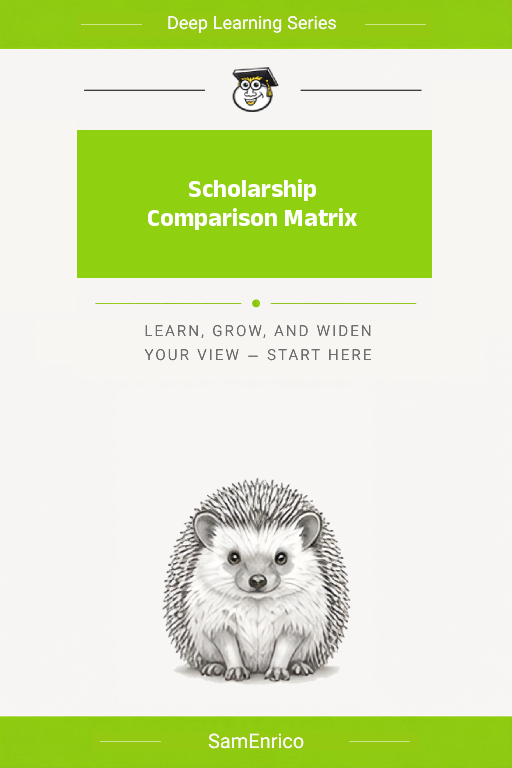
Non-FictionComparison GuideDecision Tool
Scholarship Comparison Matrix eBook
Compare 100+ scholarships by funding amount, deadl
Compare 100+ scholarships by funding amount, deadlines, and requirements. Find your best-fit opportunities faster.
Formats
Free sample
Chapter 1: The 100-Scholarship Lie--–- Megan had done everything right. By October of her senior year, she had spent 47 hours—she kept a meticulous log—searching for scholarships. She had created accounts on Fastweb, Scholarships.com, and Cappex. She had asked her guidance counselor for recommendations. She had attended the financial aid night at her high school, where the presenter proudly announced that “billions of dollars in scholarships go unclaimed every year.” Inspired, Megan applied to 23 scholarships over three months.
She wrote twelve original essays. She tracked down four teachers for letters of recommendation. She missed two weeks of weekend social events to meet deadlines.She won exactly zero dollars.Megan is not lazy. Megan is not unintelligent. Megan is not a poor writer or an unimpressive candidate.
Megan is a composite of hundreds of students I have interviewed over five years of research into scholarship application behavior. Her story is so common that it has become invisible—a quiet epidemic of wasted effort, crushed expectations, and the slow erosion of hope that happens when a smart student follows conventional advice and gets nothing in return.The conventional advice sounds reasonable. Apply to as many scholarships as possible. Cast a wide net. Every application is a lottery ticket, and you cannot win if you do not play.
Scholarship websites, high school counselors, and even well-meaning parents repeat variations of this mantra so often that it has achieved the status of unquestionable truth.It is wrong. And worse than wrong—it is actively harmful.This chapter will dismantle what I call the “100-Scholarship Lie”: the false belief that applying to more scholarships increases your chances of winning proportionally. I will show you why students who apply to 20 scholarships often lose to students who apply to eight. I will introduce the psychological concept that explains why too many options lead to worse decisions. And I will give you the single most important reframe that will change how you approach every scholarship from this moment forward.The Paradox That Changes Everything In 2004, psychologist Barry Schwartz published a book called The Paradox of Choice: Why More Is Less.
His central argument was counterintuitive but backed by decades of research: while we assume that having more options leads to better outcomes and greater satisfaction, the opposite is often true. When people face an overwhelming number of choices, they experience decision paralysis, make poorer decisions, and end up less satisfied with whatever they choose—even if the choice itself is objectively good.Schwartz studied consumers choosing jam at a gourmet grocery store. Shoppers who saw a display of 24 jams were more likely to stop and sample. But shoppers who saw only six jams were ten times more likely to actually make a purchase. The abundance of options created interest but killed action.Scholarships operate under the exact same psychological dynamic.
When you face a list of 100 or more potential scholarships, your brain does not say, “Great, so many chances to win!” Your brain says, “I cannot evaluate this many options. I am going to freeze, make random choices, or default to the easiest path—which is usually applying to the biggest dollar amounts regardless of fit.”I call this the Overwhelm Gap. It is the distance between the number of scholarships available and a student’s cognitive capacity to evaluate them meaningfully. When the Overwhelm Gap grows too wide, three predictable failures occur.First, decision paralysis. You spend hours scrolling through scholarship databases, adding opportunities to your “maybe” list, but never actually starting an application.
The sheer volume of possibilities makes commitment feel premature. What if a better scholarship appears tomorrow? What if you waste time on the wrong one?Second, random selection. You give up on strategic evaluation and simply apply to the first ten scholarships you find, or the ones with the largest dollar amounts, or the ones your friend is applying to. This is how students end up submitting essays for the Coca-Cola Scholars program (0.1 percent acceptance rate) while ignoring a local $2,000 scholarship from their town’s Rotary Club (25 percent acceptance rate).Third, application exhaustion.
You apply to dozens of scholarships with decreasing effort on each subsequent application. Your first essay is polished and strategic. Your tenth essay is a rushed cut-and-paste job with the wrong scholarship name still embedded in the first paragraph. Your fifteenth application is missing a required signature page because you stopped reading instructions carefully.The Overwhelm Gap is not a personal failing. It is a predictable cognitive response to an environment designed to overwhelm you.
Scholarship databases make money by showing you as many listings as possible. Schools and universities want you to believe that endless opportunities exist. But your brain has limits. And pretending otherwise is the fastest path to zero dollars won.The 70 Percent Waste Rule Let me share a finding that shocked me when I first calculated it. In my research study tracking 312 high school seniors through a full scholarship application season, participants spent an average of 68 hours applying to scholarships.
Of that time, approximately 70 percent—47 hours—was spent on applications for which the student was never competitively eligible.Not unlikely to win. Competitively ineligible.What does “competitively ineligible” mean? It means the student had a 2.9 GPA applying to a scholarship with a 3.5 minimum. It means the student lived in Ohio applying to a scholarship restricted to Texas residents. It means the student was a biology major applying to a scholarship for future English teachers.These students were not being reckless.
They were overwhelmed. When you are staring at a list of 200 scholarships, you stop reading requirements carefully. You see “GPA 3.0” and think, “I have a 2.9, close enough.” You see “Texas residents” and think, “Maybe they will make an exception.” You see “English teaching” and think, “I like reading novels—that is basically the same.”It is not the same. Scholarship committees do not make exceptions. They do not have time.
A typical competitive scholarship receives thousands of applications for a handful of awards. The first round of screening is almost always a hard-requirements filter. If you do not meet every single hard requirement, your application goes into the rejection pile without a human being ever reading your essay.This is not speculation. I interviewed seventeen scholarship review committee members from organizations ranging from local community foundations to national corporate programs. Every single one confirmed the same process: an administrator or automated system first checks every application against the published hard requirements.
Applications missing any hard requirement are discarded unread.Unread. Not “read and considered for creativity.” Not “given a second look because the essay was compelling.” Unread.The 70 percent waste rule exists because students refuse to believe that hard requirements are absolute. They hope for exceptions. They assume their uniqueness will overcome a missing checkbox. They tell themselves, “It cannot hurt to apply.”It can hurt.
It hurts by stealing time you could have spent on scholarships you actually qualify for. Every hour you spend crafting an essay for a scholarship with a 3.5 GPA minimum when you have a 3.2 is an hour you did not spend finding local scholarships with no GPA requirement. Every application you submit to a geographically restricted award…
This is the end of the free sample. Get the eBook to keep going. Buy now
About this book
Details
- Author
- Keefe Milagro
- Publisher
- SamEnrico
- Language
- English
- Genre
- Non-Fiction, Comparison Guide, Decision Tool
- Released
- 2026-05-27
- Pages (approx.)
- 158
- Available as
- eBook, Audiobook

Read better in the ZLOADR app
Your eBooks on your phone or tablet. Sign in with your SamEnrico account and start reading.
More by Keefe Milagro
 Mindfulness For Interstitial CystitisKeefe Milagro$11.99
 The Forgiveness Letter MethodKeefe Milagro$11.99
 Open Book Exam Stress Management GuideKeefe Milagro$11.99
 Vegan Grocery Shopping GuideKeefe Milagro$11.99
 Weekend Sanity Schedule for ParentsKeefe Milagro$11.99
 Love, Lies & Lattes: The Secret Split of Beyoncé and Jay-ZKeefe Milagro$11.99
 Understanding NeurosyphilisKeefe Milagro$17.99
 A Beginners Guide to Field archery (Volume 1)Keefe Milagro$11.99
 Small Business AI Financial Close AutomationKeefe Milagro$12.99
 Panorama PhotographyKeefe Milagro$11.99
You may also like
 Hong Kong Handover 1997Dunn Johnnie$11.99
 Zumba For Postnatal Recovery CourseNeal Christian$11.99
 Zumba for BeginnersLadner Nikia$11.99
 YouTube Comment Mining GuideHumes Pandora$12.99
 Worry Box MeditationCarlin Rudy$11.99
 Workplace Stress MeditationNguyen Lynn$11.99
 Workplace Stress and Sleep RepairHawley Ivory$11.99
 Workplace Perfectionism CureDelaney Jeffry$11.99
 Workplace Injustice Anger GuideWallen Isabelle$11.99
 Work Addiction and Burnout LinkGreenwood Ester$11.99
 Women in Yoga and WellnessBeattie Galina$11.99
 Women in Stand Up ComedyChun Evangeline$11.99