
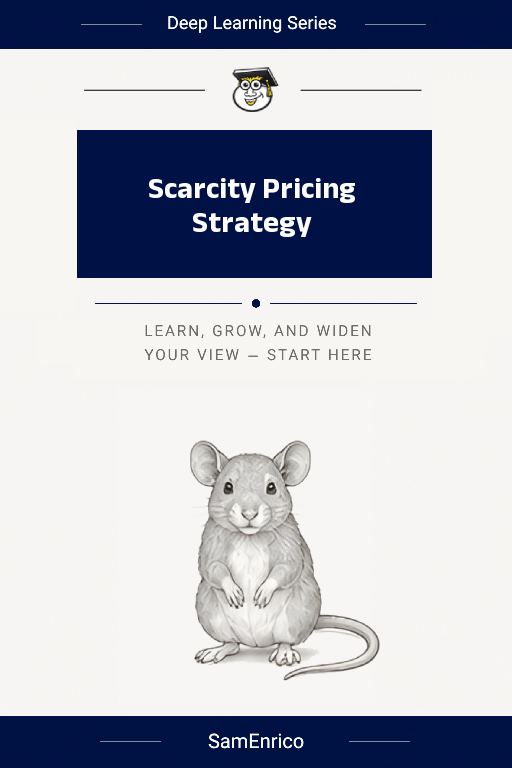
Non-FictionFirst 30 DaysScarcity
Scarcity Pricing Strategy eBook
Create urgency with limited time or limited quanti
by Bunn Missy
Create urgency with limited time or limited quantity offers to reduce price hesitation.
Formats
Free sample
Chapter 1: The Hesitation Autopsy--Every seven days, a business that does everything else right watches a customer walk away. Not because the price is wrong. Not because the product is bad. Not because the competitor is better. Because the customer said three words that felt polite but were actually lethal: “I’ll think about it.”Those three words are the most expensive sentence in commerce.They are not a decision.
They are a polite lie—a script customers have been trained to use because society has taught them that saying “no” directly feels rude. So instead of saying “I don’t want this” or “I can’t afford this,” they say “I’ll think about it.” And then they walk out the door, close the browser tab, or hang up the phone. Statistically, fewer than ten percent ever return.This chapter is called The Hesitation Autopsy because we are going to do something most business books avoid. We are going to open up the corpse of a lost sale and ask not “what happened” but why it happened at the level of the human brain. We are going to identify the specific psychological triggers that cause a willing buyer to become a reluctant walkaway.
And then we are going to build a diagnostic tool—the Price Hesitation Index—that turns the vague feeling of “something is wrong” into a targeted action plan.By the end of this chapter, you will never hear “I’ll think about it” the same way again. You will hear it as data. You will hear it as a diagnosis. And you will know exactly which scarcity lever to pull to turn that hesitation into a yes.The Million-Dollar Sentence Let me tell you about a founder I worked with a few years ago. Let’s call her Sarah.
Sarah ran a mid-sized software company selling project management tools to creative agencies. Her product was good—not great, but good. Her pricing was competitive. Her sales team was experienced. And yet, quarter after quarter, she watched deals slip through her fingers at the exact same moment in the sales process.The prospect would sit through a demo.
They would ask smart questions. They would nod along as Sarah explained the features. They would even say things like “this is exactly what we need.” And then, at the moment of truth, they would lean back in their chair and say those three words: “We’ll think about it.”Sarah’s team had a name for this phenomenon. They called it “the flinch.” Every deal had a flinch moment—the instant when a prospect who was leaning in suddenly leaned out. And once the flinch happened, the deal was effectively dead.
Oh, occasionally a prospect would come back a week later and sign. But those were the exceptions. The rule was silence.I asked Sarah to calculate something for me. I asked her to add up the total value of every deal that had ended with “we’ll think about it” over the previous twelve months. She came back with a number that made her go pale: one point seven million dollars in pipeline value, vanished into the polite lie.
That was her Hesitation Tax. That was the price she was paying every year for not understanding why customers hesitate.Sarah’s story is not unique. Every business pays a Hesitation Tax. The only difference is whether you measure it or ignore it.The Hesitation Tax is the gap between the customers who want your product and the customers who actually buy it. It is the revenue you leave on the table because something—some psychological friction—stops a willing buyer from becoming a paying customer.
And here is the painful truth that most business owners never confront: the Hesitation Tax is almost never about price. It is about uncertainty. It is about fear. It is about the logical brain waking up and asking questions that the emotional brain cannot answer.The War Inside Your Customer’s Head To understand why customers hesitate, you have to understand the fundamental architecture of the human brain. And for that, we need to talk about Daniel Kahneman.Kahneman is a psychologist who won the Nobel Prize in Economics for work he did with his collaborator Amos Tversky.
Their core insight—the insight that upended decades of economic theory—was that human beings are not rational calculators. We do not weigh costs and benefits with cold, mathematical precision. Instead, we rely on mental shortcuts. And those shortcuts are managed by two distinct systems operating inside our heads.Kahneman called them System One and System Two.System One is fast. It is intuitive.
It is emotional. It makes decisions in milliseconds, often without your conscious awareness. When you see a snake-shaped stick on a hiking trail and jump back before you realize it’s not a snake, that is System One. When you walk into a room and instantly like or dislike someone based on no rational evidence, that is System One. When you see a price tag that feels “too high” or “about right” without doing any math, that is System One.System One is your brain on autopilot.
It is efficient. It is powerful. And it is deeply influenced by emotional triggers—including scarcity.System Two is slow. It is logical. It is analytical.
It engages when you need to solve a math problem, compare two options, or evaluate whether a purchase is worth the money. System Two burns a lot of energy, which is why your brain avoids using it whenever possible. System Two is the part of your brain that asks questions like “Is this really worth it?” “Could I find a better deal elsewhere?” “Do I actually need this?”Here is the critical insight for anyone who sells anything: Price hesitation occurs when System Two wakes up.Your customer starts in System One. They see your product. They feel an emotional pull.
They want it. But then something happens. Maybe they glance at the price. Maybe they remember a competitor’s ad. Maybe they have a vague memory of a friend saying something negative about your category.
Whatever the trigger, System Two stirs awake. And once System Two is awake, it starts asking questions. And once the questions start, the hesitation begins.The job of scarcity—the entire purpose of every tactic in this book—is to keep the customer in System One.When you show a customer “Only three left,” System One processes that as a threat. I might lose this. Threat triggers the amygdala, which triggers a fight-or-flight response, which keeps System Two safely in the background.
When you show a customer “Sale ends at midnight,” System One processes that as a deadline. I have to decide now. Deadlines create urgency, which creates emotional pressure, which keeps System Two from getting a word in edgewise.Scarcity works not because it changes the logic of the purchase but because it short-circuits the logic entirely. It speaks directly to System One. And System One, as Kahneman demonstrated, is far more powerful than System Two ever gives it credit for.The Four Faces of Hesitation But here is where most scarcity advice…
This is the end of the free sample. Get the eBook to keep going. Buy now
About this book
Details
- Author
- Bunn Missy
- Publisher
- SamEnrico
- Language
- English
- Genre
- Non-Fiction, First 30 Days, Scarcity
- Released
- 2026-06-01
- Pages (approx.)
- 137
- Available as
- eBook, Audiobook

Read better in the ZLOADR app
Your eBooks on your phone or tablet. Sign in with your SamEnrico account and start reading.
More by Bunn Missy
 Event Planner Crisis StressBunn Missy$11.99
 Self Hypnosis for Fear of Loud NoisesBunn Missy$11.99
 Self Hypnosis Smartphone AppsBunn Missy$11.99
 Lena Hall Rock BroadwayBunn Missy$11.99
 Eritrean Independence StruggleBunn Missy$11.99
 Child Loss And Burial DecisionBunn Missy$11.99
 First Year Alcohol SobrietyBunn Missy$11.99
 Ectopic Pregnancy Future FertilityBunn Missy$11.99
 When the Sky Split Open: The Hopi Emergence MythBunn Missy$11.99
 The Ghost of Stalingrad: Zhukov’s Forgotten GambitBunn Missy$11.99
 How to Produce Fire-rated SealantBunn Missy$11.99
 Petit Basset Griffon Vendeen: Energetic ScenthoundBunn Missy$11.99
You may also like
 Hong Kong Handover 1997Dunn Johnnie$11.99
 Zumba For Postnatal Recovery CourseNeal Christian$11.99
 Zumba for BeginnersLadner Nikia$11.99
 YouTube Comment Mining GuideHumes Pandora$12.99
 Worry Box MeditationCarlin Rudy$11.99
 Workplace Stress MeditationNguyen Lynn$11.99
 Workplace Stress and Sleep RepairHawley Ivory$11.99
 Workplace Perfectionism CureDelaney Jeffry$11.99
 Workplace Injustice Anger GuideWallen Isabelle$11.99
 Work Addiction and Burnout LinkGreenwood Ester$11.99
 Women in Yoga and WellnessBeattie Galina$11.99
 Women in Stand Up ComedyChun Evangeline$11.99