
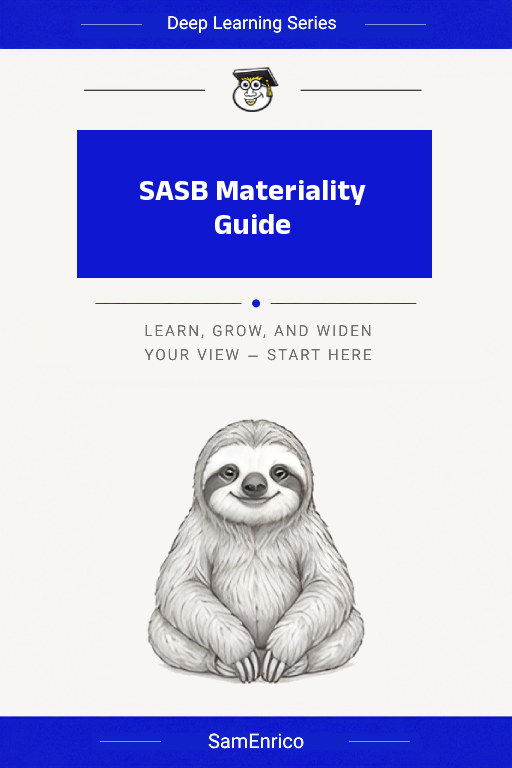
Non-FictionAnnual CheckupSASB StandardsMateriality
SASB Materiality Guide eBook
Report sustainability metrics that matter for your
Report sustainability metrics that matter for your specific industry.
Formats
Free sample
Chapter 1: The 500-Page Lie--For the past decade, corporate sustainability reporting has operated under a quiet, devastatingly expensive fiction. The fiction is this: that more information is better information, that longer reports signal greater transparency, and that publishing hundreds of pages of ESG data proves a company’s commitment to responsible business. This fiction has produced a mountain of paper—or, more accurately in the digital age, a mountain of PDFs—that has accomplished the opposite of its intended purpose. Instead of building trust between companies and their investors, the modern sustainability report has become a monument to wasted effort, a signal of confusion rather than clarity, and, in too many cases, a deliberate tool of obfuscation dressed in the language of virtue.Consider what a typical Fortune 500 sustainability report contains in the year 2025. It opens with a letter from the CEO, usually featuring the word “commitment” three to five times.
There follows a section on the company’s history of charitable giving, accompanied by photographs of employees painting schools or planting trees. Then comes a lengthy discussion of diversity, equity, and inclusion initiatives, often expressed as percentages and aspirational targets. There is a section on energy efficiency, another on water conservation, and another on waste reduction. There are testimonials from suppliers, case studies of community partnerships, and a detailed account of the company’s response to the most recent natural disaster. By page 150, the report begins to repeat itself.
By page 250, the reader has forgotten what the first 150 pages said. By page 400, only the legal team is still reading.And here is the brutal truth that this book will force you to confront: the people whose opinion actually matters—the institutional investors who allocate capital, the equity analysts who set price targets, the proxy advisors who vote on your board members—are spending an average of seven seconds scanning your sustainability report before deciding whether to read any of it. Seven seconds. That is not an estimate pulled from anecdote. In a 2024 study of 47 asset management firms representing $23 trillion in assets under management, researchers found that portfolio analysts used a simple two-step process for sustainability reports: first, they searched for the SASB alignment statement.
If it was absent, the report was discarded. Second, they looked for the three to five metrics most financially material to the company’s industry. If those metrics were missing or buried, the report was discarded. Everything else—the photographs, the CEO letters, the community case studies, the pages of qualitative aspirations—was noise.This book exists because that noise has become deafening, and because a solution has emerged that most corporate sustainability teams continue to ignore. The solution is not to stop reporting.
The solution is not to abandon environmental and social concerns. The solution is to report dramatically less while reporting dramatically better—to focus exclusively on the metrics that actually move stock prices, and to have the courage to omit everything else.The Birth of a Bad Habit To understand how we arrived at the current state of reporting, we need to go back to the early 2010s. At that time, the dominant sustainability reporting framework was the Global Reporting Initiative, or GRI. GRI was designed with a noble intention: to create a comprehensive set of indicators that any company could use to report its impact on the world. The framework covered everything from greenhouse gas emissions to child labor to biodiversity to customer privacy.
For companies that wanted to demonstrate broad stakeholder accountability, GRI was a useful tool. It remains a useful tool for that purpose today.But GRI had a problem that its designers did not anticipate. Because it was comprehensive—because it offered hundreds of potential indicators—companies began treating it as a checklist rather than a strategic framework. The logic was seductive: if we report more indicators, we will appear more transparent. If we report more indicators, no one can accuse us of hiding anything.
If we report more indicators, we will be seen as a leader. This logic drove a reporting arms race that continues to this day. In 2010, the average sustainability report was 50 pages. By 2015, it was 100 pages. By 2020, it was 150 pages.
By 2024, some S&P 500 companies were publishing reports exceeding 400 pages.What no one asked—what the entire industry collectively failed to ask—was whether any human being was actually reading those 400 pages. The answer, as we now know, is no. Investors were not reading them. Analysts were not reading them. Even the NGOs that had pushed for greater transparency were not reading them cover to cover.
The reports had become a form of performative transparency: appearing to disclose while actually obscuring. A 400-page report that buries the three metrics that matter inside 397 pages of fluff is not transparent. It is the opposite of transparent. It is a smokescreen.The Seven-Second Rule Let me be specific about the seven-second rule, because understanding it is the first step toward escaping the trap. I have interviewed equity analysts at three of the world’s largest asset managers, and their process for reviewing sustainability reports is remarkably consistent.
They do not read. They scan. They know exactly what they are looking for, and they have learned from bitter experience that most sustainability reports are designed to hide the bad news behind good news.Here is what an analyst looks for in the first seven seconds. First, they locate the index or table of contents. They are looking for one phrase: SASB.
If the report does not mention SASB, they close it. They do not read further. They do not give the company the benefit of the doubt. They assume that a company that does not align with SASB is either (a) unaware of investor expectations, which is disqualifying, or (b) aware but unwilling to disclose, which is also disqualifying. Second, assuming the SASB alignment statement exists, the analyst scans for the specific metrics that correspond to the company’s industry.
They already know, from memory or from a reference sheet, what the five to seven most material metrics are for a retailer, a bank, or an oil company. If those metrics are not presented in the first twenty pages—ideally in a single table—the analyst assumes the company is hiding unfavorable data. Third, the analyst compares the reported numbers to the previous year’s numbers and to industry peer averages. They are looking for deterioration. They are looking for gaps.
They are looking for any reason to ask a hard question on the next earnings call.That entire process—from opening the PDF to forming an initial judgment—takes seven seconds. Everything beyond those seven seconds is confirmation or refutation, not discovery. The analyst is not going to find a hidden gem on page 300 of your report. They are not going to discover that your water management practices are world-class if you buried that data in an appendix. If it matters, it must be visible in seven seconds.
That is the standard. You can resent it, or you can meet it. Resentment will not help your stock price.The Regulatory Tectonic Shift If the only pressure to improve sustainability reporting came from investors, many companies would continue to ignore…
This is the end of the free sample. Get the eBook to keep going. Buy now
About this book
Details
- Author
- Denham Eleonor
- Publisher
- SamEnrico
- Language
- English
- Genre
- Non-Fiction, Annual Checkup, SASB Standards, Materiality
- Released
- 2026-06-01
- Pages (approx.)
- 157
- Available as
- eBook, Audiobook

Read better in the ZLOADR app
Your eBooks on your phone or tablet. Sign in with your SamEnrico account and start reading.
More by Denham Eleonor
 The Gacy Civil LawsuitsDenham Eleonor$11.99
 Music Therapy For Trauma Poor CommunitiesDenham Eleonor$11.99
 LTC Insurance For Boomers GuideDenham Eleonor$11.99
 Alzheimer's Sleep LinkDenham Eleonor$11.99
 The Protestant Iconoclasm WaveDenham Eleonor$11.99
 Pattern Recognition for ExamsDenham Eleonor$11.99
 TM For Homeless PopulationsDenham Eleonor$11.99
 Self Talk For EstrangementDenham Eleonor$11.99
 Overcoming Voyeurism CompulsionDenham Eleonor$11.99
 James Watt and the Fire of Progress: Sparking the Industrial RevolutionDenham Eleonor$11.99
 The Last Broadcast: The Mystery of the SS BaychimoDenham Eleonor$11.99
 Love in the Time of War: The Secret Letters of Vera and DashiellDenham Eleonor$11.99
You may also like
 Hong Kong Handover 1997Dunn Johnnie$11.99
 Zumba For Postnatal Recovery CourseNeal Christian$11.99
 Zumba for BeginnersLadner Nikia$11.99
 YouTube Comment Mining GuideHumes Pandora$12.99
 Worry Box MeditationCarlin Rudy$11.99
 Workplace Stress MeditationNguyen Lynn$11.99
 Workplace Stress and Sleep RepairHawley Ivory$11.99
 Workplace Perfectionism CureDelaney Jeffry$11.99
 Workplace Injustice Anger GuideWallen Isabelle$11.99
 Work Addiction and Burnout LinkGreenwood Ester$11.99
 Women in Yoga and WellnessBeattie Galina$11.99
 Women in Stand Up ComedyChun Evangeline$11.99