
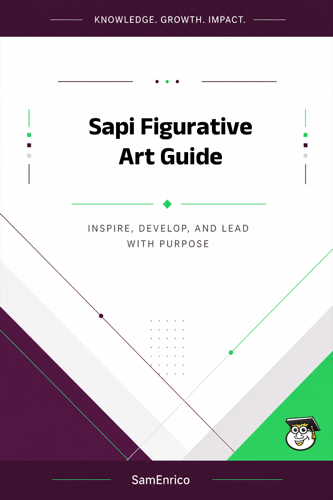
Sapi Figurative Art Guide
Explores Sapi stone figures and oral histories of
by Easley Ka
Explores Sapi stone figures and oral histories of Sierra Leonean secret societies.
Formats
About this book
Free sample
Chapter 1: The Stone Wakes...–- The morning began like any other. Mamadu Kargbo, a rice farmer from a small village near the Moa River in southern Sierra Leone, walked to his upland field before the heat became unbearable. His hoe, a worn iron blade fixed to a wooden handle, swung in a rhythm he had learned from his father and his father's father. The soil here was thin, rocky, reluctant—but it was all he had. On the third swing, the hoe struck something that was not stone and not root.
The sound was wrong: a dull thud with a hollow echo, as if the earth itself had a chamber beneath it. Mamadu stopped. He knelt. He brushed away the red laterite soil with his hands. And there, staring up at him with bulbous eyes that had not seen sunlight in perhaps five hundred years, was a face.Not a skull.
Not a mask. A face carved from soapstone, gray-green with age, its features abstracted into a geometry of power: a large head, a corded beard looped over both hands, a mouth sealed into a thin line that neither smiled nor frowned. The figure was seated, compact, its back pressed against the soil as if it had been buried deliberately, carefully, waiting. Mamadu did not know what to call it. Later, his grandfather would tell him: nomoli.
Stone person. And then his grandfather would tell him what to do next, which was nothing simple. The nomoli was not a treasure. It was a responsibility.This is how most Sapi stone figures enter the modern world—not through archaeological excavation, museum acquisition, or scholarly publication, but through the accidental encounter of a farmer who needs to eat. The figures are not found in royal tombs or ritual complexes.
They are found in rice fields, cassava plots, fallow scrub, and forest clearings. They are found by people who have never heard the word "Sapi" and who do not care about art history. They are found, and then they are feared, and then they are fed, and then they are negotiated with for…
This is the end of the free sample. Get the eBook to keep going. Buy now
Contents
- Chapter 1
- Chapter 2
- Chapter 3
- Chapter 4
- Chapter 5
- Chapter 6
- Chapter 7
- Chapter 8
- Chapter 9
- Chapter 10
- Chapter 11
- Chapter 12
Details
- Author
- Easley Ka
- Publisher
- SamEnrico
- Language
- English
- Genre
- Non-Fiction, History, West African Art
- Released
- 2026-06-06
- Pages (approx.)
- 133
- Available as
- eBook, Audiobook

Read better in the ZLOADR app
Your eBooks on your phone or tablet. Sign in with your SamEnrico account and start reading.
More by Easley Ka
 Manufacturing Cyber ThreatsEasley Ka$11.99
 Bipolar And Creativity LinkEasley Ka$11.99
 The Teen Nutrition and Mood GuideEasley Ka$11.99The Teen Nutrition and Mood GuideEasley Ka$11.99
 The Career Change Confidence GuideEasley Ka$11.99
 The Great Stock Exchange Swindle: The Fall of the London Stock Exchange (1873)Easley Ka$11.99The Great Stock Exchange Swindle: The Fall of the London Stock Exchange (1873)Easley Ka$11.99
 Streaming Music GuideEasley Ka$12.99
 GA4 and Google Ads IntegrationEasley Ka$12.99
 Coin GraderEasley Ka$11.99
 Understanding Powell–buist–stenzel SyndromeEasley Ka$17.99
 How to Become a Optical-glass SilvererEasley Ka$11.99