
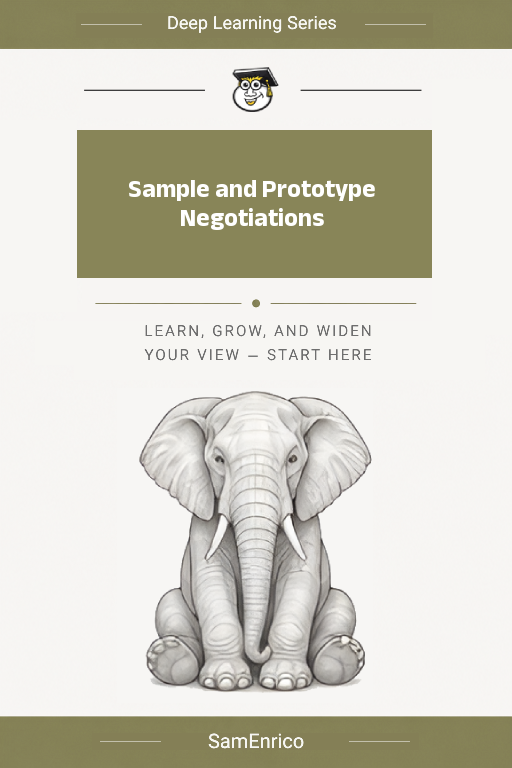
Non-FictionBusiness BriefSampling
Sample and Prototype Negotiations eBook
Secure free or cost-shared samples before placing
Secure free or cost-shared samples before placing production orders from Chinese factories.
Formats
Free sample
Chapter 1: The $15,000 Mistake--–- In 2016, I lost 15,000before Ieverheldasingleproductinmyhands.Thefactoryhadsentmebeautifulphotographsof“productionsamples.”Their Englishwasperfect.Their Alibabapagesparkledwithgoldsupplierbadgesandglowingreviews.Theyquotedme15,000 before I ever held a single product in my hands. The factory had sent me beautiful photographs of “production samples.” Their English was perfect. Their Alibaba page sparkled with gold supplier badges and glowing reviews. They quoted me 15,000before Ieverheldasingleproductinmyhands.Thefactoryhadsentmebeautifulphotographsof“productionsamples.”Their Englishwasperfect.Their Alibabapagesparkledwithgoldsupplierbadgesandglowingreviews.Theyquotedme2.50 per unit for Bluetooth speakers that looked identical to a top-selling brand on Amazon. I wired a 30% deposit—$4,500—and waited.
Six weeks later, a container arrived at my warehouse. I opened the first box with the excitement of a new entrepreneur about to launch his flagship product. What I found made my stomach turn. Glue dripped from the seams. The “metal” grille was painted plastic.
Three of the first ten speakers didn’t turn on. The rest had batteries that lasted twenty minutes instead of the promised eight hours. I emailed the factory. No reply. I called.
The number was disconnected. I checked their Alibaba store. It had vanished.That was the day I learned the most expensive lesson of my career: a quote is just a promise, and a promise without a physical sample is worth exactly nothing.This book exists because I don’t want you to make the same mistake. Over the next twelve chapters, I will teach you a system—a proven, repeatable system—for securing free or cost-shared samples from Chinese factories before you risk a single dollar on production. You will learn how to make factories compete for your business, how to spot the “student sample” trap that catches 80% of new importers, and how to negotiate refundable sample fees that come off your first order.
By the time you finish this chapter alone, you will understand why the sample is not a physical product. It is a strategic negotiation tool. And the factories that refuse to play the sample game are the ones you should never trust with your deposit.The Cost of Assumption Let me tell you about Sarah. She runs a small beauty brand out of her garage in Arizona. She found a factory on Alibaba offering custom lipstick tubes with her logo embossed on the cap.
The minimum order quantity was 10,000 units at 0.85each.Thefactorysenthera CADdrawingandavideooftheembossingmachineinaction.Sarahwasthrilled.Shewired0.85 each. The factory sent her a CAD drawing and a video of the embossing machine in action. Sarah was thrilled. She wired 0.85each.Thefactorysenthera CADdrawingandavideooftheembossingmachineinaction.Sarahwasthrilled.Shewired2,550 as a 30% deposit. The factory promised delivery in 45 days.
Sixty days later, she received a box. Inside were 10,000 lipstick tubes with no embossing—just a blank cap. The factory claimed “machine broke” and offered to refund 10% of her deposit. Sarah had no leverage because she had never asked for a physical sample. She had no signed agreement stating that embossing was a material term.
She had no golden sample to hold the factory accountable. She lost $2,295 and six months of market opportunity.Sarah’s story is not unique. I have collected over two hundred similar case studies in the last four years. The numbers tell a devastating story: buyers who skip samples lose an average of 34% of their deposit. Buyers who request samples but don’t negotiate the terms lose 12%.
Buyers who use the system in this book lose less than 2%. The difference between success and failure is not luck. It is process. It is the willingness to treat the sample phase as the most important negotiation of the entire supplier relationship.Here is what most importers get wrong. They view the sample as a “proof of concept”—a nice-to-have step before the “real” order.
They rush through it. They accept the first quote. They pay the sample fee without question. They assume that if the factory can send a photo, they can deliver a product. This is the Cost of Assumption, and it is the single biggest wealth transfer from Western buyers to Chinese factories that will never ship a quality order.How Chinese Sales Managers See You To understand why samples are the key to everything, you need to understand how Chinese sales managers are trained.
I have interviewed seventeen sales directors from factories across Guangdong, Zhejiang, and Jiangsu provinces. Their playbooks are remarkably consistent. Every sales manager categorizes incoming leads into three buckets.The first bucket is “Tire-Kickers.” These buyers ask only about price and delivery. Their emails are short: “How much for 500 units?” “Can you do faster shipping?” They never ask about materials, tolerances, certifications, or quality control. They never request samples.
To a Chinese sales manager, these buyers are amateurs who will either never place an order or will place one order, complain about quality, and never return. These buyers trigger what I call the “Foreigner Tax”—an automatic 30-50% markup because the factory assumes they will be high-maintenance and low-profit.The second bucket is “Serious Buyers.” These buyers ask specific, technical questions. They request material data sheets. They ask about production line capacity. They request samples.
Their emails reference industry standards and include detailed specifications. These buyers signal that they have done their homework and that they intend to build a long-term relationship. Sales managers prioritize these buyers. They offer better pricing. They waive sample fees.
They assign their best engineers to the project.The third bucket is “Strategic Partners.” These are serious buyers who also demonstrate deep knowledge of Chinese manufacturing culture. They reference 1688 prices. They use the “should-cost” model. They visit the factory (or promise to). They negotiate sample terms with respect and preparation.
These buyers get Tier 1 treatment: truly free samples, expedited timelines, and dedicated account managers.Here is the painful truth that most Western buyers never realize: by not requesting a sample, you are not saving time or money. You are voluntarily placing yourself in the Tire-Kicker bucket. You are triggering the Foreigner Tax. You are telling the factory, “I am an amateur who does not know how this game works.”One sales manager told me, “When a buyer doesn’t ask for a sample, I know they will be a problem. They don’t understand quality.
They will complain later. So I quote them high now to cover the future headache. If they accept, good. If they go away, also good.” That is the cold reality of cross-border manufacturing. The factories are not trying to scam you.
They are trying to filter you. And the filter is the sample request.The Two Types of Risk To build a winning sample strategy, you first need to understand the two types of risk in every supplier relationship.Financial risk is your money. It is the deposit you wire. It is the tooling fee you pay. It is the air freight cost when production is late.
Most buyers focus obsessively on financial risk. They negotiate lower deposits. They ask for payment after inspection. They try to keep their money in their pocket as long as possible. This is smart, but it is incomplete.Performance risk is the factory’s ability to deliver quality.
It is their material sourcing, their assembly line precision, their quality control processes, their communication reliability. Most buyers ignore performance risk until it is too late. They assume that if a factory…
This is the end of the free sample. Get the eBook to keep going. Buy now
About this book
Details
- Author
- Reynoso Dorathy
- Publisher
- SamEnrico
- Language
- English
- Genre
- Non-Fiction, Business Brief, Sampling
- Released
- 2026-05-29
- Pages (approx.)
- 144
- Available as
- eBook, Audiobook

Read better in the ZLOADR app
Your eBooks on your phone or tablet. Sign in with your SamEnrico account and start reading.
More by Reynoso Dorathy
 Pomodoro For Gaming BreaksReynoso Dorathy$11.99
 ABC Prioritization for CreativesReynoso Dorathy$11.99
 DBT School Program GuideReynoso Dorathy$11.99
 Pelvic Floor for Nursing MothersReynoso Dorathy$11.99
 Delegation Trust Building GuideReynoso Dorathy$11.99
 Healing Praise Starved ChildhoodReynoso Dorathy$11.99
 Breath Meditation Before SleepReynoso Dorathy$11.99
 Antwerp Heist SociologyReynoso Dorathy$11.99
 The Trial of the Century: The First War Crimes Tribunal in Victorian BritainReynoso Dorathy$11.99
 The Banshee's Last Waltz: Slavic Spirits and the Music of the DeadReynoso Dorathy$11.99
 How to Become a StonemasonReynoso Dorathy$11.99
 How to Produce Studio Lighting ControlsReynoso Dorathy$11.99
You may also like
 Hong Kong Handover 1997Dunn Johnnie$11.99
 Zumba For Postnatal Recovery CourseNeal Christian$11.99
 Zumba for BeginnersLadner Nikia$11.99
 YouTube Comment Mining GuideHumes Pandora$12.99
 Worry Box MeditationCarlin Rudy$11.99
 Workplace Stress MeditationNguyen Lynn$11.99
 Workplace Stress and Sleep RepairHawley Ivory$11.99
 Workplace Perfectionism CureDelaney Jeffry$11.99
 Workplace Injustice Anger GuideWallen Isabelle$11.99
 Work Addiction and Burnout LinkGreenwood Ester$11.99
 Women in Yoga and WellnessBeattie Galina$11.99
 Women in Stand Up ComedyChun Evangeline$11.99