
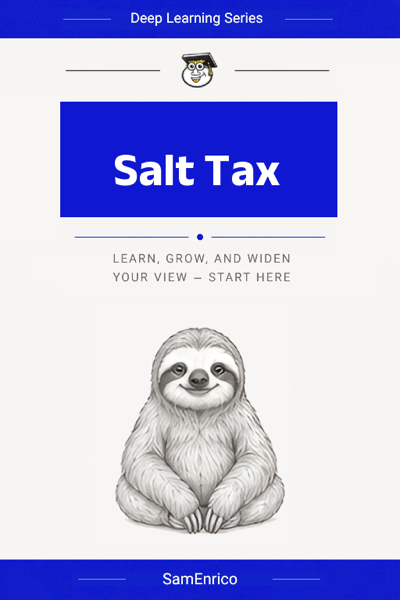
Non-FictionInformativeEducational
Salt Tax
A Coursebook on Salt Tax
A Coursebook on Salt Tax
Formats
About this book
Free sample
Chapter 1: The White Gold Trap--The most dangerous substance on your kitchen table isn't sugar. It isn't salt either. It's the piece of paper you've never seen—the tax receipt hidden in every grain.Salt is the only commodity in human history that has funded empires, sparked revolutions, and will soon determine the future of public health policy on every continent. And you have probably never thought about it for more than three seconds.This book is about that invisible piece of paper. It is about the strange, violent, and utterly unique story of taxing the one thing you cannot live without.
By the time you finish this chapter, you will understand why salt is not like sugar, not like carbon, and certainly not like tobacco—and why that difference matters more today than it has in a century.The Unremarkable Crystal That Changed Everything Walk into any grocery store. Find the salt aisle. It sits there, cheap, white, unremarkable, wedged between flour and baking soda. A box costs less than a cup of coffee. It has no brand loyalty, no advertising budget, no celebrity endorsement.
It is the most boring product on the shelf.That boring box is a lie.Behind that unassuming cardboard container lies a history more violent than oil, more politically explosive than gold, and more economically fascinating than any cryptocurrency. For most of recorded history, salt was not a condiment. It was a weapon. And the trigger was not the salt itself—it was the tax on it.Consider this: The word "salary" comes from the Latin salarium, the salt money paid to Roman soldiers. Before there was a word for your paycheck, there was a word for salt.
That is not a coincidence. That is a fossil of a forgotten world where salt was currency, where governments measured their power in tons of sodium chloride, and where the difference between eating and starving was often a tax collector's whim.Why Economists Fear Salt More Than You Do To understand why salt taxation matters, you need to understand one concept: elasticity of demand.This is economics jargon, but…
This is the end of the free sample. Get the eBook to keep going. Buy now
Contents
- Chapter 1
- Chapter 2
- Chapter 3
- Chapter 4
- Chapter 5
- Chapter 6
- Chapter 7
- Chapter 8
- Chapter 9
- Chapter 10
- Chapter 11
- Chapter 12
Details
- Author
- Medeiros Quinn
- Publisher
- SamEnrico
- Language
- English
- Genre
- Non-Fiction, Informative, Educational
- Released
- 2026-05-06
- Pages (approx.)
- 149
- Available as
- eBook, Audiobook

Read better in the ZLOADR app
Your eBooks on your phone or tablet. Sign in with your SamEnrico account and start reading.
More by Medeiros Quinn
 Pattern Recognition for TherapistsMedeiros Quinn$11.99
 Solomon Islands TimberMedeiros Quinn$11.99
 Seronegative Arthritis GuideMedeiros Quinn$11.99
 The US Phone Number for BanksMedeiros Quinn$11.99
 Burnout Prevention Energy AuditMedeiros Quinn$11.99
 Love in the Crossfire: The Cuban Campaign of the Spanish-American WarMedeiros Quinn$11.99
 Understanding Sezary SyndromeMedeiros Quinn$17.99
 Private Scholarships for JapanMedeiros Quinn$12.99
 EU Customs Clearance GuideMedeiros Quinn$12.99
 How to Become a Dye-house SupervisorMedeiros Quinn$11.99
You may also like
 Hong Kong Handover 1997Dunn Johnnie$11.99
 Zumba For Postnatal Recovery CourseNeal Christian$11.99
 Zumba for BeginnersLadner Nikia$11.99
 YouTube Comment Mining GuideHumes Pandora$12.99
 Worry Box MeditationCarlin Rudy$11.99
 Workplace Stress MeditationNguyen Lynn$11.99
 Workplace Stress and Sleep RepairHawley Ivory$11.99
 Workplace Perfectionism CureDelaney Jeffry$11.99
 Workplace Injustice Anger GuideWallen Isabelle$11.99
 Work Addiction and Burnout LinkGreenwood Ester$11.99
 Women in Yoga and WellnessBeattie Galina$11.99
 Women in Stand Up ComedyChun Evangeline$11.99