
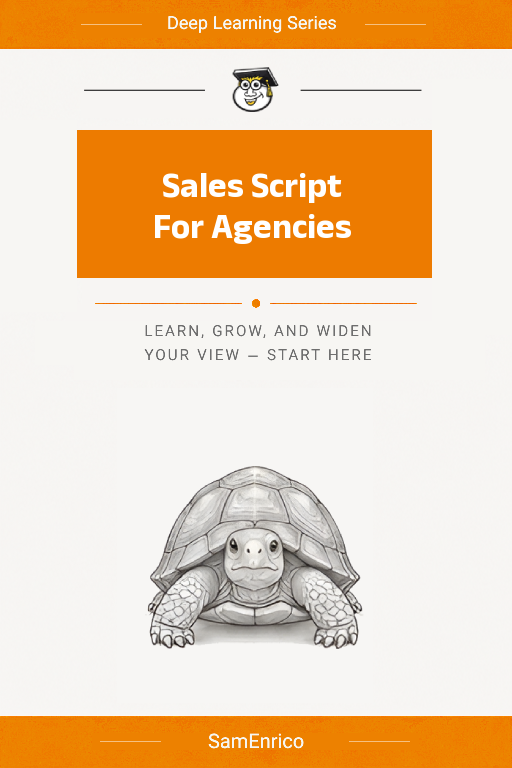
Sales Script For Agencies eBook
Pitch marketing or creative agency services using
by Mayes Marina
Pitch marketing or creative agency services using case studies.
Formats
Free sample
Chapter 1: The Crocodile Brain--–- The Zoom link connected with a soft chime. On one side of the screen sat Marcus, founder of a fifteen-person creative agency that had just completed its most visually stunning campaign to date—a rebrand for a regional bank that had won two industry awards. On the other side sat the Chief Marketing Officer of a national credit union, a potential $240,000 annual contract. Marcus had prepared for seventy-two hours. He had a thirty-slide deck.
He had the award-winning work front and center. He had testimonials, case studies, and a breakdown of his team's impeccable credentials.The CMO listened politely for forty-five minutes. Then she asked three questions."How much does this cost?""Can you share three more references?""And can you send me your full portfolio so I can compare you to two other agencies I'm speaking with?"Marcus answered each question. He gave the price. He promised references.
He sent the portfolio. And then he never heard from the CMO again. Three weeks later, he saw the credit union's new campaign launch—work done by a competitor he had never even heard of, for a higher price than he had quoted.Marcus made a catastrophic mistake. He assumed the client was rational.He was wrong. And so are you.The Myth That Is Killing Your Agency There is a lie that circulates through agency conferences, business books, and Linked In influencer posts.
It is repeated so often that most agency founders have accepted it as gospel. The lie is this: Great work sells itself.This statement is seductive because it shifts responsibility away from sales and onto craft. If you lose a deal, the lie suggests, it must be because your work wasn't good enough. So you pour more hours into design. You obsess over pixels.
You chase awards. You build a portfolio that looks like a museum of modern art.And you keep losing to competitors who are objectively less talented.The truth is the opposite of the lie. Great work does not sell itself. Great work is almost invisible to the person who matters most: the buyer. Not because they lack taste, but because their brain is not designed to appreciate craft when survival is on the line.The agency market is flooded with talented designers, developers, and strategists.
Portfolio quality has become a low-barrier entry point. Everyone has a beautiful website. Everyone has impressive logos on their client list. Everyone has case studies with percentage symbols next to them. Competing on the quality of past work is a race to the bottom that erodes pricing power and positions you as a vendor rather than a partner.To understand why, you must stop thinking like an agency founder and start thinking like a neuroscientist.The Three-Pound Problem Inside your client's skull sits a three-pound organ that has not changed significantly in two hundred thousand years.
Despite spreadsheets, quarterly business reviews, and procurement departments, the human brain is still running software designed for the African savanna. It is optimized for detecting threats, securing status, and conserving energy. It is not optimized for evaluating creative portfolios.The most important thing you will learn in this book is the distinction between two parts of that brain. The first part is the neocortex. This is the thin layer of gray matter responsible for rational thought, language, and complex analysis.
It is the part that reads white papers, compares pricing spreadsheets, and evaluates case study methodology. It is slow, energy-intensive, and easily exhausted.The second part is the limbic system. Buried deep beneath the neocortex, it is often called the "reptilian" or "Crocodile" brain—not because we descended from reptiles, but because this structure is ancient, automatic, and brutally efficient. The Crocodile Brain does not think. It reacts.
It scans for threats (danger), opportunities (food and mating), and social standing (status within the tribe). It operates in milliseconds. It consumes almost no energy. And it runs the show.The neuroscientist Paul Mac Lean popularized this triune brain model decades ago. More recent research has refined it, but the core insight remains unshaken: emotional, automatic processes dominate decision-making.
Rational analysis is mostly post-hoc justification for choices the Crocodile Brain has already made.When a client says, "Send me your portfolio," their Crocodile Brain is not asking to see your design aesthetic. It is asking four questions, none of which will appear in any RFP document:Will hiring you get me fired?Will hiring you get me promoted?Will I look smart or stupid in front of my boss and peers?Is this decision safe, or will it put my status or survival at risk?Until you answer those four questions, no amount of beautiful work will matter. Your portfolio could win a Cannes Lion, and the Crocodile Brain will still say, "But what if it fails? What if I am blamed? What if the cheaper agency is safer?"The Case of the Two MRI Machines This is not speculation.
It is documented neuroscience. Consider a famous study published in the journal Neuron that used functional magnetic resonance imaging (f MRI) to watch buyers' brains as they evaluated products. When participants saw products they recognized (Coke, Pepsi, Apple), their Crocodile Brains lit up with activity. When they saw unfamiliar products, their neocortex activated—but only weakly, and only briefly. Then their Crocodile Brain shut down the evaluation.The researchers concluded that brand recognition is not about memory.
It is about safety. The familiar product triggers a primal response: "I have seen this before. It did not kill me. It is safe to choose."Your agency is not a can of soda. But the same neurological mechanism applies.
When a client faces a decision that could cost them their job, their reputation, or their bonus, they do not want the most creative solution. They want the solution that feels safe. And nothing feels safe to the Crocodile Brain than a decision that has been made successfully before by someone similar to them.That is why the competitor Marcus had never heard of won the credit union contract. Not because they were better designers. Because they had a case study featuring a credit union of similar size, in a similar region, with a similar problem.
Marcus had a bank. The Crocodile Brain saw "bank" and thought, "Different. Risky." The competitor had a credit union. The Crocodile Brain saw "credit union" and thought, "Same. Safe."Marcus lost before he opened his mouth.
His portfolio never had a chance.The Status Calculus Fear is not the only driver. The Crocodile Brain is equally obsessed with status. In primal terms, higher status meant better access to food, mates, and protection. Lower status meant starvation and death. Today, status means bonuses, promotions, board seats, and the ability to say "I told you so" in a quarterly review.When your client hires you, they are making a status bet.
If you succeed, they gain status. If you fail, they lose status. The magnitude of the potential status gain must outweigh the magnitude of the potential status loss. Most agency pitches fail because they focus on the agency's status (awards, credentials, years in business) rather than the…
This is the end of the free sample. Get the eBook to keep going. Buy now
About this book
Details
- Author
- Mayes Marina
- Publisher
- SamEnrico
- Language
- English
- Genre
- Non-Fiction, First 30 Days
- Released
- 2026-06-01
- Pages (approx.)
- 119
- Available as
- eBook, Audiobook

Read better in the ZLOADR app
Your eBooks on your phone or tablet. Sign in with your SamEnrico account and start reading.
More by Mayes Marina
 History Dates Chronology GuideMayes Marina$11.99
 Career Transition for ArtistsMayes Marina$11.99
 Proximity Fuse: Radar Miniaturization MiracleMayes Marina$11.99
 Caregiver Self Care BasicsMayes Marina$11.99
 Step Four Personal Inventory CourseMayes Marina$11.99
 Lost Boy Of Dadaab ResettledMayes Marina$11.99
 Disappointment In RetirementMayes Marina$11.99
 Software Engineer Burnout GuideMayes Marina$11.99
 First Female Combat PilotMayes Marina$11.99
 The Last Waltz: The Secret Life of Vienna’s Forgotten BallroomsMayes Marina$11.99
 The Labors of Atalanta: The Hunt for the Calydonian BoarMayes Marina$11.99
 Steel and Shadows: The Deadly Design of the Silver BridgeMayes Marina$11.99
You may also like
 Website Launch For New LLCStrunk Tracee$12.99
 Shopify Market Expansion GuideGaffney Jude$12.99
 Power Backup Solutions for Philippine VAsPearce Eldon$12.99
 Feedback License Clause TemplateCrum Ashli$12.99Feedback License Clause TemplateCrum Ashli$12.99Feedback License Clause TemplateCrum Ashli$12.99Feedback License Clause TemplateCrum Ashli$12.99Feedback License Clause TemplateCrum Ashli$12.99Feedback License Clause TemplateCrum Ashli$12.99Feedback License Clause TemplateCrum Ashli$12.99Feedback License Clause TemplateCrum Ashli$12.99
 Channel Distribution On One PagePetersen Narcisa$12.99