
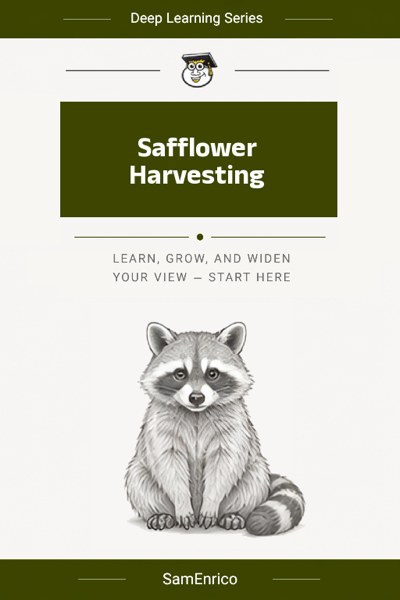
Non-FictionInformativeEducational
Safflower Harvesting
A Coursebook on Safflower Harvesting
A Coursebook on Safflower Harvesting
Formats
About this book
Free sample
Chapter 1: The Three Killers--– In the high plains of Montana, a fourth-generation farmer named Harlan Bennett once watched forty acres of safflower turn from gold to dust in a single afternoon. The wind came up at eleven o’clock, steady at fifteen miles per hour, and by three in the afternoon, the ground beneath his standing crop glittered like a field of spilled coin. He had delayed harvest by five days, waiting for a neighbor’s combine to become available. Those five days cost him 30 percent of his yield—nearly $18,000 in lost revenue from that single field. Harlan did not make the same mistake twice.
But every year, somewhere in the safflower-growing regions of the world, a grower learns this lesson for the first time.Safflower is not wheat. It is not barley, canola, or even sunflower, despite its superficial resemblance to the last. The plant that agronomists call Carthamus tinctorius has been cultivated for four thousand years, originally for the red and yellow dyes extracted from its flowers, and later for its oil-rich seeds. Yet today, safflower remains a specialty crop—grown on approximately one million acres globally, a fraction of the land devoted to soybeans or corn. Its very specialty status creates a knowledge gap.
Most harvesting guides assume that a combine is a combine, that a grain is a grain, that the principles of wheat harvest apply broadly to all small-seeded crops. This assumption fails spectacularly with safflower.This book exists because safflower demands its own harvesting science. It is a crop that punishes delay, resists conventional machinery, and actively fights back with spines that lacerate skin, clog radiators, and ignite fires. But it is also a crop that rewards precision. Growers who master safflower harvest can achieve yields of 1,500 to 2,000 pounds per acre, command premium prices for high-oleic oil, and integrate safflower into regenerative rotations that improve soil health.
The difference between profit and loss, between a smooth harvest and a disastrous one, lies in understanding what this book calls the Three Killers: shattering, moisture mismanagement, and spine hazards.The Unique Biology of Safflower To understand why…
This is the end of the free sample. Get the eBook to keep going. Buy now
Contents
- Chapter 1
- Chapter 2
- Chapter 3
- Chapter 4
- Chapter 5
- Chapter 6
- Chapter 7
- Chapter 8
- Chapter 9
- Chapter 10
- Chapter 11
- Chapter 12
Details
- Author
- Calderon Jerri
- Publisher
- SamEnrico
- Language
- English
- Genre
- Non-Fiction, Informative, Educational
- Released
- 2026-05-04
- Pages (approx.)
- 130
- Available as
- eBook, Audiobook

Read better in the ZLOADR app
Your eBooks on your phone or tablet. Sign in with your SamEnrico account and start reading.
More by Calderon Jerri
 Meal Planning Priority GuideCalderon Jerri$11.99
 Networking Event ScriptsCalderon Jerri$11.99
 Hair Loss Due to MedicationCalderon Jerri$11.99
 Upwork Freelancer Niche SelectionCalderon Jerri$11.99
 Madden Microtransaction GuideCalderon Jerri$11.99
 The Navigators of the Indian Ocean: Africa's Unsung Maritime MastersCalderon Jerri$11.99
 Understanding Mental RetardationCalderon Jerri$17.99
 UN Language Requirements and ExamsCalderon Jerri$12.99
 Project Management Api GuideCalderon Jerri$12.99
 How to Become a SplicerCalderon Jerri$11.99
You may also like
 Hong Kong Handover 1997Dunn Johnnie$11.99
 Zumba For Postnatal Recovery CourseNeal Christian$11.99
 Zumba for BeginnersLadner Nikia$11.99
 YouTube Comment Mining GuideHumes Pandora$12.99
 Worry Box MeditationCarlin Rudy$11.99
 Workplace Stress MeditationNguyen Lynn$11.99
 Workplace Stress and Sleep RepairHawley Ivory$11.99
 Workplace Perfectionism CureDelaney Jeffry$11.99
 Workplace Injustice Anger GuideWallen Isabelle$11.99
 Work Addiction and Burnout LinkGreenwood Ester$11.99
 Women in Yoga and WellnessBeattie Galina$11.99
 Women in Stand Up ComedyChun Evangeline$11.99