
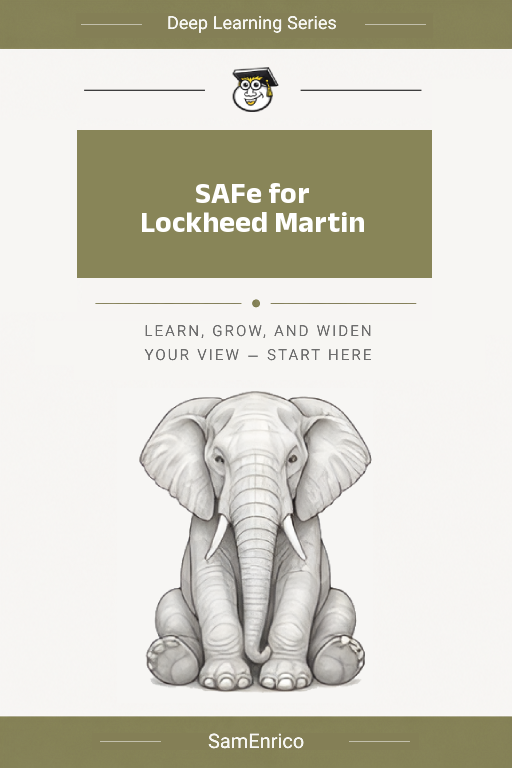
SAFe for Lockheed Martin Audiobook
Scale agile for aerospace and defense tech startup
Scale agile for aerospace and defense tech startups using Lockheed Martin's model-based SAFe approach.
Formats
Free sample
Chapter 1: The Debt You Didn't Know You Had--–- In 2015, the F-16 production line at Lockheed Martin's Greenville, South Carolina facility was dying. Not because of bad engineers. Not because of insufficient funding. Not because of foreign competition. The line was dying because the company had accumulated so much information debt that it could no longer afford the interest payments.The diagnosis came from an unlikely source.
Not a consultant. Not a general. Not a software vendor. The diagnosis came from a junior systems engineer who asked a simple question that no one had dared to ask: "Why do we keep building the same thing twice?"That question would eventually trigger a transformation that cut release cycles from twenty-four months to twelve weeks, reduced assembly rework to zero on the CHARLIE prototype, and saved the F-16 line from extinction. But before we get to the hero story, we need to understand the villain.
The villain is not China. The villain is not Russia. The villain is not even the Pentagon's infamous acquisition system. The villain is a concept so subtle, so pervasive, and so invisible that most defense tech startups don't even know they are drowning in it until they are already bankrupt.The villain is information debt.The Silent Killer of Defense Startups Information debt is the hidden cost of ambiguous requirements, undocumented assumptions, and deferred technical decisions. Like financial debt, information debt accrues interest over time.
Every week that an unclear requirement remains unresolved, the cost of fixing it grows. Every month that a design assumption goes untested, the risk of catastrophic integration failure compounds. Every quarter that a technical decision is deferred, the number of dependent subsystems that will break when you finally decide multiplies.In the world of defense technology, information debt has a specific anatomy. It manifests in three distinct forms.First, there is requirements debt. This occurs when a contract says "the system shall detect and track hypersonic threats" without specifying the probability of detection, the false alarm rate, the maximum track latency, or the minimum target cross-section.
The requirement is technically present. It is even traceable. But it is ambiguous. And ambiguity is debt.Second, there is model debt. This occurs when your CAD models, your simulation inputs, your test procedures, and your deployment artifacts are not perfectly synchronized.
The thermal simulation says the electronics will stay within spec. The physical test says they won't. Which one is wrong?…
This is the end of the free sample. Get the Audiobook to keep going. Buy now
About this book
Details
- Author
- Vanburen Hilde
- Publisher
- SamEnrico
- Language
- English
- Genre
- Non-Fiction, Startup Guide, SAFe Model
- Released
- 2026-06-01
- Pages (approx.)
- 143
- Available as
- eBook, Audiobook

Listen in the VoxFlicks app
Audiobooks and audio dramas wherever you go. Sign in with your SamEnrico account and press play.
More by Vanburen Hilde
 Chunking for Habit FormationVanburen Hilde$11.99
 The Anger Impulse Delay GuideVanburen Hilde$11.99
 Debt Stress Relief ManualVanburen Hilde$11.99
 Being Chased Dream WorkbookVanburen Hilde$11.99
 Student Failure Resilience GuideVanburen Hilde$11.99
 The Last Voyage of the Mary Celeste: Ghost Ship or Greatest Hoax?Vanburen Hilde$11.99
 The Vanishing of the SS Marie Celeste: A Mind UnraveledVanburen Hilde$11.99
 How to Start a Dairy Farming Business (Beginners Guide)Vanburen Hilde$11.99
 Gel ElectrophoresisVanburen Hilde$11.99
 Redbubble Design Upload GuideVanburen Hilde$12.99
 Understanding Enolase Deficiency Type 1Vanburen Hilde$17.99