
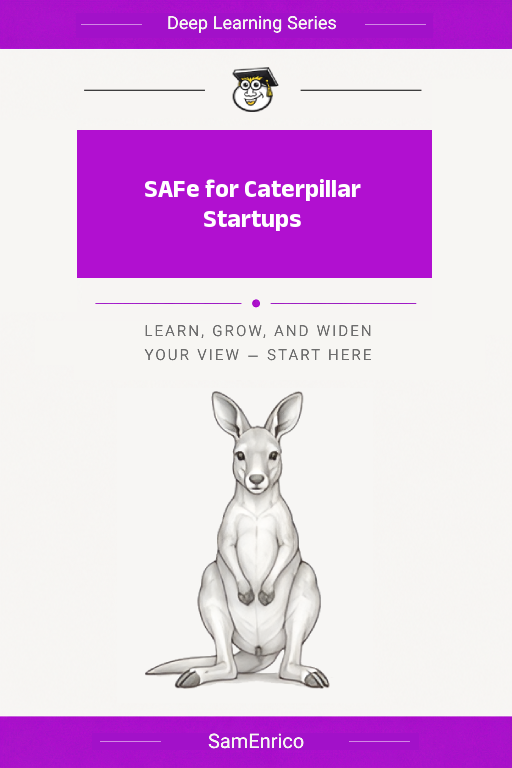
SAFe for Caterpillar Startups
Scale agile for heavy equipment and construction t
Scale agile for heavy equipment and construction tech startups using Caterpillar's SAFe for embedded software.
Formats
About this book
Free sample
Chapter 1: The Iron Clock--The first time a software engineer watches a hydraulic valve revision add eighteen weeks to their roadmap, something breaks inside them. Not the kind of break that shows up in a bug tracker or a post-mortem document. The kind of break that makes them question whether agile was ever meant for machines that weigh more than a house.I have watched this happen at four construction tech startups. In each case, the software team was doing everything right. Two-week sprints.
Automated unit tests. Continuous integration. Daily standups. Retrospectives that actually produced actionable improvements. By the textbook definition of modern software development, they were high-performing teams.
And in each case, they failed to ship a working product before running out of money.The problem was not their code. The problem was not their talent. The problem was that they were applying a software development methodology to a hardware-software integration problem, and they did not understand that the two domains obey fundamentally different clocks.This chapter is about that clock mismatch. It is about why the most sophisticated CI/CD pipeline in the world cannot make a casting cure faster, why your best Scrum Master cannot accelerate a supplier's lead time, and why treating embedded software like a Saa S product is a guaranteed path to bankruptcy. By the end of this chapter, you will understand what I call the Hardware Tax, you will be able to calculate the Cost of Delay differently for digital features versus physical prototypes, and you will have a formula that translates software velocity into hardware lead-time risk.
Most importantly, you will never again assume that a two-week sprint is a universal unit of progress.The Two Clocks Problem Software teams operate on a clock measured in hours and days. A typical continuous deployment pipeline can push code from commit to production in under an hour. A motivated engineer can write, test, and deploy a bug fix before lunch. A new feature can be A/B tested on a subset of users within a single sprint. This speed is not accidental.
The entire software industry has spent two decades optimizing for velocity. Cloud infrastructure, containerization, feature flags, canary deployments, instant rollbacks—every…
This is the end of the free sample. Get the eBook to keep going. Buy now
Contents
- Chapter 1
- Chapter 2
- Chapter 3
- Chapter 4
- Chapter 5
- Chapter 6
- Chapter 7
- Chapter 8
- Chapter 9
- Chapter 10
- Chapter 11
- Chapter 12
Details
- Author
- Sessions Amiee
- Publisher
- SamEnrico
- Language
- English
- Genre
- Non-Fiction, Startup Guide, SAFe Heavy
- Released
- 2026-06-01
- Pages (approx.)
- 141
- Available as
- eBook, Audiobook

Read better in the ZLOADR app
Your eBooks on your phone or tablet. Sign in with your SamEnrico account and start reading.
More by Sessions Amiee
 Retirement Savings Fear GuideSessions Amiee$11.99
 Insulin Resistance Stress GuideSessions Amiee$11.99
 Time Boundary Protection GuideSessions Amiee$11.99
 Teresian Dark Night of Sense GuideSessions Amiee$11.99
 Remote Decision Making FrameworkSessions Amiee$11.99
 Whispers of the Sky Serpent: The Lost Flight of the QuetzalcoatlusSessions Amiee$11.99
 Summits of Courage: The Pioneering Women of Middle Eastern MountaineeringSessions Amiee$11.99
 Understanding Epidemic EncephalitisSessions Amiee$17.99
 AI Art Prompt LibrarySessions Amiee$12.99
 High Reach OperatorSessions Amiee$11.99
 How to Start a Dairy Products (retail) Business (Beginners Guide)Sessions Amiee$11.99