
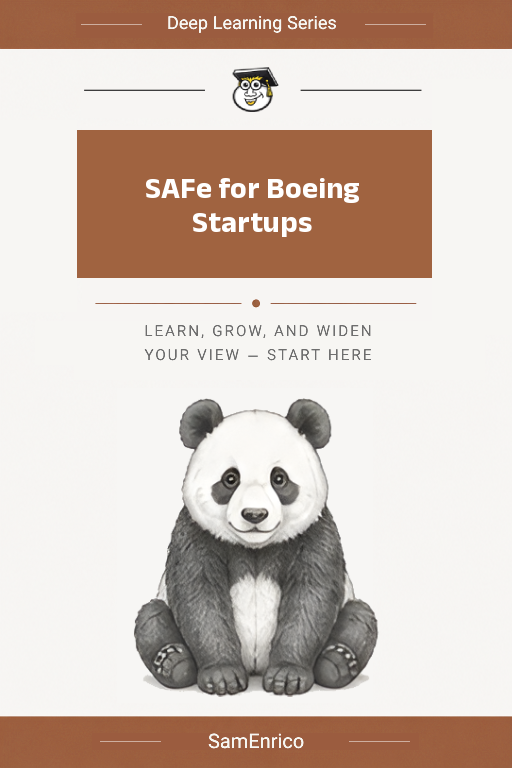
Non-FictionStartup GuideSAFe Critical
SAFe for Boeing Startups eBook
Scale agile for aerospace and defense startups usi
by Weed Ula
Scale agile for aerospace and defense startups using Boeing's safety-critical SAFe adaptation.
Formats
Free sample
Chapter 1: The Irony of Silence...--–- On October 29, 2018, Lion Air Flight 610 plunged into the Java Sea twelve minutes after takeoff. One hundred eighty-nine people died. Five months later, on March 10, 2019, Ethiopian Airlines Flight 302 crashed six minutes after departure, killing all 157 souls on board. The common thread between these two catastrophes was not a terrorist attack, not a once-in-a-century weather event, not pilot error in any conventional sense. The common thread was a piece of software called the Maneuvering Characteristics Augmentation System—MCAS—and the even more dangerous piece of organizational software that surrounded it: a project management system that had forgotten how to listen.The question that haunts aerospace engineering is not "What went wrong with MCAS?" That question has been answered by investigations, lawsuits, and congressional hearings.
The haunting question is far more uncomfortable: "How could a company with Boeing's legacy, its talent, its safety culture, produce a system that killed 346 people?" The answer, as this book will argue, lies not in any single technical flaw but in a gradual, decades-long abandonment of the very principles that made Boeing great. And paradoxically, the solution is not to abandon agility but to rediscover a specific kind of agility—one that Silicon Valley's "move fast and break things" mantra could never survive, but one that a new generation of aerospace and defense startups desperately needs.This chapter introduces the central paradox of modern aerospace development. The same industry that once landed humans on the moon with less computing power than a modern washing machine now struggles to certify a software update without eighteen months of paperwork. The same company that designed the 777 entirely on computers in the early 1990s—a project that many consider the gold standard of engineering execution—could not synchronize two sensors on the 737 MAX. And the same frameworks that have enabled software companies to deploy thousands of times per day are completely inadequate for safety-critical systems that cannot be patched over the air at 35,000 feet.We are witnessing the birth of a new kind of company: the "Boeing Startup." These are high-growth ventures building hardware-dependent, mission-critical systems for aerospace and defense.
They are not building social media apps or e-commerce platforms. They are building electric vertical takeoff and landing (e VTOL) aircraft, autonomous drone swarms, next-generation radar systems, and satellite constellations. They are funded by venture capital, staffed by former Space X and Blue Origin engineers, and pressured to move at startup speed. But they are also governed by the Federal Aviation Administration, the European Union Aviation Safety Agency, the Department of Defense, and a web of standards including DO-178C, DO-254, AS9100D, and IEC 61508.These Boeing Startups face an impossible dilemma. If they adopt standard Agile frameworks like SAFe (Scaled Agile Framework) without modification, they will produce working software that fails certification.
If they stick with traditional waterfall methods, they will move too slowly, burn through their capital, and die before delivering a single certified product. They need something new: an adaptation of SAFe specifically for safety-critical aerospace and defense. They need SAFe for Boeing Startups.But before we build that adaptation, we must understand how the aerospace industry lost its way. And to understand that, we must return to a time when Boeing was not a cautionary tale but a model of engineering excellence.The 777 Miracle: When Boeing Built Agile Without Knowing It In 1990, Boeing announced a radical new aircraft: the 777, a twin-engine wide-body jet that would become the company's best-selling wide-body airliner. But the 777 was remarkable not only for its engineering specifications but for its development process.
For the first time in commercial aviation history, Boeing designed an entire aircraft using computers—not just for drafting but for full three-dimensional digital assembly. Eight design-build teams, co-located in a single facility, worked simultaneously on the fuselage, wings, avionics, landing gear, and propulsion systems. They called it "Working Together."The 777 project embodied principles that would later be codified in the Agile Manifesto, which would not be written for another eleven years. Cross-functional teams. Iterative design.
Continuous integration—except instead of software commits, they were integrating digital mock-ups of physical components. User collaboration: Boeing invited eight major airlines, including United, American, and British Airways, to participate in the design process, resulting in the "Working Together" cockpit that incorporated pilot feedback before a single physical prototype was built.The 777 was delivered on time, on budget, and with such quality that its dispatch reliability—the percentage of flights that depart within fifteen minutes of schedule—exceeded 99 percent. It remains one of the most successful aircraft programs in history.But here is the crucial distinction that this book must make clear from the outset: The 777 succeeded not because it was Agile in the modern SAFe sense, but because it combined engineering excellence with iterative practices despite a fundamentally waterfall governance structure. The 777 did not have two-week sprints. It did not have continuous delivery.
It did not have a Product Owner writing user stories. It had rigorous phase gates, exhaustive documentation, and a certification process that took years. The "agility" of the 777 was emergent, not designed. It came from talented engineers who were empowered to collaborate across disciplines, not from a framework imposed from above.This distinction matters because many Agile evangelists have retrospectively claimed the 777 as proof that Agile works in aerospace. That is a misreading of history.
The 777 worked because Boeing had not yet lost its engineering culture—a culture that prioritized quality over schedule, safety over sales, and listening over hierarchy. When that culture eroded, no framework could save it.The Merger That Broke Boeing In 1997, Boeing merged with Mc Donnell Douglas. On paper, it was a merger of equals. In reality, it was a hostile takeover of Boeing's engineering culture by Mc Donnell Douglas's finance-driven management. The leaders who had built the 777—men like CEO Phil Condit and engineer Alan Mulally—were gradually replaced by Mc Donnell Douglas executives who believed that shareholders came before engineers, that cost-cutting was a virtue, and that schedule was a weapon.The cultural shift was subtle at first, then devastating.
Boeing had traditionally invested heavily in engineering talent, offering long-term career paths, generous research budgets, and a famous "Boeing Bonus" that rewarded engineers who discovered safety defects before they reached production. After the merger, engineering was treated as a cost center. Research budgets were slashed. Experienced engineers were pushed into early retirement. And the Boeing Bonus—a peer-recognition system that had incentivized defect discovery for decades—was eliminated because it was "inefficient."The consequences were predictable but catastrophic.
In the early 2000s, Boeing's commercial aviation division began a slow decline in quality metrics. The 787 Dreamliner program, launched in 2004, was plagued by delays, cost overruns, and supply chain problems. The lithium-ion battery fires that grounded the entire 787 fleet in 2013 were not a technical anomaly; they were a symptom of a culture that had stopped asking "What could go wrong?" and started assuming that suppliers would manage safety.But the most dramatic failure of this new Boeing culture was yet to come. It would involve a 1960s airframe, a pair of oversized engines, and a piece of software called MCAS.The 737 MAX: A Case Study in Process Failure…
This is the end of the free sample. Get the eBook to keep going. Buy now
About this book
Details
- Author
- Weed Ula
- Publisher
- SamEnrico
- Language
- English
- Genre
- Non-Fiction, Startup Guide, SAFe Critical
- Released
- 2026-06-01
- Pages (approx.)
- 151
- Available as
- eBook, Audiobook

Read better in the ZLOADR app
Your eBooks on your phone or tablet. Sign in with your SamEnrico account and start reading.
More by Weed Ula
 Chunking for Creative BrainstormingWeed Ula$11.99
 Self Hypnosis For Confidence Building WorkbookWeed Ula$11.99
 The Anger Script RewriteWeed Ula$11.99
 Naked in Public Dream CourseWeed Ula$11.99
 Interruption Tracking Log WorkbookWeed Ula$11.99
 Midnight Glitch: The Last Broadcast of Radio Free Y2KWeed Ula$11.99
 The Unstoppable Comeback: How a 1998 Underdog Team Defied All OddsWeed Ula$11.99
 Gas Shutoff Valve Location TrainingWeed Ula$11.99
 Understanding Englemann DiseaseWeed Ula$17.99
 How to Start a Dairy Machinery and Plant (not Agricultural) Business (Beginners Guide)Weed Ula$11.99
You may also like
 Hong Kong Handover 1997Dunn Johnnie$11.99
 Zumba For Postnatal Recovery CourseNeal Christian$11.99
 Zumba for BeginnersLadner Nikia$11.99
 YouTube Comment Mining GuideHumes Pandora$12.99
 Worry Box MeditationCarlin Rudy$11.99
 Workplace Stress MeditationNguyen Lynn$11.99
 Workplace Stress and Sleep RepairHawley Ivory$11.99
 Workplace Perfectionism CureDelaney Jeffry$11.99
 Workplace Injustice Anger GuideWallen Isabelle$11.99
 Work Addiction and Burnout LinkGreenwood Ester$11.99
 Women in Yoga and WellnessBeattie Galina$11.99
 Women in Stand Up ComedyChun Evangeline$11.99