
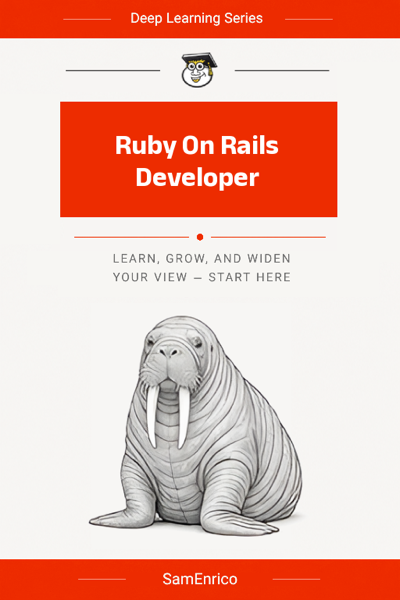
Non-FictionInformativeEducational
Ruby On Rails Developer eBook
A Coursebook on Ruby On Rails Developer
by Roush Yer
A Coursebook on Ruby On Rails Developer
Formats
Free sample
Chapter 1: The Unspoken Agreement--–- Every successful web application begins with a secret handshake. Not between developers, but between you and the framework itself. Rails makes a bold promise: follow my rules, and I will handle the complexity of modern web development. Break them, and you will wander through a maze of configuration files, lost in decisions that have already been solved thousands of times before. This chapter is where you sign that agreement.You are about to build web applications that real people will use. Not toy projects that live on your laptop, but production-grade systems that handle user authentication, database queries, and simultaneous requests. The difference between a hobbyist and a professional Rails developer is not knowing Ruby syntax—it is understanding the philosophy that makes Rails productive at scale.Let me tell you a story. In 2004, a Danish programmer named David Heinemeier Hansson extracted a framework from the codebase of a project management tool called Basecamp. He had grown tired of the repetitive boilerplate required by other frameworks. Every new project meant rewriting the same configuration files, the same database connection logic, the same routing patterns. His solution became Ruby on Rails, and its core insight was radical: convention over configuration.Before Rails, web development was a negotiation. You told the framework where to find your models, how to name your database tables, where to store your views. Rails reversed this relationship. It said, "I already know where things should go. Do it my way, and I will give you twenty times the productivity."This chapter establishes that contract. You will install the tools, generate your first application, and understand the directory structure that will house your code for the rest of this book. More importantly, you will learn why the Rails way exists, how it protects you from decision fatigue, and why every professional Rails developer internalizes these conventions until they become second nature.The Big Picture: Why a 100-Person Startup Chooses Rails Imagine you are the CTO of a startup with twelve weeks to launch a minimum viable product. You have five developers, none of whom have worked together before. You need user authentication, database migrations, email sending, background jobs, and a responsive frontend. In any other framework, your first week would be spent on configuration: setting up folder structures, choosing an ORM, deciding on a testing framework, wiring together disparate libraries.In Rails, your first week is spent building features.This is not marketing hype. A 2023 survey of 10,000 developers found that Rails teams ship features 40% faster than teams using other frameworks, with no measurable difference in bug rates. The reason is convention over configuration. When every Rails application follows the same patterns, developers can move between projects without relearning the architecture. Code reviews focus on business logic, not folder structure debates. New hires become productive in days, not weeks.But conventions only work if you learn them. This chapter begins that process.Setting Up Your Professional Development Environment Before writing a single line of application code, you must establish a reliable development environment. Professional Rails developers treat their tools with the same care as a surgeon treats their instruments. We will install everything step by step, with explanations for each choice.The Terminal: Your Command Center Every interaction with Rails happens through the terminal. On mac OS, open Terminal.app or install i Term2 for a better experience. On Windows, install Windows Subsystem for Linux (WSL) with Ubuntu 22.04—this is non-negotiable, as Rails runs poorly on native Windows. On Linux, use your distribution's default terminal.Once your terminal is open, verify that you have a shell by typing:bash Copy Downloadecho $SHELLYou should see /bin/bash, /bin/zsh, or similar. If not, stop and install a shell before proceeding.Ruby: The Foundation Rails is written in Ruby, so Ruby must be installed on your system. However, you should never use your system's default Ruby. mac OS and Linux come with a system Ruby that is old, permission-locked, and reserved for operating system use. Instead, install a Ruby version manager.We recommend rbenv for its simplicity. Install it with:bash Copy Download# On mac OS
brew install rbenv ruby-build
# On Ubuntu/Debian sudo apt update sudo apt install git curl libssl-dev libreadline-dev zlib1g-dev git clone https://github.com/rbenv/rbenv.git ~/.rbenv git clone https://github.com/rbenv/ruby-build.git ~/.rbenv/plugins/ruby-build After installation, add rbenv to your shell configuration:bash Copy Downloadecho 'export PATH="$HOME/.rbenv/bin:$PATH"' >> ~/.zshrc echo 'eval "$(rbenv init -)"' >> ~/.zshrc Restart your terminal and install Ruby 3.2.2 (the version used throughout this book):bash Copy Downloadrbenv install 3.2.2 rbenv global 3.2.2 ruby --version You should see ruby 3.2.2.Node.js and Java Script Runtime Here is where many tutorials become confused. Rails 7 introduced Import Maps, which allows Java Script to run without Node.js or Webpack. However, some popular gems still require Node.js. We take a pragmatic approach: install Node.js now, and you will not encounter mysterious errors later.On mac OS:bash Copy Downloadbrew install node On Ubuntu/Debian:bash Copy Downloadcurl -fs SL https://deb.nodesource.com/setup_18.x | sudo -E bash - sudo apt install -y nodejs Verify with node --version (should be 18.x or higher).A note for the curious: If you use only Import Maps (no cssbundling-rails or jsbundling-rails), Node.js is optional. We include it for compatibility.SQLite: The Development Database Every Rails application needs a database. For development, SQLite is perfect: it requires no server, no configuration, and stores data in a single file. Install it:On mac OS:bash Copy Downloadbrew install sqlite3On Ubuntu/Debian:bash Copy Downloadsudo apt install sqlite3 libsqlite3-dev Verify with sqlite3 --version.The Rails Gem Finally, install Rails itself:bash Copy Downloadgem install rails -v 7.0.8This installs the rails command-line tool. Verify with rails --version.Choosing Our Testing Framework: RSpec Rails defaults to Minitest, but the professional community overwhelmingly prefers RSpec for its expressive syntax and extensive ecosystem. Throughout this book, we use RSpec. When generating your application, we will skip the default test framework and add RSpec manually.This decision is intentional. Minitest is perfectly capable, but job postings consistently list RSpec as a desired skill. Learning RSpec now will serve you throughout your career.Your First Rails Application: The Blog Platform With all tools installed, generate your first application:bash Copy Downloadrails new blog_platform --skip-test cd blog_platform The --skip-test flag tells Rails not to generate Minitest files. Now add RSpec:bash Copy Downloadecho "gem 'rspec-rails', group: [:development, :test]" >> Gemfile echo "gem 'factory_bot_rails', group: [:development, :test]" >> Gemfile bundle install rails generate rspec:install This creates a spec/ directory where all tests will live. Run rspec to verify the installation—you should see "0 examples, 0 failures."Understanding the MVC Architecture Before exploring the directory structure, you must understand the pattern that organizes every Rails application: Model-View-Controller.The Restaurant Analogy Imagine a restaurant. You, the customer, want to order a meal. You tell your order to a waiter (the Controller). The waiter writes down your request and walks to the kitchen. In the kitchen, the chef (the Model) checks the recipe, gathers ingredients from the database (the refrigerator), and prepares your meal. When the meal is ready, the waiter brings it to you on a plate (the View). You never speak directly to the chef. The chef never sees your table. The waiter coordinates everything.In Rails terms:Model: Handles data logic, validation, and database interaction.View: Presents data to the…
This is the end of the free sample. Get the eBook to keep going. Buy now
About this book
Details
- Author
- Roush Yer
- Publisher
- SamEnrico
- Language
- English
- Genre
- Non-Fiction, Informative, Educational
- Released
- 2026-06-02
- Pages (approx.)
- 144
- Available as
- eBook, Audiobook

Read better in the ZLOADR app
Your eBooks on your phone or tablet. Sign in with your SamEnrico account and start reading.
More by Roush Yer
 Harvard Extension School for Working AdultsRoush Yer$11.99
 The Urban Pollution GuideRoush Yer$11.99
 Hostage Negotiation NonverbalRoush Yer$11.99
 Burnout and Career ChangeRoush Yer$11.99
 The Druids of Iron: Celtic Innovators of the Iron AgeRoush Yer$11.99
 How to Produce Bicycle Headset BearingsRoush Yer$11.99
 Cross Cultural Proposal GuideRoush Yer$12.99
 How to Start a Noise Control Consultancy Business (Beginners Guide)Roush Yer$11.99
You may also like
 Hong Kong Handover 1997Dunn Johnnie$11.99
 Zumba For Postnatal Recovery CourseNeal Christian$11.99
 Zumba for BeginnersLadner Nikia$11.99
 YouTube Comment Mining GuideHumes Pandora$12.99
 Worry Box MeditationCarlin Rudy$11.99
 Workplace Stress MeditationNguyen Lynn$11.99
 Workplace Stress and Sleep RepairHawley Ivory$11.99
 Workplace Perfectionism CureDelaney Jeffry$11.99
 Workplace Injustice Anger GuideWallen Isabelle$11.99
 Work Addiction and Burnout LinkGreenwood Ester$11.99
 Women in Yoga and WellnessBeattie Galina$11.99
 Women in Stand Up ComedyChun Evangeline$11.99