
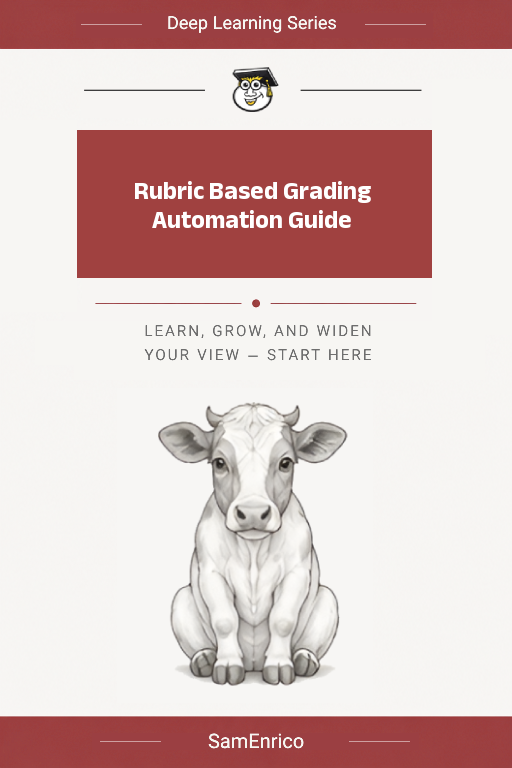
Non-FictionAI OperatorEducational TechnologyAssessment Design
Rubric Based Grading Automation Guide eBook
Train AI to score essays and short answers against
by Tejada Dina
Train AI to score essays and short answers against your rubrics. Generate consistent feedback comments and identify class-wide skill gaps instantly.
Formats
Free sample
Chapter 1: The 10,000-Hour Mistake--–- The stack of papers sat on my kitchen table for three full days. Not because I was lazy. Not because I didn't care. Because I had calculated the math on Sunday night and realized something that broke me: I would spend the next twelve hours writing the same six comments, over and over, while my two-year-old slept on my chest. I cried in the dark.
Not a dramatic sob. The kind of silent, exhausted crying where your shoulders shake but you make no sound because you don't want to wake the baby. That was the moment I stopped believing that grading had to feel like this.The Math That No One Tells You in Grad School Let me show you the calculation that changed everything for me. You can run it for yourself in about ninety seconds.Take your average time to grade one assignment. Not the complex ones that require deep reading.
The average one. The essay that needs the same feedback you gave twenty times last week. Be honest: six minutes? Eight? If you teach writing, you know it's closer to ten.Now multiply that by the number of students you have.
Let's say 150 across five classes. At eight minutes per paper, that's 1,200 minutes. Twenty hours. Twenty hours of grading per assignment.Now multiply that by the number of major assignments per semester. Let's be conservative: four essays, six lab reports, ten short-answer quizzes.
That's twenty assignments. Twenty hours times twenty assignments equals four hundred hours per semester.Four hundred hours. That is ten full work weeks. That is every waking hour of your winter break, spring break, and three full weekends. That is the equivalent of teaching an entire extra course that meets for four hours every single day.And here is the part that no one told you in graduate school: most of those four hundred hours are not teaching.
You are not diagnosing learning needs. You are not designing interventions. You are not having the kind of transformative conversation that made you want to become a teacher in the first place.You are writing the same comment about comma splices. The same comment about citing sources. The same comment about organizing paragraphs.
The same six comments, four hundred hours per semester, year after year.This is the 10,000-hour mistake. And it is not your fault.The Data That Should Make Us All Angry In 2025 and 2026, multiple large-scale studies on teacher workload confirmed what we have known anecdotally for years. Let me share the numbers that stopped me cold.The Teacher Workload Project, which surveyed over twelve thousand K-12 teachers across forty states, found that grading consumes an average of 10.5 hours per week for secondary English teachers. For elementary teachers, it is lower but still significant: 6.2 hours per week when you include all subject areas. Those numbers are averages.
Many teachers reported 15 hours or more during peak assessment periods.But here is the statistic that should make every administrator and policy maker pay attention. The same study asked teachers to rank the top three contributors to their consideration of leaving the profession. Classroom management was third. Low pay was second. Grading workload was first.
Fifty-seven percent of teachers who said they had seriously considered quitting in the past year named grading as a primary factor.Think about that for a moment. More teachers are thinking about leaving because of the stack of papers on their kitchen table than because of the size of their paycheck.The reasons are consistent across every study. Teachers report that grading is the part of the job that feels most unlike teaching. It is solitary, repetitive, and never complete. There is no moment when you close your gradebook and say, "I am done with grading forever." The stack always regenerates.
You finish one set of essays, and the next set is already waiting.This is not a sustainable system. And more importantly for the purpose of this book, it is not an inevitable system. The workload is real, but the belief that it must be done entirely by hand, comment by repetitive comment, is a choice. One we have been making for so long that we have forgotten it is a choice at all.The 80/20 Rule That Exposes the Waste Before I show you the solution, let me show you the waste more precisely.Pareto's principle – the 80/20 rule – applies to grading with almost cruel precision. Take any stack of student work from any subject and any grade level.
Look at the comments you write. You will find that approximately 80 percent of your comments fall into 20 percent of comment types.I have run this audit with hundreds of teachers. The specific six to eight comments vary by subject, but the pattern is universal. English teachers write variations of: "Cite your evidence," "Run spell check," "Where is your thesis statement," "This paragraph needs a topic sentence," "Show don't tell," and "Watch for comma splices." Math teachers write: "Show your work," "Label your units," "Check your signs," "Simplify your fractions," "Why did you choose this formula," and "You made an arithmetic error here." Science teachers write: "What is your hypothesis," "Where are your controls," "Explain your reasoning," "Significant figures matter," "Cite your sources," and "Your conclusion does not match your data."Six to eight comments. That is it.
The vast majority of your grading time is spent typing, handwriting, or copying and pasting the same six to eight instructional nudges, hundreds of times per semester.Now let me ask you a question that changed everything for me. If you could hire a teaching assistant – a very fast, slightly literal-minded, but highly consistent teaching assistant – to write those six comments for you, would you? And if that teaching assistant cost less than a cup of coffee per week and never complained about the workload, would you feel guilty using them?Most teachers say no to the guilt and yes to the assistant. And yet, when I suggest that this assistant already exists in the form of a well-prompted AI, the same teachers suddenly feel like they are cheating. Let me be explicit about what this book is and is not advocating.The Critical Distinction: Automated vs.
Augmented There is a term in educational technology that you may have heard: Automated Essay Scoring, or AES. These are systems that take a student essay and output a single number – a score – with no explanation, no feedback, and no human oversight. AES has been around for decades. It is used in large-scale standardized testing. And it is not what this book is about.AES is fundamentally a replacement model.
The machine takes the job. The human steps aside. The score is final. The student learns nothing except a number. This approach has been studied extensively, and the consensus among teaching professionals is clear: AES is useful for sorting but useless for teaching.This book is about something different.
I call it Augmented Feedback Systems. In this model, the AI does not replace the teacher. It handles the pattern recognition, the repetitive comment generation, and the initial scoring against a rubric. But the teacher remains in the loop at every critical juncture: setting the…
This is the end of the free sample. Get the eBook to keep going. Buy now
About this book
Details
- Author
- Tejada Dina
- Publisher
- SamEnrico
- Language
- English
- Genre
- Non-Fiction, AI Operator, Educational Technology, Assessment Design
- Released
- 2026-06-01
- Pages (approx.)
- 149
- Available as
- eBook, Audiobook

Read better in the ZLOADR app
Your eBooks on your phone or tablet. Sign in with your SamEnrico account and start reading.
More by Tejada Dina
 Letter Of Intent Validation GuideTejada Dina$11.99
 Talking About Prenuptial AgreementsTejada Dina$11.99
 Everett DirksenTejada Dina$11.99
 Workplace Stress App ToolkitTejada Dina$11.99
 Habit Apps GuideTejada Dina$11.99
 Carson Cancer BattleTejada Dina$11.99
 Dream Incubation for HealingTejada Dina$11.99
 Bipolar Pharmacogenomics PrimerTejada Dina$11.99
 Gig Economy Burnout GuideTejada Dina$11.99
 The Vanishing Act: The Disappearance of the Mary CelesteTejada Dina$11.99
 Tangaroa’s Deep: The Birth of the Ocean’s SongTejada Dina$11.99
 The Jade Serpent's Lament: How a Dragon's Tears Shaped the YangtzeTejada Dina$11.99
You may also like
 Hong Kong Handover 1997Dunn Johnnie$11.99
 Zumba For Postnatal Recovery CourseNeal Christian$11.99
 Zumba for BeginnersLadner Nikia$11.99
 YouTube Comment Mining GuideHumes Pandora$12.99
 Worry Box MeditationCarlin Rudy$11.99
 Workplace Stress MeditationNguyen Lynn$11.99
 Workplace Stress and Sleep RepairHawley Ivory$11.99
 Workplace Perfectionism CureDelaney Jeffry$11.99
 Workplace Injustice Anger GuideWallen Isabelle$11.99
 Work Addiction and Burnout LinkGreenwood Ester$11.99
 Women in Yoga and WellnessBeattie Galina$11.99
 Women in Stand Up ComedyChun Evangeline$11.99