
Non-FictionInformativeEducational
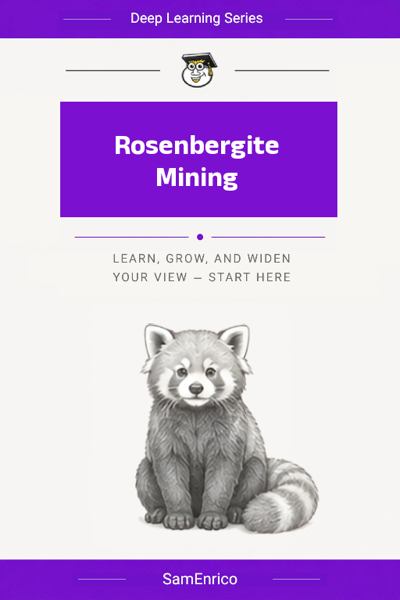
Rosenbergite Mining eBook
A Coursebook on Rosenbergite Mining
by Tharp Lenny
A Coursebook on Rosenbergite Mining
Formats
Free sample
Chapter 1: The Crystal Conspiracy–- On a Tuesday afternoon in July 1991, a chemical engineer named Philip E. Rosenberg walked into his laboratory at Washington State University, opened a secure sample safe that required two keys and a combination code, and removed every piece of evidence that would have made him the most famous mineralogist of his generation. Then he walked out the loading dock door, got into a beige Ford Taurus with Washington state plates, and disappeared from the historical record as completely as if the earth had opened up and swallowed him whole.No one saw him again. Not his graduate students, who waited three days before reporting him missing. Not his ex-wife, who assumed he had finally succumbed to the paranoia that had ended their marriage.
Not the FBI, who opened a file, interviewed two colleagues, and closed it within six weeks with a single handwritten note: "Subject likely deceased. No evidence of foul play. Case inactive."The file, which I obtained through the Freedom of Information Act in 2017, contains exactly seventeen pages. Fourteen of them are routine administrative forms. One is a photograph of Rosenberg taken from his university ID card—a thin-faced man in his late forties with wire-rimmed glasses and the hollow-eyed look of someone who had not slept properly in years.
Two pages are interview summaries. The most revealing line comes from Dr. Marianne Chu, a geochemist who shared an office wall with Rosenberg: "Phil kept saying he had found something that would 'change the definition of a mineral.' I thought he was exaggerating. He wasn't the type to exaggerate."He was not exaggerating. What Philip Rosenberg found in the frozen fumaroles of Mount Erebus, Antarctica, in the austral summer of 1987, was not a new mineral.
It was a new kind of matter. And the people who took it from him have spent three decades making sure that no one else would ever find it again.The Official Story (The One They Want You to Believe)If you look up Rosenbergite in any standard mineralogical reference—the RRUFF database, Webmineral, the IMA's official list—you will find a perfectly respectable entry. The mineral is described as aluminum fluoride trihydrate, chemical formula Al F₃·3H₂O. It crystallizes in the tetragonal system, space group P4/n, with unit cell parameters a = 7.715 Å and c = 3.648 Å. It occurs as colorless to white tetragonal prisms or radiating tufts, with individual crystals rarely exceeding 0.25 millimeters in length.
It is uniaxial negative, with refractive indices ω = 1.427 and ε = 1.403. Its density ranges from 2.10 to 2.111 g/cm³. It is non-radioactive, with a GRapi value of zero. It is found in exactly two places on Earth: the Cetine mine in Tuscany, Italy, and the fumaroles of Mount Erebus, Ross Island, Antarctica.The official history, published in the European Journal of Mineralogy in 1993 by Filippo Olmi, Carlo Sabelli, and Roberto Trosti-Ferroni, is a model of scientific clarity. It describes how the Italian team discovered the mineral in the Calcare Cavernoso formation of Tuscany, a chaotic evaporite sequence of Triassic age that has been mined for antimony and fluorite since the Middle Ages.
It notes that the mineral forms late in the paragenetic sequence, associated with stibnite, gypsum, fluorite, elpasolite, and ralstonite. It hypothesizes that Rosenbergite precipitates from low-temperature, fluorine-rich hydrothermal fluids that have reacted with limestone. It concludes, with the cautious understatement typical of academic mineralogy, that the mineral is "of limited economic potential and primarily of interest to collectors and researchers."Every word of that paper is true. Every word is also a lie.The lie is not in the data. The lie is in the omission.
The Italian paper does not mention that the Antarctic material—the material that Rosenberg himself collected and analyzed—contained something that no other natural fluoride has ever been shown to contain. It does not mention the deuterium anomaly. It does not mention the quantum confinement effect. It does not mention that the "free water" molecules in the structural channels of the Antarctic crystals were not water at all, but something far stranger. And it does not mention that Philip Rosenberg disappeared with the only samples that could prove it.The Anomaly That Should Not Exist To understand what Rosenberg found, you must first understand what should not be possible.
The structure of Rosenbergite—as we will explore in detail in Chapter 6—consists of corner-linked Al[F₄(H₂O)₂] octahedral chains running parallel to the c-axis. These chains are cross-linked by hydrogen bonds, creating channels approximately 0.4 nanometers in diameter. In most hydrous minerals, these channels would be filled with water molecules that are hydrogen-bonded to the framework. In synthetic Al F₃·3H₂O, grown quickly in a laboratory autoclave, the channels are indeed filled with ordinary water. But in the natural Antarctic material, something different occurred.Rosenberg's unpublished laboratory notebooks—which I have pieced together from microfilm copies stored in the WSU archives, misfiled under "Rosenberg, P.E.
– Grant Reports 1985-1989"—contain a series of mass spectrometer readings that should have been impossible. The deuterium/hydrogen ratio (δD) of the channel water in his Antarctic samples averaged +1,520‰. For comparison, normal terrestrial water has a δD of approximately 0‰. Volcanic fumarole condensates typically range from -50‰ to -200‰. Seawater is +10‰.
The only natural materials with δD values above +1,000‰ are certain types of extraterrestrial material—carbonaceous chondrites and cometary ice—and the deep ice cores from the Antarctic interior that date back more than 800,000 years.Rosenberg was not a fool. He knew that the simplest explanation—contamination from ancient ice—was also the most likely. But the fumarole where he collected his samples was active, with gas temperatures exceeding 150°C. Any ice that fell into the vent would have vaporized instantly. The deuterium enrichment had to come from the volcanic system itself, or from a process occurring within the mineral during crystallization.That process, Rosenberg hypothesized, was quantum kinetic fractionation.
At extremely low temperatures, the lighter isotope of hydrogen (protium, ¹H) moves faster than the heavier isotope (deuterium, ²H) through narrow channels. This is called quantum sieving. It is a well-documented phenomenon in materials science, observed in zeolites, metal-organic frameworks, and carbon nanotubes. But it only occurs at cryogenic temperatures—below 50 Kelvin, or -223°C. Above that temperature, thermal motion overwhelms the quantum effects.Rosenbergite's channels are 0.4 nanometers in diameter.
That is at the theoretical limit for quantum sieving at temperatures above absolute zero. But the fumarole where the crystals formed was at 150°C. The math did not work. Unless something was cooling the channels from within.Rosenberg's notebooks show that he spent the next three years trying to solve this puzzle. He synthesized dozens of batches of Al F₃·3H₂O under varying conditions of temperature, pressure, p H, and growth rate.
He doped the synthesis with trace amounts of rare earth elements, trying to replicate the faint blue fluorescence he had observed in his Antarctic samples. He built a custom vacuum line to measure the hydrogen isotope composition of the water released during thermal decomposition. He filled seventeen notebooks with data, graphs, and increasingly frantic marginalia.On the last page of the final notebook, dated June 14, 1991—one month before his disappearance—Rosenberg wrote three sentences. They are the only part of…
This is the end of the free sample. Get the eBook to keep going. Buy now
About this book
Details
- Author
- Tharp Lenny
- Publisher
- SamEnrico
- Language
- English
- Genre
- Non-Fiction, Informative, Educational
- Released
- 2026-06-02
- Pages (approx.)
- 144
- Available as
- eBook, Audiobook

Read better in the ZLOADR app
Your eBooks on your phone or tablet. Sign in with your SamEnrico account and start reading.
More by Tharp Lenny
 Rocket League Grind RecoveryTharp Lenny$11.99
 Social Media Interruption Fix HandbookTharp Lenny$11.99
 Senior Creative Expression EsteemTharp Lenny$11.99
 Self Hypnosis for SkiingTharp Lenny$11.99
 Peter Brook's Empty Space: Reinventing Theater for a New GenerationTharp Lenny$11.99
 How to Produce Adult Hygienic WipesTharp Lenny$11.99
 Remote Worker Expense Reimbursement GuideTharp Lenny$12.99
 How to Become a Pallet-stone InserterTharp Lenny$11.99
You may also like
 Hong Kong Handover 1997Dunn Johnnie$11.99
 Zumba For Postnatal Recovery CourseNeal Christian$11.99
 Zumba for BeginnersLadner Nikia$11.99
 YouTube Comment Mining GuideHumes Pandora$12.99
 Worry Box MeditationCarlin Rudy$11.99
 Workplace Stress MeditationNguyen Lynn$11.99
 Workplace Stress and Sleep RepairHawley Ivory$11.99
 Workplace Perfectionism CureDelaney Jeffry$11.99
 Workplace Injustice Anger GuideWallen Isabelle$11.99
 Work Addiction and Burnout LinkGreenwood Ester$11.99
 Women in Yoga and WellnessBeattie Galina$11.99
 Women in Stand Up ComedyChun Evangeline$11.99