
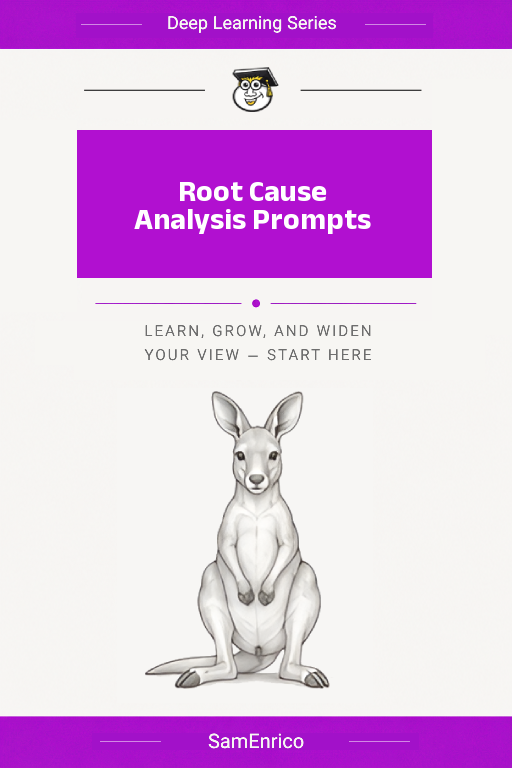
Root Cause Analysis Prompts eBook
Use prompt chains to conduct root cause analysis a
Use prompt chains to conduct root cause analysis and generate fishbone diagrams from incident data.
Formats
Free sample
Chapter 1: The Silence Before Failure--The explosion at the Texas oil refinery killed two men and sent four others to the burn unit before the alarms even finished sounding. It was 1:47 AM on a Tuesday. The investigation that followed took seven months, consumed four million dollars, and produced a final report that was six hundred pages long. The root cause, according to that report, was "operator error." A twenty-three-year-old technician named Marcus had pressed the wrong button. He had been on shift for fourteen hours. His training had consisted of three days of Power Point slides and a single supervised walkthrough. The button he pressed was unlabeled and located directly next to the correct button, which was also unlabeled. The two buttons were visually identical. The procedure manual for that panel had not been updated since 1997—eleven years before Marcus was born.But the report said operator error. And because it said operator error, nothing fundamental changed. The buttons remained unlabeled. The shifts remained fourteen hours. The training remained three days of Power Point. And somewhere in the industry, a safety officer read that report, nodded knowingly, and said to a colleague: "Classic case. Bad hire."This is not a story about negligence or incompetence. It is a story about how human beings investigate failure—and how we systematically, predictably, and disastrously get it wrong.The Ritual We Mistake for Investigation Every organization on earth performs some version of Root Cause Analysis. In manufacturing, it is the "5 Whys." In healthcare, it is the "Sentinel Event Review." In software, it is the "Post-Mortem" or "Incident Retrospective." In aviation and nuclear power, it is the formalized "Accident Investigation." These methodologies share a common promise: that by asking the right questions in the right order, we can trace an effect backward through a chain of causes until we reach the foundational origin—the root—and then correct it.The promise is beautiful. The reality is almost uniformly grim.Most RCAs are not investigations at all. They are rituals. They are performed because policy requires them, not because the organization genuinely wants to know what happened. They are conducted under time pressure, with incomplete data, and—most damagingly—with a pre-existing assumption about who or what is to blame. The average RCA takes less than ninety minutes from incident to conclusion. In that ninety minutes, a team of well-intentioned professionals will gather around a whiteboard, ask "Why?" three or four times, arrive at an answer that feels satisfying, write a report, and move on to the next fire.Ninety minutes. For a failure that may have been brewing for months or years.Consider what happens in those ninety minutes. The most senior person in the room speaks first, and their theory becomes the anchor around which every subsequent question orbits—a cognitive bias so well-documented that psychologists have a name for it: anchoring. The loudest person speaks second, and their confidence overrides the quieter person who has contradictory data—authority bias and groupthink working in concert. The team recalls recent similar failures more easily than distant ones, so they over-weight the most memorable incident rather than the most relevant—availability heuristic. And because every person in the room has a stake in the outcome (reputation, budget, career), the investigation naturally drifts toward explanations that distribute blame away from the powerful and onto the powerless—a phenomenon the sociologist Diane Vaughan called the normalization of deviance.The result is not a root cause. The result is a socially acceptable story that protects the organization from uncomfortable change.The refinery explosion report was not wrong because the investigators were stupid or malicious. It was wrong because human cognition is not designed for root cause analysis. Our brains evolved to make fast, pattern-based judgments about immediate threats—snake or stick? friend or foe?—not to trace causal chains through complex sociotechnical systems over months of latent conditions. When we try to do RCA with our natural cognitive equipment, we fail. Consistently. Predictably. And often catastrophically.The Five False Gods of Traditional RCABefore we can understand how artificial intelligence rescues root cause analysis, we must understand exactly how traditional RCA fails. The literature on this subject is vast—Okes, Dekker, Reason, Hollnagel, Woods, and many others have documented these failure modes over decades—but they condense into five predictable patterns.The First False God: The Single Cause Fallacy Every complex failure has multiple causes. This is not an opinion; it is a thermodynamic necessity in any system with interacting components. Yet most RCA methods, particularly the "5 Whys," produce a linear chain that implies a single root. The 5 Whys asks "Why?" five times and stops. But why five? Why not three? Why not twelve? The number is arbitrary, and the linear form forces the investigator to choose a single path while ignoring branches. In the refinery explosion, a linear 5-Whys might have produced: Why did Marcus press the wrong button? Because the buttons were unlabeled. Why were they unlabeled? Because the labeling procedure was not followed. Why was the procedure not followed? Because no one enforced it. Why was no one enforcing it? Because management did not prioritize labeling. Why did management not prioritize labeling? Because there was no budget. Stop. Root cause: budget constraints.But this linear chain ignored at least six other causal branches: the fourteen-hour shift, the inadequate training, the identical button placement, the lack of peer review, the missing alarm, and the failure of the previous three shifts to report the problem. Each of those branches was a cause. Each contributed. And each was erased by the linear form.The Second False God: The Blame Imperative Organizations do not want causes; they want accountability. This is a subtle but crucial distinction. A cause is gender-neutral, depersonalized, and systemic: "The pressure relief valve was underspecified for the operating range." Accountability requires a name: "Marcus made an error." The pressure to produce a name—a person who can be retrained, reassigned, or terminated—is immense. It comes from legal departments who need to limit liability. It comes from executives who need to demonstrate action to shareholders. It comes from the human need for narrative closure: stories with villains are more satisfying than stories about valve specifications.The result is that most RCAs stop as soon as they find a human. They do not ask why that human was in that situation, with that training, under those conditions, at that time. They do not ask why the system was designed to make that error possible, attractive, or inevitable. They stop at the person because stopping at the person is useful.The Third False God: The Retrospective Fallacy After an incident occurs, we know the outcome. This knowledge distorts our perception of the events that led to it. Psychologists call this hindsight bias. In the moment, before the explosion, the unlabeled button was one of thousands of minor design flaws in the refinery—inconvenient, perhaps, but not obviously catastrophic. After the explosion, the unlabeled button becomes obviously dangerous. The investigators, knowing the outcome, cannot reconstruct the genuine uncertainty that existed before it. They see a clear line from cause to effect that was never clear to the people living through the hours before the failure.This bias leads to harsh judgments of the operators who were there. "How could Marcus not see that the buttons were unlabeled?"…
This is the end of the free sample. Get the eBook to keep going. Buy now
About this book
Details
- Author
- Balderas Aleen
- Publisher
- SamEnrico
- Language
- English
- Genre
- Non-Fiction, AI Operator, RCA
- Released
- 2026-05-29
- Pages (approx.)
- 142
- Available as
- eBook, Audiobook

Read better in the ZLOADR app
Your eBooks on your phone or tablet. Sign in with your SamEnrico account and start reading.
More by Balderas Aleen
 Wilder Cynical SweetBalderas Aleen$11.99
 Nanny and Sleep TrainingBalderas Aleen$11.99
 Workload Management For Burnout GuideBalderas Aleen$11.99
 Gynecomastia Self Esteem GuideBalderas Aleen$11.99
 Navigating Customer Complaint ConversationsBalderas Aleen$11.99
 The Last Whisper of the Great Library of AlexandriaBalderas Aleen$11.99
 Swing Set AssemblyBalderas Aleen$11.99
 Understanding Mesangial Sclerosis, DiffuseBalderas Aleen$17.99
 How to Become a Kiln WorkerBalderas Aleen$11.99
 UK Financial Services ReformBalderas Aleen$12.99
You may also like
 Hong Kong Handover 1997Dunn Johnnie$11.99
 Zumba For Postnatal Recovery CourseNeal Christian$11.99
 Zumba for BeginnersLadner Nikia$11.99
 YouTube Comment Mining GuideHumes Pandora$12.99
 Worry Box MeditationCarlin Rudy$11.99
 Workplace Stress MeditationNguyen Lynn$11.99
 Workplace Stress and Sleep RepairHawley Ivory$11.99
 Workplace Perfectionism CureDelaney Jeffry$11.99
 Workplace Injustice Anger GuideWallen Isabelle$11.99
 Work Addiction and Burnout LinkGreenwood Ester$11.99
 Women in Yoga and WellnessBeattie Galina$11.99
 Women in Stand Up ComedyChun Evangeline$11.99