
Non-FictionInformativeEducational
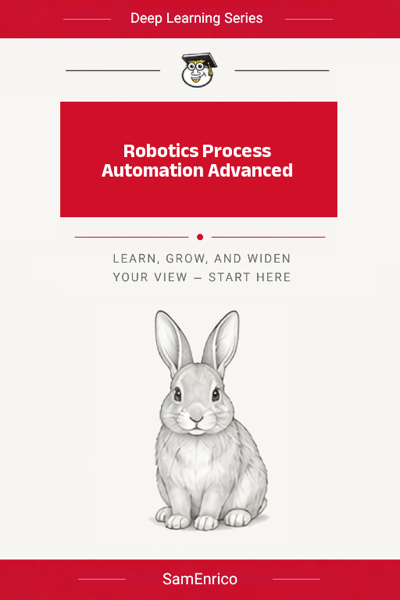
Robotics Process Automation Advanced eBook
A Coursebook on Robotics Process Automation Advanc
by Chang Velva
A Coursebook on Robotics Process Automation Advanced
Formats
Free sample
Chapter 1: The Architecture Mandate...--– In a windowless conference room on the forty-seventh floor of a global bank, a senior operations director watched the same invoice get rejected for the seventh time in ninety minutes. The robotic process automation bot she had championed—the one her team spent six months building—had crashed again. This time the error log read: “Element not found: Submit button (selector: ‘#btn Submit’).” The button hadn’t moved. The application hadn’t been updated. The only thing that had changed was the screen resolution on the virtual machine, because someone in IT had pushed a routine patch overnight. A single pixel shift in a button’s bounding box had brought down a $2.3 million automation project. That bank is not an outlier. It is the rule.This opening story, drawn from an anonymized post‑mortem of a real enterprise failure, illustrates a painful truth that the top ten best‑selling RPA books rarely admit: advanced RPA is not about building more bots. It is about building architecture that survives the chaos of real enterprises. The difference between a fragile script that breaks when a button moves and an industrial‑grade automation that runs for years without intervention is not the quality of the code. It is the quality of the architecture and, more specifically, the discipline of exception handling.This chapter dismantles the most dangerous misconception in RPA today: that exception handling is something you add at the end, after the “happy path” works. In fact, exception handling is not error prevention. It is a design‑first architecture for resilience. By the time you finish this chapter, you will understand why the bank’s bot failed, how to categorize every possible failure your bot will encounter, how to build a hierarchy of handlers that never lets a single crash take down your entire automation, and how to create logging systems that turn silent errors into actionable alerts. You will also receive the Error Handling Map—a roadmap that shows exactly where each resilience concept lives in this book, from transaction‑level recovery in Chapter 2 to disaster recovery in Chapter 12.The Three Deployment Models: Attended, Unattended, and the Myth of “Decoupled”Before we can design resilient architecture, we must understand where robots live and how they are deployed. The RPA industry has created confusing terminology around deployment models, including the term “decoupled robots,” which some vendors use to describe unattended robots running on separate infrastructure. Throughout this book, we treat “decoupled” as a deployment variant of unattended robots, not a separate category. This clarity prevents the confusion that plagues many advanced texts.Attended Robots: The Human‑Assisted Model Attended robots run on a user’s workstation, triggered by that user, and share the user’s desktop session. They are designed for tasks that require human judgment at specific decision points. For example, a customer service representative might click a button to invoke an attended robot that gathers data from six legacy screens, presents a summary to the representative, and then waits for the representative to approve the next action.Characteristics of attended robots:Run only when a human triggers them Share the user’s credentials and permissions (a security implication we will revisit in Chapter 8)Cannot run when the user is logged off or the workstation is locked Typically handle processes with high variability or mandatory human review Failure modes unique to attended robots:The user closes the application the robot needs The user’s network connection drops mid‑process The user interrupts the robot by moving the mouse or typing Because attended robots operate in an unpredictable human environment, their exception handling must be designed for graceful degradation—if the robot cannot complete its task, it must leave the system in a state the human can understand and recover.Unattended Robots: The Autonomous Workforce Unattended robots run on servers or virtual machines without human intervention. They are triggered by schedules (e.g., every night at 2 AM), by queues (e.g., when ten items are waiting), or by API calls (covered in depth in Chapter 4). These robots form the backbone of enterprise automation at scale.Characteristics of unattended robots:Run completely autonomously on dedicated infrastructure Use service accounts with managed credentials (see Chapter 8)Can be orchestrated in pools of dozens or hundreds of robots Require sophisticated state management and recovery mechanisms Failure modes unique to unattended robots:The server reboots for a patch during a bot’s execution The target application’s API rate limit is exceeded The robot’s session is disconnected without warning A single unattended robot might process thousands of transactions per night. An exception handling failure in an unattended robot can corrupt hundreds of records before a human notices. This is why the patterns in this chapter are non‑negotiable for unattended deployments.What About “Decoupled Robots”?Some platform documentation refers to “decoupled robots” to describe unattended robots where the execution host is separate from the orchestration layer. This is purely a deployment topology choice, not a different category of robot. In this book, when you see “unattended robot,” assume it may be running on dedicated infrastructure decoupled from the orchestrator, unless otherwise specified. The architectural principles remain identical.The Advanced Exception Taxonomy: Know What Broke Before You Try to Fix It Most RPA developers learn a simple try‑catch pattern: if something goes wrong, log the error and stop. This is insufficient at enterprise scale. Advanced exception handling begins with classification. Without a taxonomy, you cannot route errors to the correct recovery mechanism, and you cannot measure which failure types are most common in your environment.This book introduces a four‑category exception taxonomy. Every error your bot encounters should be mapped to exactly one of these types before any handling logic executes.Business Exceptions: The Data Is Wrong Business exceptions occur when the bot receives validly formatted data that violates business rules. The bot’s execution environment is healthy; the target applications are responsive; but the data itself cannot be processed.Examples:An invoice total does not match the sum of line items A customer ID is active but has a credit freeze flag set A purchase order exceeds the requester’s approval limit A date field contains a future date when only past dates are allowed Handling strategy: Business exceptions should never cause a bot to retry the same transaction automatically, because the data will still be wrong on the second attempt. Instead, the bot should route the transaction to a human‑in‑the‑loop queue with structured error context: “Rejected because invoice total (12,400)doesnotmatchsumoflineitems(12,400) does not match sum of line items (12,400)doesnotmatchsumoflineitems(11,200).” The human corrects the data or overrides the rule, and the transaction re‑enters the queue.What not to do: Do not log business exceptions as “system errors.” This obscures the distinction between infrastructure failures (which require IT attention) and data problems (which require business user attention). Chapter 9’s metrics differentiate these categories.System Exceptions: The Application Is Unavailable System exceptions occur when the bot’s target applications or infrastructure components fail to respond as expected, even though the bot’s own code is correct.Examples:The target web application returns HTTP 500 or 503The database connection times out after thirty seconds A required API returns an unexpected schema The robot’s own orchestrator is unreachable Handling strategy: System exceptions often benefit from retry logic with exponential backoff. If an API is temporarily overloaded, waiting two seconds, then four seconds, then eight seconds may resolve the issue without human intervention. However…
This is the end of the free sample. Get the eBook to keep going. Buy now
About this book
Details
- Author
- Chang Velva
- Publisher
- SamEnrico
- Language
- English
- Genre
- Non-Fiction, Informative, Educational
- Released
- 2026-05-04
- Pages (approx.)
- 158
- Available as
- eBook, Audiobook

Read better in the ZLOADR app
Your eBooks on your phone or tablet. Sign in with your SamEnrico account and start reading.
More by Chang Velva
 The Mayor's 24 Hour CallChang Velva$11.99
 Parenting Grief And Loss GuideChang Velva$11.99
 LinkedIn Connection EnvyChang Velva$11.99
 Validating Suicidal IdeationChang Velva$11.99
 Thyroid Eye Disease GuideChang Velva$11.99Thyroid Eye Disease GuideChang Velva$11.99
 Coping With Car Repossession FearChang Velva$11.99
 Reputation Recovery LeadershipChang Velva$11.99
 Material Boundary GuideChang Velva$11.99
 Earplugs For Deep SleepChang Velva$11.99
 Quantum Leap: The Man Who Cracked Time with a ComputerChang Velva$11.99
 The Red River Campaign: Grant’s Bloody Misadventure in the WestChang Velva$11.99
You may also like
 Hong Kong Handover 1997Dunn Johnnie$11.99
 Zumba For Postnatal Recovery CourseNeal Christian$11.99
 Zumba for BeginnersLadner Nikia$11.99
 YouTube Comment Mining GuideHumes Pandora$12.99
 Worry Box MeditationCarlin Rudy$11.99
 Workplace Stress MeditationNguyen Lynn$11.99
 Workplace Stress and Sleep RepairHawley Ivory$11.99
 Workplace Perfectionism CureDelaney Jeffry$11.99
 Workplace Injustice Anger GuideWallen Isabelle$11.99
 Work Addiction and Burnout LinkGreenwood Ester$11.99
 Women in Yoga and WellnessBeattie Galina$11.99
 Women in Stand Up ComedyChun Evangeline$11.99