
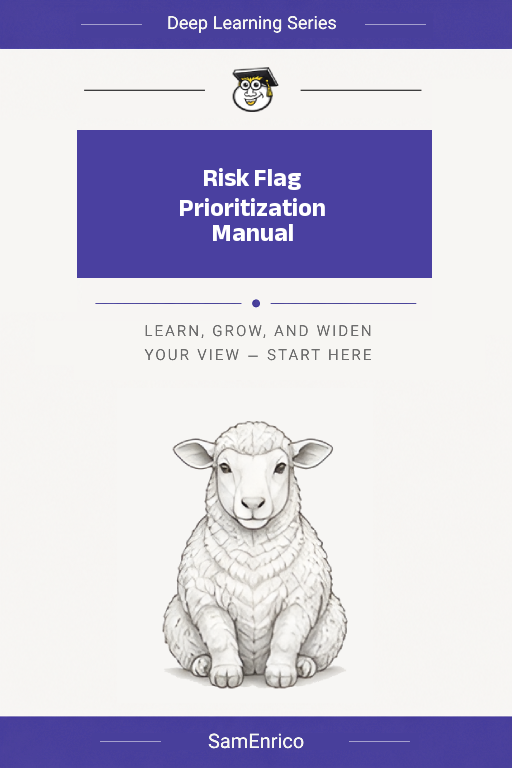
Non-FictionAI OperatorRisk PrioritizationCompliance
Risk Flag Prioritization Manual eBook
Score abstraction outputs for financial, complianc
by Schell Karyn
Score abstraction outputs for financial, compliance, and operational risk. Tier contracts for review based on AI-assigned severity levels.
Formats
Free sample
Chapter 1: The Paralysis of Precision--–- The email arrived at 9:47 AM on a Tuesday. Attached was a spreadsheet with 10,447 rows—one for every active contract in the organization. Each row contained an AI-generated risk score, precise to two decimal places. Scores ranged from 3.27 to 98.64. The instructions were simple: "Review all contracts scoring above 70.00.
Flag any issues by Friday."The legal team of twelve people stared at the spreadsheet for twenty minutes without speaking. Then came the questions. "What's the difference between a 71.3 and a 71.8?" "Is 69.9 substantially safer than 70.1?" "Do we review every contract above 70, or prioritize the top 100?" "What about the contract scoring 68.4 that has a $10 million exposure?"By Wednesday, no reviews had been completed. By Thursday, the team had produced a six-page memo debating whether the threshold should be 70, 72, or 65. By Friday, the general counsel overrode the entire process and reverted to the old manual method.
The AI tool, which cost $400,000 to implement, was never used again.This is not an outlier. It is the rule.Across financial services, healthcare, technology, and manufacturing, organizations are spending billions on AI risk scoring systems only to discover that precision without abstraction produces paralysis. The numbers are too exact to ignore but too ambiguous to act upon. Teams freeze. Decisions stall.
Risk materializes not because the AI failed to see it, but because human beings could not agree on what the AI was telling them.This book exists to solve that single problem: how to convert the mathematical output of artificial intelligence into actionable, tiered priorities that drive decisions rather than debates. It is called the Risk Flag Prioritization Manual, and it is built on one foundational insight—that abstraction is not a loss of information but a gain in action.The Spreadsheet That Broke the Bank Let us examine a real case, though the name has been anonymized at the organization's request. A regional bank with approximately $8 billion in assets deployed a sophisticated NLP model to score its vendor contracts. The model analyzed 147 features per contract—indemnification clauses, termination provisions, data privacy commitments, liability caps, insurance requirements, and force majeure terms. It produced a risk score from 0 to 100, where higher scores indicated greater risk.The bank's risk committee, after three meetings, decided that any contract scoring above 75 would require legal review.
Contracts scoring 60 to 75 would require manager review. Contracts below 60 would auto-approve.The first batch contained 843 contracts. Forty-one scored above 75. Two hundred and thirty scored between 60 and 75. The rest were below 60.The problem emerged immediately.
A contract with a major software vendor scored 74.9—just below the legal review threshold. The vendor had inserted a clause requiring the bank to indemnify them for "any third-party claims arising from the use of the software," with no cap on liability. A second contract, with a different vendor, scored 75.1—just above the threshold. Its risk was primarily operational: the vendor had a history of missed SLAs, but the financial exposure was capped at three months of fees.The risk committee spent two weeks debating these two contracts. Was a 74.9 truly safer than a 75.1?
Should the threshold be absolute, or should there be a "gray zone" requiring manual review? Should the score weight financial risk more heavily than operational risk? The committee produced eleven different proposed threshold models. No one signed off on any of them.Meanwhile, the software vendor with the uncapped indemnification clause grew impatient. They had a competing offer from another bank.
On day fifteen of the debate, they withdrew their proposal. The bank ended up signing with a more expensive, less capable vendor. The cost of the delay, measured in additional fees and lost functionality, exceeded $2 million.The second vendor—the one with the SLA history—proceeded through the manager review track. No one flagged the operational risk because the score was 75.1 and thus "above the legal review threshold." But the legal team, overloaded with other contracts scoring above 75, never looked at it closely. The manager assigned to review it assumed the score spoke for itself.
The contract was signed. Six months later, the vendor suffered a major outage that took the bank's customer portal offline for four days. The SLA penalty? Three months of fees waived—approximately 45,000.Thecostoftheoutageinlostcustomergoodwillandstaffovertime?Over45,000. The cost of the outage in lost customer goodwill and staff overtime?
Over 45,000.Thecostoftheoutageinlostcustomergoodwillandstaffovertime?Over800,000.The bank had the data. The AI had identified both risks. But the organization lacked a mechanism to translate scores into action. They had precision without abstraction. They had noise without signal.Defining the Terms That Will Save You Before we proceed further, we must establish a shared vocabulary.
The concepts introduced here will appear in every subsequent chapter of this book. Read this section twice.Score Abstraction is the process of mapping continuous numerical outputs—scores that can take any value within a range, such as 0.00 to 100.00—into discrete, finite categories that trigger specific actions. For example, mapping a score of 73.6 to "Yellow" and a score of 81.2 to "Red" is abstraction. The loss of decimal precision is intentional. It is the mechanism that converts analysis into decision.Raw scores are the direct output of AI models.
They are mathematically precise. A raw score of 73.6 is exactly 1.4 points higher than a raw score of 72.2. But that precision is often spurious—the AI model cannot actually distinguish 73.6 from 73.7 with any statistical confidence. Raw scores invite debate. They create the illusion of objective measurement while concealing the subjective choices embedded in the model's training.Abstracted tiers are the categories after abstraction: Red, Yellow, Green.
Or High, Medium, Low. Or Tier 1, Tier 2, Tier 3. The specific labels matter less than the principle: each tier maps to a distinct, pre-defined action. Red means legal review. Yellow means manager review.
Green means auto-approve. No debate. No case-by-case judgment. The decision is made when the thresholds are set, not when the score arrives.False positives occur when the AI flags a contract as higher risk than a human expert would judge it. For example, the AI says Red; the human says Green.
False positives waste reviewer time. They erode trust in the system. They are annoying but not dangerous.False negatives occur when the AI flags a contract as lower risk than a human expert would judge it. For example, the AI says Green; the human says Red. False negatives are the most dangerous error type in risk management because they lead to missed risks that later materialize.
A false negative on a compliance flag can mean a regulatory fine. A false negative on a financial flag can mean an uncapped liability. A false negative on an operational flag can mean a vendor outage that halts production.The three risk vectors are the categories of risk that this book addresses. They are distinct, require different AI models, and often conflict with one another.Financial risk concerns direct monetary loss. This includes liability clauses that expose the organization to uncapped damages, credit risk from counterparty default, currency or commodity price volatility, penalty clauses for late delivery, and any other provision that directly transfers money from the organization to another party.Compliance risk concerns regulatory penalties and legal exposure separate from contractual liability.
This includes data privacy obligations (GDPR, CCPA, HIPAA), anti-money laundering requirements, sanctions compliance, export controls, and any other regulatory regime…
This is the end of the free sample. Get the eBook to keep going. Buy now
About this book
Details
- Author
- Schell Karyn
- Publisher
- SamEnrico
- Language
- English
- Genre
- Non-Fiction, AI Operator, Risk Prioritization, Compliance
- Released
- 2026-05-28
- Pages (approx.)
- 149
- Available as
- eBook, Audiobook

Read better in the ZLOADR app
Your eBooks on your phone or tablet. Sign in with your SamEnrico account and start reading.
More by Schell Karyn
 Social Media Detox WorkbookSchell Karyn$11.99
 Imposter Syndrome In AcademiaSchell Karyn$11.99
 Branch Davidian EscapeeSchell Karyn$11.99
 Pregnancy Immunization GuideSchell Karyn$11.99
 Discord Server Status RankingSchell Karyn$11.99
 Healing From Enmeshed FamiliesSchell Karyn$11.99
 Thunberg Vegan AdvocacySchell Karyn$11.99
 CBD and Nightmare ReductionSchell Karyn$11.99
 Resilience Building GuideSchell Karyn$11.99
 The Sky’s the Limit: How the Wright Brothers’ First Flight Redefined HumanitySchell Karyn$11.99
 The Shattered Tides of Manilla Bay: Commodore Dewey's Lightning StrikeSchell Karyn$11.99
 The Philosopher’s Stone: Macleay and the Birth of Australian ScienceSchell Karyn$11.99
You may also like
 Hong Kong Handover 1997Dunn Johnnie$11.99
 Zumba For Postnatal Recovery CourseNeal Christian$11.99
 Zumba for BeginnersLadner Nikia$11.99
 YouTube Comment Mining GuideHumes Pandora$12.99
 Worry Box MeditationCarlin Rudy$11.99
 Workplace Stress MeditationNguyen Lynn$11.99
 Workplace Stress and Sleep RepairHawley Ivory$11.99
 Workplace Perfectionism CureDelaney Jeffry$11.99
 Workplace Injustice Anger GuideWallen Isabelle$11.99
 Work Addiction and Burnout LinkGreenwood Ester$11.99
 Women in Yoga and WellnessBeattie Galina$11.99
 Women in Stand Up ComedyChun Evangeline$11.99