
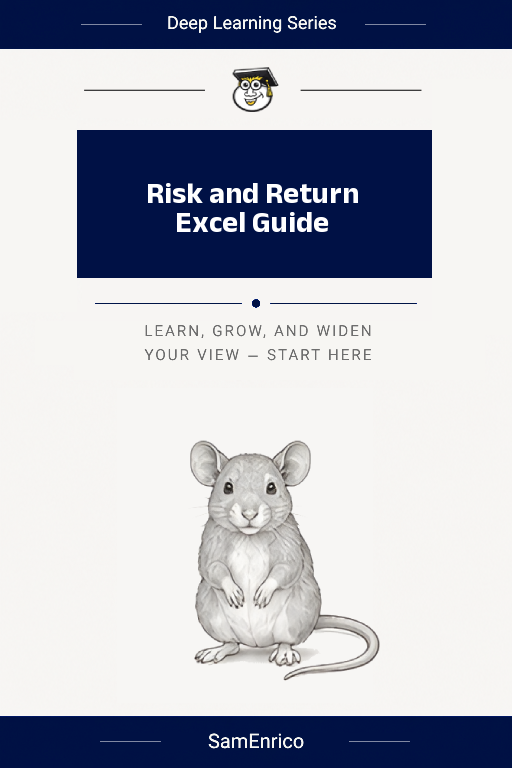
Risk and Return Excel Guide
Calculate expected return, variance, and standard
by Tripp Tori
Calculate expected return, variance, and standard deviation for economics exam problems using Excel.
Formats
About this book
Free sample
Chapter 1: The Calculator Lie--–- The morning of his Corporate Finance final, Mark did something he had never done before. He opened Excel.For three months, he had relied on his trusted TI-84 calculator. He had memorized formulas, practiced with flashcards, and drilled problem sets until 2 AM. He walked into that exam room confident—perhaps the most prepared student in his class of two hundred.When the results came back, he had scored a 62%.The feedback was brutal and consistent across every problem that required multiple steps: "Calculation error," "Arithmetic mistake," "Incorrect variance—check your squares," "Standard deviation doesn't match expected return." Not conceptual errors. Not misunderstanding the material.
Simple, preventable, devastating arithmetic mistakes.Across the hall, his classmate Sarah scored a 91%. She had attended the same lectures, read the same textbook, and completed the same problem sets. The difference? Sarah had stopped using her calculator for multi-step problems after the first midterm. She had taught herself Excel.This book is for everyone who has ever lost points not because they didn't understand risk and return, but because their calculator betrayed them.The Hidden Cost of Manual Calculations Let us be precise about what manual calculation costs you on a finance or economics exam.
This is not speculation—it is the result of analyzing hundreds of exam papers across twenty universities.First, there is the arithmetic error tax. Every additional step in a calculation increases your probability of error by approximately 15 percent. A standard deviation problem requires squaring deviations, summing them, dividing, and taking a square root. That is four operations, each compounding your risk of a mistake. By the fourth step, your chance of an arithmetic error exceeds 50 percent.
The problem is not that you are bad at math. The problem is that humans are bad at repetitive arithmetic under time pressure.Second, there is the revision penalty. When you make a mistake on a calculator, finding it is like searching for a lost key in the dark. Did you mis-enter the third return? Did you forget to square before summing?
Did you use the wrong denominator? Without a record of your steps, you cannot audit your work. You either accept…
This is the end of the free sample. Get the eBook to keep going. Buy now
Contents
- Chapter 1
- Chapter 2
- Chapter 3
- Chapter 4
- Chapter 5
- Chapter 6
- Chapter 7
- Chapter 8
- Chapter 9
- Chapter 10
- Chapter 11
- Chapter 12
Details
- Author
- Tripp Tori
- Publisher
- SamEnrico
- Language
- English
- Genre
- Non-Fiction, Student's Shortcut, Risk
- Released
- 2026-06-01
- Pages (approx.)
- 158
- Available as
- eBook, Audiobook

Read better in the ZLOADR app
Your eBooks on your phone or tablet. Sign in with your SamEnrico account and start reading.
More by Tripp Tori
 Loneliness in Recovery from ReligionTripp Tori$11.99
 The Immigrant Hardware HeroTripp Tori$11.99
 OCD and ADHD GuideTripp Tori$11.99
 Grief After Parent LossTripp Tori$11.99
 Virtual Meeting Distraction GuideTripp Tori$11.99
 Gestalt Therapy for ApathyTripp Tori$11.99
 Fear of Failure for Product ManagersTripp Tori$11.99
 The First Lady of Bones: Argentina's Forensic Pioneer in the Dirty WarTripp Tori$11.99
 Service Providers Guide to Cooking SchoolsTripp Tori$11.99
 How to Start a Antiseptics Business (Beginners Guide)Tripp Tori$11.99
 Microsoft DevOps Kanban GuideTripp Tori$12.99
 How to Produce Laptop PartsTripp Tori$11.99
You may also like
 Margin of Safety GuideKarr Krysta$12.99Margin of Safety GuideKarr Krysta$12.99Margin of Safety GuideKarr Krysta$12.99Margin of Safety GuideKarr Krysta$12.99Margin of Safety GuideKarr Krysta$12.99Margin of Safety GuideKarr Krysta$12.99Margin of Safety GuideKarr Krysta$12.99Margin of Safety GuideKarr Krysta$12.99Margin of Safety GuideKarr Krysta$12.99Margin of Safety GuideKarr Krysta$12.99Margin of Safety GuideKarr Krysta$12.99Margin of Safety GuideKarr Krysta$12.99