
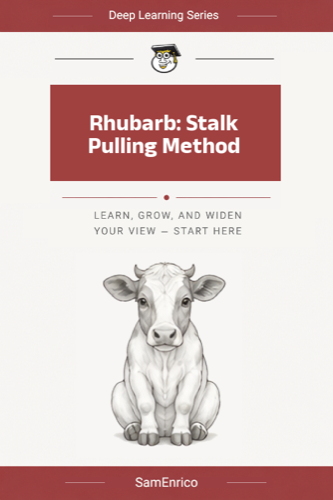
Rhubarb: Stalk Pulling Method
This harvesting publication, published by SamEnric
by Wylie Tonja
This harvesting publication, published by SamEnrico, covers Rhubarb: Stalk Pulling Method
Formats
About this book
Free sample
Chapter 1: The Knife Lie--–- I killed my first rhubarb plant with kindness.It was a gift from my grandmother—a division from a corm she had tended for over forty years. She dug it up on a drizzly April morning, wrapped the knobby roots in damp newspaper, and handed it to me like a sleeping infant. "This plant has fed our family for three generations," she said, brushing soil from her hands. "Don't you dare kill it."I killed it in fourteen months.I followed every instruction from the best-selling gardening books stacked on my shelf. I waited until the stalks reached a respectable twelve inches.
I took a sharp knife, gripped the stalk near its base, and sliced cleanly at a forty-five-degree angle. I was meticulous. I was precise. I was, by every written standard, doing everything right.By July of the second year, the new stalks emerged thin and pale. By August, the once-majestic leaves drooped like tired shoulders.
By the following spring, when I gently tugged at the center of the plant, the entire corm came up in my hand—a brown, mushy, foul-smelling lump that had once been a living inheritance.I blamed myself. I blamed the soil. I blamed an unusually wet winter. It never once occurred to me to blame the knife.That mistake cost me more than a plant. It cost me a living piece of my family's history.
And it cost me years of frustrated trial and error before I stumbled upon the single, simple, almost laughably obvious truth that the gardening industry has been hiding—perhaps unintentionally, but hiding nonetheless.The knife is the problem.Not because knives are inherently evil tools. Not because you should never use a blade anywhere near your garden. But because cutting a rhubarb stalk is physiologically opposite to everything the plant evolved to expect. When you cut, you trigger a cascade of stress responses that shorten the plant's life, invite disease, and reduce your harvest. When you pull, you work with the plant's natural design, triggering regeneration and abundance.This chapter will dismantle the cutting myth, explain the…
This is the end of the free sample. Get the eBook to keep going. Buy now
Contents
- Chapter 1
- Chapter 2
- Chapter 3
- Chapter 4
- Chapter 5
- Chapter 6
- Chapter 7
- Chapter 8
- Chapter 9
- Chapter 10
- Chapter 11
- Chapter 12
Details
- Author
- Wylie Tonja
- Publisher
- SamEnrico
- Language
- English
- Genre
- Non-Fiction, Informative, Educational
- Released
- 2026-06-02
- Pages (approx.)
- 144
- Available as
- eBook, Audiobook

Read better in the ZLOADR app
Your eBooks on your phone or tablet. Sign in with your SamEnrico account and start reading.
More by Wylie Tonja
 Delegation for AccountantsWylie Tonja$11.99
 The Annual OKR Planning GuideWylie Tonja$11.99
 Growth Mindset Carol Dweck GuideWylie Tonja$11.99
 The Financial Shame WorkbookWylie Tonja$11.99
 Self Exclusion ProgramWylie Tonja$11.99
 Reverse Brainstorming MethodWylie Tonja$11.99
 Wage Garnishment Stress ReliefWylie Tonja$11.99
 Flow for Remote WorkersWylie Tonja$11.99
 Grail’s Last Guardian: The Forgotten Knight of the Round TableWylie Tonja$11.99
 Dancing Through the Storm: Edouard Borovansky and the Birth of Australian BalletWylie Tonja$11.99
 How to Produce Electronic Pest ControlWylie Tonja$11.99
 How to Produce a Pulsar 590Wylie Tonja$11.99