
Non-FictionInformativeEducational
Rf Testing eBook
A Coursebook on Rf Testing
by Oldham Alla
A Coursebook on Rf Testing
Formats
Free sample
Chapter 1: The First Measurement--– The first time you connect a device to a spectrum analyzer, nothing works the way you expect. The trace jumps, spurs appear from nowhere, and the signal you were sure would be a clean, beautiful spike looks like a drunken caterpillar. You check the cables. You check the connectors. You check your sanity.
Everything seems fine, but the measurement is wrong. This moment – the collision between theory and reality – is where RF testing begins. It is also where most textbooks end, having politely described perfect waveforms in ideal systems. This book starts here, in the mess, because that is where you will live as an RF test engineer.The Three Hats You Will Wear Let us be brutally honest about your future. If you become an RF test engineer – or if you are already one and picked up this book to fill in the gaps – you will not have one job.
You will have three distinct jobs, often switching between them multiple times in a single day. Understanding these three roles is the first step toward mastering them.The first role is characterization. This happens early in a product's life, when the design is fresh out of simulation and the first silicon or first hand-assembled board is sitting on your bench. Characterization means: find every limit. How much power can this amplifier deliver before it distorts?
What is the lowest input level at which the receiver can still decode a signal? How does performance change when you vary the supply voltage from 4.5V to 5.5V? How does it behave at -40°C? At +85°C? Characterization is exploratory, open-ended, and often frustrating because the device was never intended to be operated at the conditions you are about to subject it to.
You will blow things up. Accept this. Every characterization engineer has a graveyard of dead components. The goal is not to avoid destruction but to learn the precise boundary between functional and failed.The second role is verification. This happens later, when the design is supposedly finalized and you need to prove that it meets its published specifications.
Verification is less about exploration and more about confirmation. You take the datasheet – a document that marketing and design engineers may have written in parallel, sometimes with conflicting numbers – and you test every claim. Gain of 20 d B ± 1 d B? Verify it. Noise figure below 2.5 d B?
Verify it. Output power at 1 d B compression of at least +18 d Bm? Verify it. Verification is methodical, documented, and defensive. If a device fails verification, someone goes back to the design lab.
If it passes, it moves toward production. The pressure here is different from characterization: now there is a schedule, a budget, and a manager asking when the report will be ready.The third role is production testing. This is the industrial-scale version of verification, performed on thousands or millions of units. Production testing is not about deep understanding – it is about speed and cost. A production tester might have one second to decide if a device is good or bad.
In that second, it must apply power, measure a handful of critical parameters, compare them to limits, and sort the part into a bin. There is no time for warm-up, no time for averaging, no time for second-guessing. Production tests are ruthlessly optimized. Every millisecond of test time costs money because the tester could be testing another part. And the decisions made in production testing have real consequences: a bad device that escapes to a customer damages the brand; a good device that fails testing wastes money.Throughout this book, we will follow a single device through all three of these phases.
Our recurring example will be a 2.4 GHz Wi-Fi front-end module (FEM) – a chip containing a power amplifier (PA), a low-noise amplifier (LNA), and a transmit/receive switch. It is simple enough to understand but complex enough to be interesting. In Chapter 1, we are just meeting this device. By Chapter 13, you will have tested every part of it.The Economics of Test: Why You Matter More Than You Think Most engineers enter RF testing because they like equipment and measurements. They stay because they discover that testing sits at the economic heart of the hardware business.
Here is the simple truth that every executive understands: any device that fails after shipment costs ten to a hundred times more to fix than catching the failure in production. And any device that passes but should have failed costs the company in returns, support calls, and lost trust.This leads to a fundamental tension. Testing adds cost – equipment, floor space, engineering time, handler time, operator time. But not testing adds risk. The optimal test program finds the balance: enough testing to catch the vast majority of defects, but not so much that the product becomes unprofitable.
As a test engineer, you are constantly negotiating this line. When a yield problem appears – meaning many devices are failing – you might add tests to understand why. When yield improves, you might remove tests to save time. Every test you add costs money. Every test you remove risks quality.Consider the numbers.
A high-volume RF chip might sell for 2.00inquantitiesofonemillionunits.Thatis2.00 in quantities of one million units. That is 2.00inquantitiesofonemillionunits.Thatis2 million in revenue. If testing each unit takes two seconds on a tester that costs 200,000peryeartooperate(lease,maintenance,floorspace,power,cooling),andthehandlercanprocess5,000unitsperhour,thetestcostperunitisroughly200,000 per year to operate (lease, maintenance, floor space, power, cooling), and the handler can process 5,000 units per hour, the test cost per unit is roughly 200,000peryeartooperate(lease,maintenance,floorspace,power,cooling),andthehandlercanprocess5,000unitsperhour,thetestcostperunitisroughly0.04. That seems small. But if you can reduce test time to one second, you save $40,000 per year on that one tester – enough to hire another engineer.
Now multiply by ten testers. Now multiply by ten products. The numbers become real. This is why production test engineers obsess over milliseconds.The Vocabulary of Trust: Accuracy, Precision, Resolution, and Traceability Before you can trust any measurement, you must understand what the numbers actually mean. Four terms form the foundation of measurement science, and they are constantly misused even by experienced engineers.Accuracy answers the question: how close is your measurement to the true value?
If a signal generator is set to output exactly 0 d Bm (1 milliwatt), but a perfect power meter would read −0.2 d Bm, the generator has an accuracy error of −0.2 d B. Accuracy is about systematic error – bias that affects every measurement in the same direction. A scale that always reads 2 pounds heavy when you weigh yourself is inaccurate but precise.Precision answers a different question: how repeatable are your measurements? If you measure the same signal ten times and get −0.19, −0.21, −0.20, −0.19, −0.20 d Bm, you have high precision. The numbers are tightly clustered.
If you get −0.2, +0.3, −0.7, +1.2, −0.5, you have low precision. Precision is about random error – noise, vibration, temperature fluctuations, connector repeatability.The classic analogy is a target. High accuracy means the average of your shots is near the bullseye. High precision means your shots are tightly clustered. An accurate but imprecise shooter puts shots evenly scattered around the bullseye.
A precise but inaccurate shooter puts shots in a tight cluster away from the bullseye. An ideal measurement is both…
This is the end of the free sample. Get the eBook to keep going. Buy now
About this book
Details
- Author
- Oldham Alla
- Publisher
- SamEnrico
- Language
- English
- Genre
- Non-Fiction, Informative, Educational
- Released
- 2026-05-04
- Pages (approx.)
- 125
- Available as
- eBook, Audiobook

Read better in the ZLOADR app
Your eBooks on your phone or tablet. Sign in with your SamEnrico account and start reading.
More by Oldham Alla
 Uber Driver Airport Queue StrategyOldham Alla$11.99
 The Connector PersonalityOldham Alla$11.99
 Event Planning Priority GuideOldham Alla$11.99
 Clash of Clans Notification FixOldham Alla$11.99
 Nutritional Hair Loss GuideOldham Alla$11.99
 Project Management For StudentsOldham Alla$12.99
 Resilience Adaptability Skills GuideOldham Alla$12.99
 Understanding MeningococcemiaOldham Alla$17.99
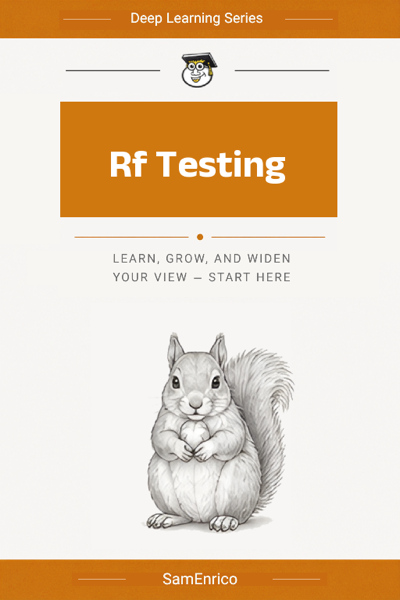 Rf TestingOldham Alla$11.99Rf TestingOldham Alla$11.99
 How to Become a Splitter OperatorOldham Alla$11.99
You may also like
 Hong Kong Handover 1997Dunn Johnnie$11.99
 Zumba For Postnatal Recovery CourseNeal Christian$11.99
 Zumba for BeginnersLadner Nikia$11.99
 YouTube Comment Mining GuideHumes Pandora$12.99
 Worry Box MeditationCarlin Rudy$11.99
 Workplace Stress MeditationNguyen Lynn$11.99
 Workplace Stress and Sleep RepairHawley Ivory$11.99
 Workplace Perfectionism CureDelaney Jeffry$11.99
 Workplace Injustice Anger GuideWallen Isabelle$11.99
 Work Addiction and Burnout LinkGreenwood Ester$11.99
 Women in Yoga and WellnessBeattie Galina$11.99
 Women in Stand Up ComedyChun Evangeline$11.99