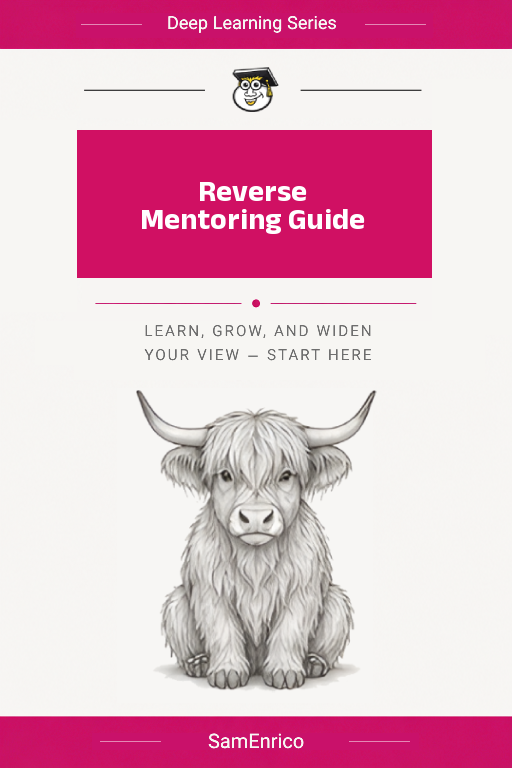
Reverse Mentoring Guide eBook
Offer reverse mentoring on social media, AI, or Ge
Offer reverse mentoring on social media, AI, or Gen Z perspectives in exchange for guidance.
Formats
Free sample
Chapter 1: The Schooling...--– I was presenting our five-year digital strategy to the board. Twenty slides. Three months of work. A hundred conversations with stakeholders across the organization. I had rehearsed the opening for an hour that morning, standing in front of my bathroom mirror in a hotel room near the airport, running through every objection I could anticipate.
I knew the numbers cold. I had memorized the competitor analysis. I had prepared responses for the usual suspects—the skeptical CFO, the nitpicking audit chair, the board member who always asked about cybersecurity no matter what the topic.One minute in, the youngest person in the room—a twenty-three-year-old analyst I had never met, sitting near the end of the long conference table, wearing glasses and a quietly skeptical expression—raised her hand and asked a question that stopped me cold."Have you actually used the product we're building?"I opened my mouth. Nothing came out. Because the answer was no.I had approved budgets for the product.
I had signed off on the roadmap. I had presented its projected returns to this very board in three previous meetings. But I had never opened the app. I had never created an account. I had never tried to perform the simple task that our entire business case depended upon.The room was silent for what felt like an eternity.
The young analyst did not gloat. She did not smirk. She simply waited, her hand now lowered, her eyes still fixed on mine with an expression that was not hostile but was definitely not sympathetic. In that silence, I understood something that I had resisted understanding for years: my title, my experience, my carefully cultivated reputation—none of it mattered in that moment. I was the person in the room who knew the least about the thing that mattered most.That moment changed everything.
Not because I learned to use the product—I did, eventually, and it was humbling to discover how clunky and confusing it was—but because I learned that the only person willing to tell me the truth was the person who had the least to lose by telling it.The Traditionalist's Trap For most of my career, I believed that wisdom flowed downward. Senior leaders possessed knowledge. Junior employees received it. That was the natural order of things. I had mentors when I was young—generous, accomplished people who took time to explain how the world worked, how decisions got made, where the hidden traps were.
I repaid them by becoming a mentor myself, dispensing the same kind of wisdom to the next generation. It felt virtuous. It felt right. It felt like the way organizations had always worked and should always work.But somewhere along the way, the world changed, and I did not notice.The change did not announce itself. There was no single day when the old model stopped working.
Instead, it eroded slowly, like a coastline reshaped by waves that seem gentle until you realize the beach has disappeared. The first sign was subtle: I noticed that my junior colleagues stopped asking me how to use technology. They stopped asking me about social media. They stopped asking me about culture, about trends, about the way young people thought and talked and lived. I assumed they had simply become more self-sufficient.
In truth, they had become experts in domains where I was not merely ignorant but willfully, arrogantly ignorant.The second sign was less subtle. I started missing things. Important things. Market shifts that seemed to come from nowhere but had been visible on Reddit for months. Talent retention problems that blindsided me but had been predicted by every junior employee I had ignored.
Communication disasters that went viral in hours but could have been prevented by a single five-minute conversation with anyone under thirty.The third sign was unmistakable: I became irrelevant in conversations where I used to lead. Not because I had lost my strategic mind—I still understood finance, operations, organizational dynamics—but because the strategic questions themselves had changed. The questions that mattered most were no longer about efficiency and margins and execution. They were about AI ethics and algorithmic bias and digital culture and authenticity and psychological safety and a dozen other domains where my experience was not an asset but a liability.The Meeting That Changed Everything Let me return to that board meeting, because it holds the key to everything that follows in this book.After the young analyst asked her question, I did something that still embarrasses me to admit. I pivoted.
I said something about how the product was in late-stage testing and that executive leadership was actively engaged with user feedback. It was not a lie, exactly, but it was not the truth. The truth was that I had not used the product because I had not thought I needed to. I had delegated that responsibility to people whose job descriptions included user testing. I was the strategist.
I was the decider. I was above such things.The board meeting ended. The product was approved—the numbers were too compelling to reject, even with my embarrassing admission. But as I packed my bag, the young analyst approached me. I braced myself for a lecture or, worse, a pitying expression.
Instead, she said something I have never forgotten."I'm not trying to embarrass you," she said quietly. "I'm trying to help you. The product is bad. Everyone knows it except the people who approve budgets. If you want to fix it before launch, you have about six weeks.
But you need someone to show you what we actually see."She paused. Then she added: "I could be that person. If you're willing to be embarrassed again."I said yes. Not because I was brave or humble or forward-thinking. I said yes because I was terrified.
I could see the disaster coming—a failed product launch, a wasted budget, a reputation in tatters—and she was holding out a lifeline that no one else had offered.For the next eight weeks, we met every Tuesday morning for an hour. She showed me the product. She showed me how real users actually navigated it—where they got stuck, what they misunderstood, which features they loved and which they hated. She showed me the competitor products that were eating our lunch, products I had dismissed as unserious because their interfaces looked "too playful." She showed me the Reddit threads where our potential customers were openly mocking our approach. She showed me the Tik Tok videos that had made one of our competitors a household name among people under thirty—a demographic we had written off as "not our target market."I learned more in those eight weeks than I had learned in the previous eight years of product strategy meetings.
Not because I was suddenly smarter or more diligent, but because I finally had a teacher who knew things I did not know and was willing to tell me the truth.The Three Forces That Flipped the Script That experience was not unique. Across every industry, in every type of organization, the old mentoring model is breaking down. Three forces…
This is the end of the free sample. Get the eBook to keep going. Buy now
About this book
Details
- Author
- Castaneda Latoria
- Publisher
- SamEnrico
- Language
- English
- Genre
- Non-Fiction, First 30 Days, Reverse
- Released
- 2026-05-30
- Pages (approx.)
- 146
- Available as
- eBook, Audiobook

Read better in the ZLOADR app
Your eBooks on your phone or tablet. Sign in with your SamEnrico account and start reading.
More by Castaneda Latoria
 Parent Guide to Teen DrugsCastaneda Latoria$11.99
 Memory Palace ChecklistCastaneda Latoria$11.99
 The Loci AcceleratorCastaneda Latoria$11.99
 First Responder NightmaresCastaneda Latoria$11.99
 Depression EQ Coping HandbookCastaneda Latoria$11.99
 Zion Narrows Slot CanyonsCastaneda Latoria$11.99
 Postpartum Stress Couples GuideCastaneda Latoria$11.99
 The Architecture Studio StressCastaneda Latoria$11.99
 Loving Kindness For FearCastaneda Latoria$11.99
 The System: How Larry Nassar Abused Gymnastics' GreatestCastaneda Latoria$11.99
 The Phoenix Conspiracy: How a 19th-Century Fire Forensic Breakthrough Changed the WorldCastaneda Latoria$11.99
 The Lost Tapes of the Apollo 11 MoonwalkCastaneda Latoria$11.99