
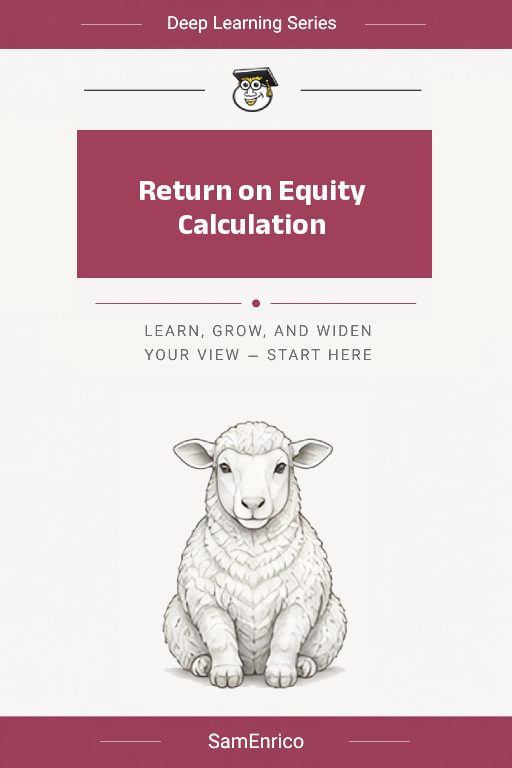
Return on Equity Calculation eBook
Divide net income by shareholders equity to measur
Divide net income by shareholders equity to measure profitability from owner investment, comparing ROE across competitors.
Formats
Free sample
Chapter 1: The Two Numbers--The moment you realize that Return on Equity can be both a beacon and a mirage—often at the same time—is the moment you stop being a casual investor and start thinking like a proprietor. This chapter builds the foundation upon which everything else in this book rests. Without mastering the raw ingredients of ROE, the sophisticated Du Pont deconstructions, forecasting models, and competitor comparisons that follow will be built on sand.Let us begin with a simple truth that most finance books obscure: Return on Equity is not a mysterious formula handed down from Wall Street oracles. It is two numbers divided by each other. Net income divided by shareholders' equity.
That is it. The entire multi-billion dollar industry of equity research, the thousands of pages of annual reports, the shouting heads on financial television—all of it, at its core, is an argument about what those two numbers actually mean and how they should be adjusted.But here is where the trouble starts. Net income can be manufactured. Shareholders' equity can be manipulated. And when you divide one distorted number by another, you get something that looks like insight but is actually illusion.
This chapter will teach you to see through the illusions.The Numerator: Net Income Net income appears on the bottom line of the income statement. It is called the "bottom line" for a reason—it is the final result after every expense, every tax, every extraordinary charge, and every one-time gain has been processed through the accounting machinery. But that machinery has levers, and management teams pull those levers constantly.Consider two identical businesses. Both generate 10millioninoperatingprofit.Bothpay10 million in operating profit. Both pay 10millioninoperatingprofit.Bothpay2 million in taxes.
Both report 8millioninnetincome.Exceptoneofthemsoldawarehousethisyearfora8 million in net income. Except one of them sold a warehouse this year for a 8millioninnetincome.Exceptoneofthemsoldawarehousethisyearfora5 million gain, while the other took a $3 million restructuring charge for closing a factory. Their income statements look radically different. Their ROE calculations will diverge. But their underlying business performance is identical.This is the first and most important lesson of this chapter: You must distinguish between operating earnings and one-time events.Operating Income vs.
Net Income Operating income—often labeled "Income from Operations" or "EBIT" (Earnings Before Interest and Taxes)—represents the profit generated from a company's core business activities. Selling products, delivering services, manufacturing goods. This is the number that matters for assessing whether a company has a sustainable competitive advantage.Net income includes operating income but then adds or subtracts a parade of other items: interest expense (if the company carries debt), interest income (if it holds cash), taxes, and—most dangerously—"non-recurring" items.The phrase "non-recurring" appears on income statements with remarkable frequency for something that supposedly does not recur. A company might take a "restructuring charge" every two or three years, yet each time it is labeled non-recurring. A company might sell a division every few years, booking a gain, yet each sale is treated as a one-time event.
The accounting rule is simple: if something happens more than once every five years, it is recurring. But many companies stretch this definition.The Five Most Common Distortions to Net Income Let us walk through the most frequent manipulations you will encounter when calculating adjusted ROE.1. Restructuring Charges. When a company closes a plant, lays off workers, or consolidates operations, it takes a restructuring charge. These charges are real expenses—but they are also discretionary in timing.
A management team facing a bad quarter might "take the bath," loading as many charges as possible into one period to create a clean slate for future quarters. The result: net income is artificially depressed in the charge year and artificially elevated in subsequent years. For ROE purposes, you should add back restructuring charges when they are truly non-recurring, but only if you can confirm that similar charges do not appear every few years.2. Asset Sales. Selling a building, a subsidiary, or a patent portfolio generates a gain or loss.
That gain is real cash, but it is not operating income. A company can have a terrible year in its core business but report healthy net income because it sold the corporate headquarters. For ROE, you must strip out gains and losses from asset sales. Compare net income before and after these sales. If the after number is significantly lower, the company's operating ROE is much worse than reported.3.
Legal Settlements and Litigation Charges. A one-time lawsuit judgment or settlement is not operating income. But be careful: some industries (pharmaceuticals, tobacco, financial services) face litigation so regularly that it becomes a recurring expense. In those cases, you should not adjust it out.4. Impairment Charges.
When the value of an asset (a brand, a factory, an acquisition) falls below its book value, accounting rules require an impairment charge. These charges are non-cash and often reflect poor past decisions rather than current operations. Many analysts add them back. However, repeated impairment charges signal that management consistently overpays for acquisitions—a warning sign, not something to ignore.5. Tax Adjustments.
A company might receive a one-time tax benefit from settling a dispute with the IRS or from changes in tax law. These benefits inflate net income for a single year. Strip them out. Use a normalized tax rate—typically the statutory corporate rate for the company's jurisdiction, or a 3-5 year average effective tax rate.A Practical Rule for Adjusting Net Income Here is the rule of thumb that professional analysts use: Normalized Net Income = Net Income as Reported − One-Time Gains + One-Time Charges (that are truly non-recurring).But with a crucial qualification: if a "one-time" charge appears more than once in five years, it is not one-time. Treat it as operating expense.Let us work through an example.
Company XYZ reports net income of 100million.Thefootnotesreveal:a100 million. The footnotes reveal: a 100million.Thefootnotesreveal:a20 million gain from selling a subsidiary, a 15millionrestructuringcharge,anda15 million restructuring charge, and a 15millionrestructuringcharge,anda5 million impairment of an old factory. The subsidiary sale is a one-time gain, so subtract it. The restructuring charge appears for the third time in four years—so treat it as operating. The impairment is the first in a decade, so add it back.
Adjusted net income = 100M−100M − 100M−20M + 5M=5M = 5M=85 million. The reported ROE would have been too high by 15% relative to operating reality.The Denominator: Shareholders' Equity If net income is the numerator, shareholders' equity is the denominator. And just as net income can be distorted, equity can be manipulated. Understanding equity requires understanding what it represents and, crucially, what it does not represent.Shareholders' equity—also called book value or net worth—is the residual claim on assets after liabilities are paid. The accounting equation is simple: Assets = Liabilities + Shareholders' Equity.
Rearranged: Shareholders' Equity = Assets − Liabilities.If a company has 100millioninassetsand100 million in assets and 100millioninassetsand60 million in liabilities, shareholders' equity is 40million.That40 million. That 40million.That40 million represents the cumulative net investment of shareholders over the company's entire history: every dollar of paid-in capital plus every dollar of retained earnings (profits kept in the business rather than paid as dividends), minus any share buybacks.But here is…
This is the end of the free sample. Get the eBook to keep going. Buy now
About this book
Details
- Author
- Harden Ayesha
- Publisher
- SamEnrico
- Language
- English
- Genre
- Non-Fiction, Student's Shortcut
- Released
- 2026-06-01
- Pages (approx.)
- 147
- Available as
- eBook, Audiobook

Read better in the ZLOADR app
Your eBooks on your phone or tablet. Sign in with your SamEnrico account and start reading.
More by Harden Ayesha
 Veterans Sleep MeditationHarden Ayesha$11.99
 Video Game Voice Over LifeHarden Ayesha$11.99
 The Growth Mindset for DepressionHarden Ayesha$11.99
 Stress and Dental BruxismHarden Ayesha$11.99
 Peyronie Disease ED GuideHarden Ayesha$11.99
 Hypopressives Low PressureHarden Ayesha$11.99
 Job Loss AffirmationsHarden Ayesha$11.99
 Daily Creative Habit BuilderHarden Ayesha$11.99
 The Colossal Calculators of the Olmec: Decoding the Jades and PyramidsHarden Ayesha$11.99
 The Enigma of the Black Death: A Plague of ShadowsHarden Ayesha$11.99
 How to Produce Corsage and Boutonnière PinsHarden Ayesha$11.99
 How to Produce Painting ConsumablesHarden Ayesha$11.99
You may also like
 Hong Kong Handover 1997Dunn Johnnie$11.99
 Zumba For Postnatal Recovery CourseNeal Christian$11.99
 Zumba for BeginnersLadner Nikia$11.99
 YouTube Comment Mining GuideHumes Pandora$12.99
 Worry Box MeditationCarlin Rudy$11.99
 Workplace Stress MeditationNguyen Lynn$11.99
 Workplace Stress and Sleep RepairHawley Ivory$11.99
 Workplace Perfectionism CureDelaney Jeffry$11.99
 Workplace Injustice Anger GuideWallen Isabelle$11.99
 Work Addiction and Burnout LinkGreenwood Ester$11.99
 Women in Yoga and WellnessBeattie Galina$11.99
 Women in Stand Up ComedyChun Evangeline$11.99