
Non-FictionSelf-HelpRetirement
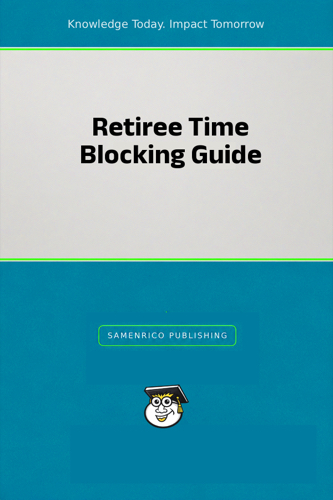
Retiree Time Blocking Guide eBook
Structures volunteer, hobby, and social activities
Structures volunteer, hobby, and social activities.
Formats
Free sample
Chapter 1: The Long Weekend Trap--–- Margaret cried on her third Tuesday of retirement. Not a gentle tear, but the heaving, embarrassing kind that arrived without warning as she stood in her pajamas at 11:47 AM, holding a cold cup of coffee, staring at the same spot on the living room wall she had stared at for the past four hours. The dishwasher had finished its cycle at 9:15 AM. The mail wouldn't arrive until 1:30 PM. Her husband was still at work.
Her friends were still at work. And she had absolutely nothing—nothing—that needed to be done before 3:00 PM, when she had scheduled a phone call with her daughter that would last maybe twenty minutes.It was her eighteenth day of retirement. And she was already losing her mind.Margaret had done everything "right." She had saved diligently for thirty-seven years. She had attended the pre-retirement seminars with titles like "Charting Your Golden Years" and "Financial Freedom Awaits." She had a list of hobbies she planned to try—watercolors, birdwatching, learning Italian, maybe some light hiking. She had dreamed of lazy mornings with the newspaper and long, unhurried lunches.
She had looked forward to freedom.But no one had warned her that Tuesday morning at 11:47 AM would feel like a punishment.What Margaret was experiencing has a name, though you won't find it in any medical textbook. I call it the Long Weekend Trap, and it is the single most dangerous psychological hazard of modern retirement. The Long Weekend Trap is what happens when every day becomes Saturday—and Saturday, as it turns out, is not a sustainable emotional state.Think about your own experience with three-day weekends. You know the pattern: Friday night feels electric with possibility. Saturday morning is blissful and slow.
Saturday afternoon starts to feel… a little aimless. By Sunday, there's a vague restlessness. And Monday? By Monday, you're actually looking forward to returning to work, not because you love your job, but because you crave structure. Now imagine that Monday never comes.
Imagine that every single day is Sunday. No rhythm. No external reason to get out of bed. No container for your energy, your talents, or your identity.That is the Long Weekend Trap. And it is why so many retirees—high-achieving, capable, financially secure people—find themselves depressed within eighteen months of leaving the workforce.The Day the Container Disappears For most of your adult life, work provided an invisible but essential service: it gave your day a shape.
Whether you loved your job or tolerated it, the workweek imposed a structure that you didn't have to invent yourself. Monday morning meant something. Friday afternoon meant something else. Lunch happened around noon not because your body demanded it at that exact hour, but because the clock and the culture conspired to create a shared rhythm.That rhythm was a container. And containers, as any gardener or cook or parent will tell you, are not restrictions.
They are enablers. A flowerpot gives the plant boundaries within which roots can spread safely. A soup pot gives the broth a shape to fill. A crib keeps a sleeping infant from rolling into danger. Containers don't trap us; they free us to grow, to heat, to rest without vigilance.Retirement removes the container without warning.
One day you have meetings, deadlines, commutes, and coworkers. The next day you have… nothing scheduled. And the human brain, for all its remarkable capabilities, does not handle infinite possibility well.Psychologists call this decision fatigue—the phenomenon where the quality of our decisions degrades after we make many choices in a row. But decision fatigue in retirement is different from decision fatigue at work. At work, the decisions are bounded: which email to answer first, which task to prioritize, which meeting to attend.
In retirement, the decisions are unbounded: What should I do today? Should I do anything at all? Is it okay to watch television at 10 AM? Should I feel guilty about that? What's the point of getting dressed if no one will see me?
What's the point of anything?Without a container, every hour becomes a question. And answering questions all day, every day, is exhausting.Two Retirees, Two Trajectories Let me introduce you to two people. Their names have been changed, but their stories are real.Margaret (the woman crying in her pajamas) retired from her position as a regional manager for a healthcare company. She had supervised fourteen people, managed a budget of three million dollars, and resolved conflicts that would make most people's heads spin. She was good at her job—organized, decisive, compassionate without being sentimental.
She retired at sixty-two, as planned, with a gold watch and a tearful goodbye party.Within six months, Margaret had stopped setting an alarm. Within eight months, she had stopped getting dressed before noon on most days. Within a year, she had stopped returning phone calls from friends. The watercolor supplies remained unopened. The Italian language app sat untouched on her phone.
She watched approximately four hundred hours of home renovation television, despite having no interest in home renovation. When her husband came home from his (still ongoing) job, she had nothing to tell him about her day because nothing had happened.Margaret was not lazy. She was not depressed in a clinical sense, at least not yet. She was trapped in the Long Weekend, and she didn't have the vocabulary to name her problem, let alone the tools to solve it.Now meet James.James retired from his career as a high school history teacher at age sixty-five. He loved teaching—the classroom energy, the lightbulb moments, the rhythm of the academic calendar.
But he was tired of grading papers at midnight and managing parents who emailed him at 10 PM. He retired with no clear plan other than "spend more time with grandchildren and maybe read some Civil War biographies."Here's what James did differently, though. On his first Monday of retirement, he sat down with a piece of paper and drew a grid. Seven days across the top. Two rows for AM and PM.
Then he wrote down exactly four commitments for the week: Monday AM at the food bank sorting donations, Wednesday PM coffee with his former teaching colleague, Friday AM gym class at the senior center, and Sunday afternoon phone call with his daughter and grandchildren. That was it. Four blocks in a week of fourteen possible slots. The rest of his time was open.James didn't have a sophisticated system. He didn't know what "time blocking" was.
He just knew, from decades of teaching, that a blank schedule was a dangerous thing. So he gave his week a skeleton—just enough bones to hold the shape—and then let the rest fill in naturally.Three years later, Margaret was still watching home renovation shows. James had completed a Civil War podcast series, taken up birdwatching with a neighbor, and become the volunteer coordinator at the food bank. He wasn't happier because he was busier. He was happier because his week had a container.
The container wasn't rigid; it was just… present.The difference between Margaret and James is not personality. It is not willpower. It…
This is the end of the free sample. Get the eBook to keep going. Buy now
About this book
Details
- Author
- Cordero Dusty
- Publisher
- SamEnrico
- Language
- English
- Genre
- Non-Fiction, Self-Help, Retirement
- Released
- 2026-06-09
- Pages (approx.)
- 146
- Available as
- eBook, Audiobook

Read better in the ZLOADR app
Your eBooks on your phone or tablet. Sign in with your SamEnrico account and start reading.
More by Cordero Dusty
 Homicide Scene ReconstructionCordero Dusty$11.99
 Playlist Organization for HypnosisCordero Dusty$11.99
 The Startup Financial DashboardCordero Dusty$11.99
 Imposter Support Group GuideCordero Dusty$11.99
 Blind Advocate for Parking JusticeCordero Dusty$11.99Blind Advocate for Parking JusticeCordero Dusty$11.99
 Project Manager Time BlockingCordero Dusty$11.99
 Deep Work For EntrepreneursCordero Dusty$11.99
 Ash and Fury: The Untold Story of the 1980 Mount St. Helens CataclysmCordero Dusty$11.99
 How to Produce Drain CleanersCordero Dusty$11.99
 Grad School Research Proposal Template GuideCordero Dusty$12.99
 College Essay Revision ChecklistCordero Dusty$12.99
You may also like
 Hong Kong Handover 1997Dunn Johnnie$11.99
 Zumba For Postnatal Recovery CourseNeal Christian$11.99
 Zumba for BeginnersLadner Nikia$11.99
 YouTube Comment Mining GuideHumes Pandora$12.99
 Worry Box MeditationCarlin Rudy$11.99
 Workplace Stress MeditationNguyen Lynn$11.99
 Workplace Stress and Sleep RepairHawley Ivory$11.99
 Workplace Perfectionism CureDelaney Jeffry$11.99
 Workplace Injustice Anger GuideWallen Isabelle$11.99
 Work Addiction and Burnout LinkGreenwood Ester$11.99
 Women in Yoga and WellnessBeattie Galina$11.99
 Women in Stand Up ComedyChun Evangeline$11.99