
Non-FictionSelf-HelpConsumer Psychology
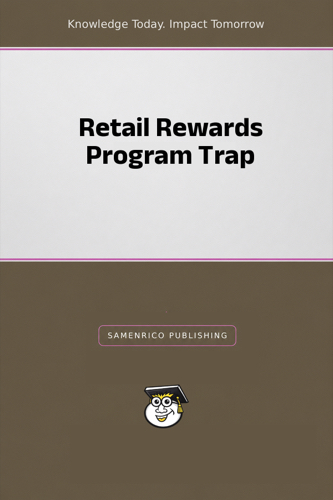
Retail Rewards Program Trap eBook
Breaks the cycle of chasing points and loyalty dis
Breaks the cycle of chasing points and loyalty discounts.
Formats
Free sample
Chapter 1: The $200 Billion Bribe--–- The first lie of every loyalty program is printed in eight-point font on the back of your card: “Earn points on every purchase.” The truth is the opposite. You do not earn points. You earn the right to be tracked. The points are a sugar coating on a poison pill. This chapter is not about how to maximize rewards.
It is about understanding why the rewards exist in the first place—and why that reason has nothing to do with thanking you for your business.The Economics of Your Attention Let us begin with a number that will appear throughout this book: five to twenty-five. According to Fred Reichheld’s seminal work The Loyalty Effect and decades of marketing data, acquiring a new customer costs between five and twenty-five times more than retaining an existing one. Think about what that means. A retailer can spend $50 in marketing, ads, and discounts to bring one new person through the door—or they can spend $2 to keep you coming back. The math is not subtle.
Loyalty programs exist because they are the cheapest retention mechanism ever invented. They are not rewards. They are economic insulation.Here is what retailers know that you do not: a customer enrolled in a loyalty program spends, on average, twenty-two percent more per transaction, visits thirty-five percent more frequently, and is fifty percent less likely to comparison shop at a competitor. These numbers come from anonymized internal retail data, leaked and aggregated over years. They are not estimates.
They are the bedrock of the loyalty industry. Your points balance is not a thank-you. It is a behavioral mortgage—a psychological investment that makes leaving feel expensive even when staying is irrational.The chapter’s title refers to the estimated annual value of the loyalty industry. But that $200 billion is not what retailers spend on rewards. It is what you overpay as a direct result of being in the system.
Every time you choose a store because you have points there, you are not being loyal. You are being predictable. And predictability has a price.The Bribe That Buys Your Silence Imagine two identical stores side by side. Store A lowers its prices by five percent across the board. Store B keeps prices the same but offers a loyalty card that gives you five percent back in points.
Which store wins your business? Most people choose Store B. Why? Because the points feel like a bonus, while the lower price feels invisible. This is the bribe dynamic at the heart of every loyalty program.The trap is subtle but devastating.
Store A’s five percent discount is immediate, universal, and honest. Store B’s five percent back is deferred, conditional, and complex. You do not get the five percent until you have spent enough to trigger a reward. You cannot use the five percent on anything—only on specific items or within specific windows. And critically, Store B now has your data.
They know what you buy, when you buy it, how much you are willing to pay, and how easily you can be upsold. Store A knows nothing about you. Store B knows everything.Which store is actually giving you a better deal? The answer is Store A, but your brain does not feel it that way. The points feel like earned currency.
The discount feels like charity. This inversion is the single most profitable psychological trick in modern retail.Willingness to Pay: The Algorithm’s Favorite Number There is a number that every retailer wants to know about you. It is not your birthday, your email address, or even your credit card number. It is your Willingness to Pay—the maximum price you will accept before walking away. WTP varies by product, by time of day, by your mood, by whether you have had coffee, by whether you are shopping alone or with children.
It is a moving target, and loyalty programs are the dartboard.Every time you scan your loyalty card, you are not just paying for your items. You are telling the retailer: “I am a repeat customer. I have demonstrated that I will come back. You can raise my prices slightly, and I probably will not notice. You can show me higher prices than new customers, and I will assume they are standard.”This is not paranoia.
It is documented practice. In 2018, a major airline was found to be showing higher fares to logged-in loyalty members than to anonymous users searching in incognito mode. The difference was as high as fifteen percent. When confronted, the airline’s defense was buried in the terms of service: “Prices may vary based on account activity.” Translation: we charge loyal customers more because we can.Dan Ariely’s Predictably Irrational demonstrates that humans are terrible at recognizing when we are being manipulated by personalized pricing. We assume that if a price is offered to us specifically, it must be fair.
In fact, the opposite is true. Personalized prices are almost always higher than standard prices—because the algorithm has learned exactly how much you are willing to overpay.The Data Harvest: What They Actually Know Let us be specific. When you join a loyalty program, you typically provide: your name, email address, postal code, and birthday. That is the application. What the program learns over the next twelve months is exponentially more detailed.Here is a partial inventory of the data points collected by a typical retail loyalty program over one year of regular shopping:Your address – Reveals home value, property tax bracket, neighborhood income averages, and proximity to competitors.Your purchase frequency – Tells the algorithm whether you are a habitual shopper (easy to retain) or a deal-seeker (needs constant bribes).Your basket size – The average dollar amount per trip.
This is the single strongest predictor of WTP.Your category preferences – Organic vs. conventional, brand-name vs. generic, impulse buys vs. planned purchases.Your life stage – Diapers and formula indicate young children. Pet food indicates pet ownership.
Vitamins and supplements indicate health concerns. Wine and spirits indicate income level and social habits.Your price sensitivity – Do you buy items on sale or at full price? Do you use coupons? Do you wait for markdowns? Each answer refines your WTP model.Your response to urgency – Do “limited time offers” trigger immediate purchases?
Do “only three left” notifications work on you? This data is sold to marketers who specialize in urgency manipulation.Your late-night purchases – Shopping after 10 PM correlates with stress, impulsivity, and lower price sensitivity. These customers are shown higher prices and fewer discounts.By the end of year one, the retailer knows more about your spending psychology than your spouse does. They know when you are vulnerable, when you are generous, and when you are likely to overspend. And they use that knowledge not to help you, but to maximize every transaction.The Illusion of Choice Here is a common objection: “I understand all of that, but I still get free stuff from my loyalty program.
A free coffee after ten purchases. A free flight after enough miles. A discount on my birthday. Isn’t that worth giving up some data?”Let us do the math…
This is the end of the free sample. Get the eBook to keep going. Buy now
About this book
Details
- Author
- Ziegler Sirena
- Publisher
- SamEnrico
- Language
- English
- Genre
- Non-Fiction, Self-Help, Consumer Psychology
- Released
- 2026-06-08
- Pages (approx.)
- 113
- Available as
- eBook, Audiobook

Read better in the ZLOADR app
Your eBooks on your phone or tablet. Sign in with your SamEnrico account and start reading.
More by Ziegler Sirena
 Business Succession With Purpose GuideZiegler Sirena$11.99
 The Vacuum Erection Device GuideZiegler Sirena$11.99
 Lecturer Communication for Less StressZiegler Sirena$11.99
 Asha Degree Case FilesZiegler Sirena$11.99
 The Cry of the Eagle: Greece's Bloody Birth (1821-1829)Ziegler Sirena$11.99
 Promotion Case Email TemplatesZiegler Sirena$12.99
 BOP Housing Product GuideZiegler Sirena$12.99
 Understanding Valproic ACID Antenatal InfectionZiegler Sirena$17.99
 How to Become a Outside Property AgentZiegler Sirena$11.99
 Investment Advisory Business LaunchZiegler Sirena$11.99
You may also like
 Hong Kong Handover 1997Dunn Johnnie$11.99
 Zumba For Postnatal Recovery CourseNeal Christian$11.99
 Zumba for BeginnersLadner Nikia$11.99
 YouTube Comment Mining GuideHumes Pandora$12.99
 Worry Box MeditationCarlin Rudy$11.99
 Workplace Stress MeditationNguyen Lynn$11.99
 Workplace Stress and Sleep RepairHawley Ivory$11.99
 Workplace Perfectionism CureDelaney Jeffry$11.99
 Workplace Injustice Anger GuideWallen Isabelle$11.99
 Work Addiction and Burnout LinkGreenwood Ester$11.99
 Women in Yoga and WellnessBeattie Galina$11.99
 Women in Stand Up ComedyChun Evangeline$11.99