
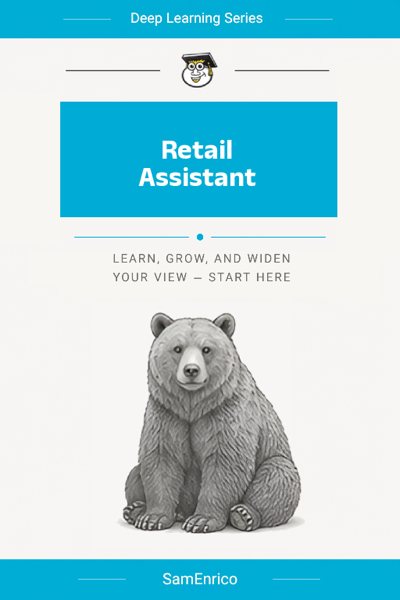
Non-FictionInformativeEducational
Retail Assistant eBook
A Coursebook on Retail Assistant
A Coursebook on Retail Assistant
Formats
Free sample
Chapter 1: The Stockroom MBA--–- The fluorescent lights buzzed overhead, casting a sickly yellow glow on stacks of cardboard boxes that reached toward the ceiling. It was 9:47 PM on a Tuesday, and I was knee-deep in a mountain of denim, each pair needing to be folded, tagged, and placed on the sales floor before midnight. My feet ached. My phone buzzed with a text from a college friend who was posting pictures from a study abroad program I couldn't afford. I was twenty-two years old, had a degree in communications, and was folding jeans for eleven dollars an hour.Two years later, I sat in a corner office on the thirty-first floor of a Manhattan skyscraper, reviewing a profit-and-loss statement for a region of forty-seven stores.
My title was Regional Vice President of Operations. My salary had increased by nearly 600 percent. And I owed none of it to that communications degree.I owed it to the stockroom.This book is not a collection of motivational quotes or theoretical management fluff. It is a field manual. It is the book I wish someone had handed me on that first night of folding denim—a book that would have told me, in no uncertain terms, that retail is not a fallback plan.
It is the single best leadership laboratory on the planet.Before we write a single line of this chapter, let me state a hard truth that most career guides are too polite to say: If you treat retail as something you are "doing until something better comes along," you will be folding those jeans for eleven dollars an hour for a very long time. But if you treat retail as a paid MBA in human psychology, operational logistics, financial literacy, and crisis management, you will leapfrog your peers who are accumulating student debt for degrees that teach theory, not survival.This chapter dismantles the lie that physical retail is dying. It builds, in its place, a framework for seeing your job as a retail assistant not as a transaction—not as a way to earn a paycheck while you wait for your "real life" to start—but as a rocket ship.Let us begin.The Great Lie: Why "Retail Is Dying" Is the Stupidest Thing Anyone Ever Told You Every year, without fail, a new article goes viral with a headline like "The Death of the Mall" or "Why Amazon Is Eating the World." These articles get shared by people who have never run a payroll, managed a supply chain, or watched a customer's face light up when a salesperson found the perfect pair of shoes in the back.Here is the data that those articles conveniently ignore.In 2024, global retail sales exceeded thirty trillion dollars. Physical stores still accounted for nearly 85 percent of all retail purchases in the United States. For every dollar spent on e-commerce, five dollars are still spent in a physical building with a door, a floor, and a human being behind a counter.But here is where the story gets interesting.
The retail landscape has bifurcated—split into two distinct types of stores. The first type is the "fulfillment center masquerading as a store." These are the big-box retailers where customers walk in, grab a specific item they already decided to buy online, and leave. There is no experience, no discovery, no human connection. These stores are dying, and they deserve to.The second type is the "experience destination." These stores understand that they are not competing with Amazon on price or speed. They cannot.
They compete on something Amazon will never master: human connection, tactile discovery, and immediate gratification. These stores are thriving. They are growing. And they are desperately searching for retail assistants who understand the difference.This book is for the second type of store. And it is for the assistant who wants to be the reason those stores succeed.The Three Numbers That Will Change Your Career Trajectory Before you can become indispensable to a retail organization, you must understand the three numbers that every district manager, regional vice president, and chief operating officer stares at every single morning.
These numbers are not complicated. But they are unforgiving.Number One: Conversion Rate Conversion rate is the percentage of people who walk into your store who actually buy something. That is it. If one hundred people walk through your front door and twenty of them buy something, your conversion rate is 20 percent.Here is why this number matters more than almost any other metric in retail. You can have the most beautiful displays in the world.
You can have the lowest prices in the city. But if your assistants are hiding in the backroom on their phones, if the checkout line is too long, if the fitting rooms are a mess, customers will leave without buying. Every person who walks out without purchasing is not just a lost sale. They are a lost opportunity to create a repeat customer.The best retail assistants understand that they are conversion drivers. Every interaction you have with a customer—every smile, every question, every moment of eye contact—is either increasing or decreasing the probability that they will buy something.Number Two: Average Transaction Value (ATV)Average transaction value is the average amount of money spent by each customer who buys something.
If you have ten transactions today totaling five hundred dollars, your ATV is fifty dollars.Here is what most retail assistants never learn: increasing ATV is often easier than increasing the number of customers. Why? Because you already have the customer at the register. They have already decided to trust you. They have already pulled out their wallet.
At that moment, they are psychologically primed to say "yes" to one more item.The best retail assistants master the art of what the industry calls "suggestive selling" but what I call "helpful addition." You are not trying to trick the customer into buying something they do not want. You are trying to solve a problem they did not know they had. "These jeans you are buying look great with our new chambray shirt. Would you like to see how they look together?" That is not manipulation. That is service.Number Three: Sales per Square Foot Sales per square foot is exactly what it sounds like: the amount of revenue generated by every square foot of selling space in your store.
Luxury retailers like Tiffany & Co. generate over four thousand dollars per square foot. Big-box retailers like Target generate around three hundred dollars per square foot.Why should a retail assistant care about this number? Because every time you leave a display looking messy, every time you fail to restock a popular item, every time you let a product sit in the backroom instead of bringing it to the floor, you are reducing the sales per square foot of your store. You are leaving money on the table.These three numbers—conversion rate, average transaction value, and sales per square foot—are the holy trinity of retail performance.
Throughout this book, we will return to them again and again. By the time you finish Chapter 12, you will be able to look at any retail…
This is the end of the free sample. Get the eBook to keep going. Buy now
About this book
Details
- Author
- Gabriel Palmer
- Publisher
- SamEnrico
- Language
- English
- Genre
- Non-Fiction, Informative, Educational
- Released
- 2026-06-02
- Pages (approx.)
- 152
- Available as
- eBook, Audiobook

Read better in the ZLOADR app
Your eBooks on your phone or tablet. Sign in with your SamEnrico account and start reading.
More by Gabriel Palmer
 Loving Kindness for Retirement Transition WorkbookGabriel Palmer$11.99
 Jewelry Insurance Agency ListGabriel Palmer$11.99
 Building Belonging From WithinGabriel Palmer$11.99
 Beginner Fitness Mindset ShiftGabriel Palmer$11.99
 The Notorious Antwerp Diamond HeistGabriel Palmer$11.99
 The Silk Code: How a Chinese Tech Mogul Cracked the Global MarketGabriel Palmer$11.99
 The Last Great Sahara Crossing: A Modern Odyssey of Courage and ScienceGabriel Palmer$11.99
 Understanding Dercum's Disease AKA Adiposis DolorosaGabriel Palmer$17.99
 Coursera Plus Strategy GuideGabriel Palmer$12.99
 Federal Student Loan RulesGabriel Palmer$12.99
 How to Become a Char-conveyor TenderGabriel Palmer$11.99
You may also like
 Hong Kong Handover 1997Dunn Johnnie$11.99
 Zumba For Postnatal Recovery CourseNeal Christian$11.99
 Zumba for BeginnersLadner Nikia$11.99
 YouTube Comment Mining GuideHumes Pandora$12.99
 Worry Box MeditationCarlin Rudy$11.99
 Workplace Stress MeditationNguyen Lynn$11.99
 Workplace Stress and Sleep RepairHawley Ivory$11.99
 Workplace Perfectionism CureDelaney Jeffry$11.99
 Workplace Injustice Anger GuideWallen Isabelle$11.99
 Work Addiction and Burnout LinkGreenwood Ester$11.99
 Women in Yoga and WellnessBeattie Galina$11.99
 Women in Stand Up ComedyChun Evangeline$11.99