
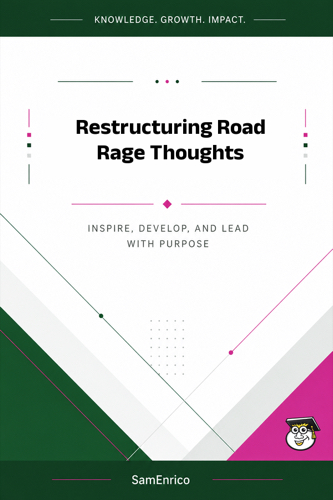
Restructuring Road Rage Thoughts eBook
Applies cognitive restructuring specifically to dr
Applies cognitive restructuring specifically to driving-related anger and aggression.
Formats
Free sample
Chapter 1: The Fear Mask--–- You are not angry. Not really. What you feel—the pounding heart, the clenched jaw, the white-knuckle grip on the steering wheel, the urge to scream or honk or worse—is not anger at all. It is fear wearing a Halloween mask. And once you see that mask for what it is, it loses its power over you.This is the single most important sentence you will read in this entire book: Road rage is a defensive fear response, not an aggressive character flaw.Everything you have been told about your temper behind the wheel is probably wrong.
Your partner has called you aggressive. Your friends have made jokes about your "road rage problem." Maybe you have even called yourself a hothead, an angry person, or someone with a short fuse. But these labels are not just unkind—they are inaccurate. They point to the wrong problem entirely. And when you aim your solutions at the wrong problem, nothing changes.Let me prove it to you in the next sixty seconds.Think about the last time you lost your temper while driving.
Maybe someone cut you off without signaling. Maybe a slow driver sat in the left lane, oblivious to the line of cars behind them. Maybe someone tailgated you so closely that you could see the sweat on their forehead in your rearview mirror. Now answer this question honestly: What did you feel in the split second before the anger arrived?If you are like ninety percent of drivers, you felt something that you did not call anger. You felt a jolt.
A startle. A flash of something hot and tight in your chest. Your breath caught. Your shoulders lifted toward your ears. Your field of vision narrowed.
For one terrible, electric moment, you felt—and I am using the precise word here—threatened.You felt threatened by a stranger in a two-ton metal box moving at seventy miles per hour. And that threat response, that ancient animal alarm system, is not anger. It is fear. The anger comes one beat later, as a coping mechanism. But the primary emotion, the root emotion, the driver of everything that follows?
Fear.This is not a metaphor. It is neuroscience. And it is the foundation of everything this book will teach you.The Great Mislabeling Every major anger management text, from the clinical gold standard Road Rage by Galovski, Malta, and Blanchard (American Psychological Association, 2006) to the popular classic When Anger Hurts by Matthew Mc Kay, agrees on one foundational principle: anger is almost never a primary emotion. It is a secondary emotion—a reaction to a deeper, more vulnerable feeling that arises first. Usually, that deeper feeling is fear, hurt, shame, or helplessness.But here is what those books do not emphasize enough, because they are general anger management texts rather than driving-specific interventions: Driving is uniquely suited to trigger fear.
More than almost any other modern activity, driving activates your brain's ancient threat-detection system as if you were being hunted by a predator.Consider what happens when you drive.You are sealed inside a metal and glass container that weighs between one and three tons. You are moving at speeds that would have been unimaginable to your great-grandparents—speeds at which a single mistake can kill you or someone else. You are surrounded by dozens, hundreds, or thousands of other humans in identical metal containers, each of them making split-second decisions that could affect your survival. You cannot control them. You cannot predict them with certainty.
You can only react to them. And you are doing all of this while managing a complex machine, reading signs, navigating, and often listening to music, talking on the phone, or arguing with a passenger.This is not a normal human environment. Your brain did not evolve for this.The 360-Degree Threat In 2025, social psychologist Kurt Gray published a landmark paper in Nature that changed how researchers think about road rage. Gray's "Theory of Dyadic Vulnerability" argues that humans are not primarily aggressive by nature—we are primarily defensive. We do not seek out conflict for its own sake.
Rather, we perceive vulnerability, feel threatened, and then respond with whatever force seems necessary to restore safety. Aggression, in Gray's framework, is almost always defensive aggression. It is fear that has learned to punch back.Gray's theory explains something that traditional anger models miss: road rage is not a failure of temper. It is a failure of threat assessment. Your brain misclassifies a slow driver as a predator.
It misclassifies a tailgater as an attacker. It misclassifies a lane-change without a signal as a deliberate act of hostility. And then it responds accordingly—with fear-driven defensive aggression.This is why you do not get road rage when you are walking down a crowded sidewalk, even though people cut you off there too. It is why you do not get road rage when you are sitting in a waiting room, even though people are rude there as well. The difference is vulnerability.
On the sidewalk, you are in control of your own body. You can stop, start, step aside, or step back. In the waiting room, the stakes are low. But behind the wheel, you are acutely, primally vulnerable. You are moving at lethal speeds in a machine that requires constant attention.
Your life depends on the competence and goodwill of strangers. And your brain knows it.The modern driving environment presents what I call the 360-Degree Threat. Threats can come from any direction—a car merging from the right, a driver braking suddenly ahead, a child running into the street from the left, a tailgater approaching from behind. Your brain must monitor all 360 degrees simultaneously while also controlling the vehicle. This is cognitively overwhelming.
And when the brain becomes overwhelmed, it falls back on its most ancient survival circuits: the amygdala, the hypothalamus, the sympathetic nervous system. The same circuits that fire when you see a snake in the grass or hear a growl in the dark.You are not angry. You are afraid. The anger is just fear's costume.Protective Anger vs. Punitive Rage Not all anger behind the wheel is problematic.
In fact, some anger is essential for survival. This book will never ask you to become a passive, doormat driver who never feels a flash of heat when danger arises. That would be unsafe. Instead, we need to distinguish between two very different experiences that both get called "anger."Protective Anger is brief, proportional, and survival-oriented. It is the flash of heat that makes you brake when someone cuts you off.
It is the surge of alertness that sharpens your focus when a driver drifts into your lane. It is the burst of energy that helps you swerve away from a collision. Protective anger lasts seconds. It serves a clear purpose. And then it dissolves.
You do not need to eliminate protective anger. You need to thank it for doing its job.Punitive Rage is what happens when protective anger does not dissolve. It is the anger that persists long after the threat has passed. It is the urge to punish, retaliate, or "teach someone a lesson."…
This is the end of the free sample. Get the eBook to keep going. Buy now
About this book
Details
- Author
- Blythe Majorie
- Publisher
- SamEnrico
- Language
- English
- Genre
- Non-Fiction, Self-Help / Driving Anger
- Released
- 2026-06-06
- Pages (approx.)
- 138
- Available as
- eBook, Audiobook

Read better in the ZLOADR app
Your eBooks on your phone or tablet. Sign in with your SamEnrico account and start reading.
More by Blythe Majorie
 Sober Spirituality Without ReligionBlythe Majorie$11.99
 MBSR for Nonprofit LeadersBlythe Majorie$11.99
 Affirmations For PostpartumBlythe Majorie$11.99
 The N Scott Momaday StoryBlythe Majorie$11.99
 Procrastination for StudentsBlythe Majorie$11.99
 Gut Brain Skin AxisBlythe Majorie$11.99
 Messenger Notification AnxietyBlythe Majorie$11.99
 The Silent Coup: How a 1970s CIA Operation Shaped Modern Pop CultureBlythe Majorie$11.99
 The Essential Guide to Tex-mexBlythe Majorie$11.99
 How to Start a Magnetic Storage Devices for Computers Business (Beginners Guide)Blythe Majorie$11.99
 Peer and Stakeholder EndorsementsBlythe Majorie$12.99
 B2B Sales for Security ServicesBlythe Majorie$12.99