
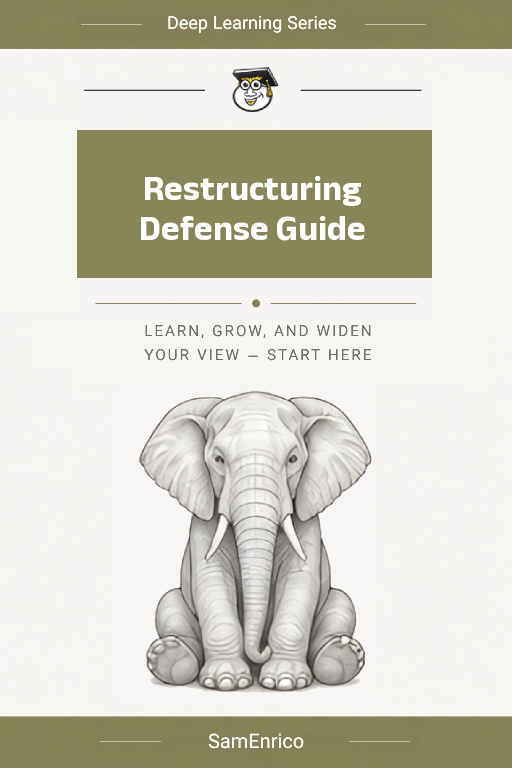
Non-FictionCrisis ManagementRestructuring
Restructuring Defense Guide eBook
Spin off divisions or restructure to make the comp
Spin off divisions or restructure to make the company less attractive to the acquirer.
Formats
Free sample
Chapter 1: The Vanishing Fortress...--The corporate fortress is crumbling. For decades, public company boards relied on a familiar arsenal of anti-takeover weapons—the poison pill, the staggered board, the supermajority voting requirement, the fair price provision—confident that these mechanisms would repel any unwanted suitor. That era is over. Not because these defenses have stopped working entirely, but because the nature of the attacker has changed so fundamentally that the old fortifications now resemble medieval walls facing precision-guided munitions.This book is not about those traditional defenses. They have been covered exhaustively elsewhere, and their limitations are now well understood by any competent M&A lawyer.
Instead, this book is about a different approach—one that moves beyond the reactive posture of blocking a takeover and embraces the proactive strategy of becoming genuinely unattractive to the specific acquirer threatening you. It is about the art of strategic divestiture, financial restructuring, and operational reorientation that makes your company, in a word, indigestible.But before we can discuss how to make your company unappealing, we must first understand who is threatening you and why. This chapter establishes the foundational threat assessment framework that underpins every tactic in this book. We will identify the three distinct species of modern hostile acquirers, analyze why traditional defenses have failed against them, and introduce the core analytical tool—Synergy Mapping—that will guide every restructuring decision you make.The New Predators The hostile bidder of popular imagination—the mustachioed corporate raider in a pinstripe suit, buying stock on margin and threatening to break up companies for quick profit—is a creature of the 1980s. Carl Icahn and T.
Boone Pickens played that role in their era, and they were fearsome adversaries. But today's threat landscape is more sophisticated, more varied, and more dangerous.Three distinct predator species now circle vulnerable public companies. Each has different motivations, different time horizons, and different vulnerabilities. Mistaking one for another is the first step toward a failed defense.Activist Hedge Funds The first species is the activist hedge fund. Firms like Elliott Management, Starboard Value, Third Point, and Value Act pool capital from institutional investors and acquire minority stakes in public companies—typically 5 to 10 percent of outstanding shares.
Their declared goal is to unlock "trapped value" by forcing strategic, operational, or financial changes. Their actual goal, in most cases, is to force a sale of the entire company at a premium.These activists are not owners in any meaningful sense. Their time horizon is measured in months, not years—typically 12 to 24 months from initial investment to exit. They do not build businesses; they extract value from them. Their primary weapons are the proxy fight (seeking to replace board members with their own nominees), the public campaign (using letters, presentations, and media interviews to pressure management), and litigation (challenging defensive measures in court).The activist's business model is straightforward.
They identify a company trading below what they believe is its intrinsic value. They acquire a stake. They publicly agitate for change—often a sale, sometimes a spin-off, occasionally a management shakeup. The resulting stock price appreciation allows them to exit at a profit. They do not need to be right about long-term value; they only need to be right about the market's reaction to their campaign.What makes activists particularly dangerous is their sophistication.
They study corporate governance documents meticulously. They know exactly which defenses are vulnerable to which tactics. They have standing legal teams and relationships with the largest proxy advisory firms (ISS and Glass Lewis). And they coordinate with each other, forming "wolf packs" that acquire collective stakes large enough to control shareholder votes without any single fund triggering ownership disclosure thresholds.Private Equity Consortiums The second species is the private equity consortium. Firms like KKR, Blackstone, Silver Lake, and Apollo Global Management do not acquire minority stakes; they acquire entire companies.
They pool capital from pension funds, endowments, and sovereign wealth funds to fund leveraged buyouts, typically using 50 to 70 percent debt financing.Private equity's advantage is speed and certainty. Unlike strategic acquirers, private equity firms do not need to conduct extensive operational due diligence. They are not seeking synergies with existing businesses; they are seeking financial returns through leverage, operational improvements, and eventual exit. A private equity consortium can move from initial indication of interest to signed merger agreement in 30 to 60 days—far faster than most strategic acquirers.Their vulnerabilities are financial. Private equity deals depend on accessible debt markets.
When interest rates rise or credit tightens, their ability to finance acquisitions diminishes. They also have limited tolerance for complexity; the more contingent liabilities, regulatory hurdles, and operational entanglements a target has, the less attractive it becomes.Strategic Corporate Acquirers The third species is the strategic corporate acquirer. These are operating companies—Microsoft, Amazon, Pfizer, Exxon, and thousands of smaller public and private firms—that seek to acquire other companies to achieve specific operational or market objectives.Strategic acquirers are fundamentally different from activists and private equity. They are not seeking a quick exit. Their time horizon is three to five years or longer.
They do not plan to break up and sell assets; they plan to integrate the target into their existing operations. They bring deep industry expertise and often have strong balance sheets that allow them to pay the highest premiums.The strategic acquirer's motivation is synergy—the belief that the combined company will be worth more than the sum of its parts. Those synergies can take three forms. Cost synergies arise from eliminating redundant functions: closing duplicate headquarters, consolidating manufacturing facilities, reducing headcount in finance, HR, and IT. Revenue synergies arise from cross-selling, market access, and pricing power: a pharmaceutical company acquires a biotech firm to fill a pipeline gap; a technology company acquires a software provider to offer a bundled solution.
Financial synergies arise from lower cost of capital, tax benefits, and increased debt capacity: a profitable acquirer can use its own cash flow to fund the target's growth at lower cost than the target could achieve independently.Because strategic acquirers can extract these synergies, they can justify paying premiums that activists and private equity cannot match. A target trading at 20persharemightbeworth20 per share might be worth 20persharemightbeworth25 to a private equity buyer (based on leveraged returns) but $35 to a strategic buyer (based on synergy value). This is why strategic acquisitions dominate the M&A landscape: when the synergies are real, the strategic buyer always wins.But those synergies also create the strategic acquirer's vulnerability. The synergies depend on specific assets. If those assets disappear—if the target spins off the valuable division, sells the key patent, or restructures in a way that destroys the synergy thesis—the strategic acquirer's willingness to pay a premium evaporates.
This is the central insight of this book: you cannot deter a strategic acquirer with poison pills and staggered boards. You can only deter a strategic acquirer by making the specific synergies they seek unattainable.The Failure of Traditional Defenses If you have spent any time in corporate boardrooms or M&A practices, you have heard the standard defensive playbook. Adopt a poison pill. Classify the board with staggered terms. Require supermajority shareholder approval for mergers.
Include fair price provisions in the corporate charter. These defenses were developed in the 1980s and 1990s, and for a…
This is the end of the free sample. Get the eBook to keep going. Buy now
About this book
Details
- Author
- Staton Valentine
- Publisher
- SamEnrico
- Language
- English
- Genre
- Non-Fiction, Crisis Management, Restructuring
- Released
- 2026-06-01
- Pages (approx.)
- 156
- Available as
- eBook, Audiobook

Read better in the ZLOADR app
Your eBooks on your phone or tablet. Sign in with your SamEnrico account and start reading.
More by Staton Valentine
 Listening In Change ManagementStaton Valentine$11.99
 The Short Fuse Couple WorkbookStaton Valentine$11.99
 IPT for Depression GuideStaton Valentine$11.99
 Impermanence Breath InsightStaton Valentine$11.99
 The Mormon Polygamy EscapeStaton Valentine$11.99
 Gratitude for Financial StrugglesStaton Valentine$11.99
 Phone Free StudyStaton Valentine$11.99
 Mia Hamm GoalStaton Valentine$11.99
 The Last ShipStaton Valentine$11.99
 Icebound: The Forgotten Arctic Expedition That Changed Science ForeverStaton Valentine$11.99
 The Deal That Made a Champion: Faith Kipyegon's Olympic JourneyStaton Valentine$11.99
 Neon Oracle: The Last Prophet of Times SquareStaton Valentine$11.99
You may also like
 Hong Kong Handover 1997Dunn Johnnie$11.99
 Zumba For Postnatal Recovery CourseNeal Christian$11.99
 Zumba for BeginnersLadner Nikia$11.99
 YouTube Comment Mining GuideHumes Pandora$12.99
 Worry Box MeditationCarlin Rudy$11.99
 Workplace Stress MeditationNguyen Lynn$11.99
 Workplace Stress and Sleep RepairHawley Ivory$11.99
 Workplace Perfectionism CureDelaney Jeffry$11.99
 Workplace Injustice Anger GuideWallen Isabelle$11.99
 Work Addiction and Burnout LinkGreenwood Ester$11.99
 Women in Yoga and WellnessBeattie Galina$11.99
 Women in Stand Up ComedyChun Evangeline$11.99