
Non-FictionSelf-HelpCareer Change
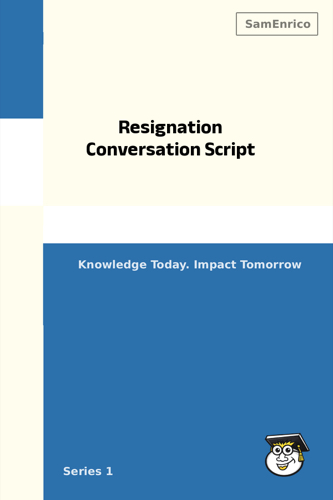
Resignation Conversation Script eBook
Quit your job professionally without burning bridg
by Soto Marvin
Quit your job professionally without burning bridges.
Formats
Free sample
Chapter 1: The Sunk Cost Cage--–- Kelly had worked at her marketing firm for eleven years. Eleven years of 8:00 AM meetings, three rounds of layoffs, two promotions that came with more work and only modest pay bumps, and one corner office that still smelled like the previous occupant’s cologne. She was good at her job—really good. Clients requested her by name. Junior associates asked to be assigned to her projects.
Her annual reviews were filled with phrases like “indispensable” and “exceeds expectations.”And yet, every Sunday evening for the past eighteen months, Kelly felt a knot in her stomach that no amount of herbal tea or meditation apps could dissolve. She had started fantasizing about quitting during her morning commute. She had saved enough money to cover six months of expenses. She had even updated her résumé and scrolled through job listings late at night when she couldn’t sleep.But she didn’t leave.When her best friend asked why, Kelly’s answer came automatically, almost rehearsed: “I’ve put too much into this place to just walk away. I built that department from the ground up.
If I leave now, those eleven years will have been a waste.”That answer felt logical. It felt responsible. It felt like the kind of thing a loyal, hardworking professional should say.It was also dead wrong.The Trap You Didn’t Know You Were In Kelly was caught in what behavioral economists call the sunk cost fallacy. The term comes from economics and decision theory, but its effects are painfully personal. A sunk cost is any investment—time, money, energy, emotion, identity—that you have already made and cannot recover.
The fallacy is allowing that irrecoverable investment to dictate your future decisions.Here is the simple, brutal truth that this entire book rests upon: What you have already invested in your job does not matter. Only what you will invest from this moment forward matters.The five years you spent climbing the corporate ladder? Gone. The late nights and weekends you sacrificed for that promotion? Irretrievable.
The identity you built around your job title? A story you told yourself—not a contract you signed with the universe.The sunk cost fallacy is the single most powerful psychological force keeping people in jobs they should leave. It explains why a lawyer with fifteen years at a firm stays even though she hates the work. It explains why a software engineer stays at a dying startup because he was employee number ten. It explains why you are still reading this chapter instead of drafting your resignation letter—because some part of you believes that leaving means admitting that everything before was a mistake.But leaving is not an admission of error.
Leaving is an acknowledgment of change. And change is not failure—it is the only evidence that you are still growing.The Behavioral Economics of Staying Too Long To understand why we stay, we have to understand how our brains misfire. Daniel Kahneman and Amos Tversky, the pioneers of behavioral economics, demonstrated that humans are not rational actors. We do not calculate expected value coldly and dispassionately. Instead, we are driven by loss aversion—the psychological principle that losses hurt approximately twice as much as gains feel good.When you consider leaving your job, your brain does not neutrally weigh “potential for a better role” against “potential for regret.” Instead, your brain screams: You will lose the status you have earned.
You will lose the relationships you have built. You will lose the identity you have constructed.Your brain treats these potential losses as if they are already real. And because losses hurt twice as much as gains satisfy, the math gets distorted. A 30% chance of a better job feels like a 30% chance of a gain. But a 30% chance of regretting your decision feels like a 60% chance of a loss.
The numbers are not equal. Your brain rigs the game.This is why you can look at a spreadsheet that clearly shows you would be financially better off in a new role, emotionally healthier in a new environment, and professionally more fulfilled—and still you hesitate. The spreadsheet uses logic. Your brain uses fear. And fear almost always wins unless you have a tool to override it.That tool is the subject of this chapter.
It is called expected value calculation, and once you learn it, you will never again be able to pretend that staying is the rational choice when the math says otherwise.The 80,000-Hour Reality Check Before we get to the math, let us establish the stakes. The average person spends approximately 80,000 hours at work over the course of a lifetime. That is not a typo. Eighty thousand hours.Let that number sit with you for a moment.Eighty thousand hours is equivalent to more than nine entire years of continuous, twenty-four-hour-a-day existence. It is more time than you will spend with your children before they leave for college.
It is more time than you will spend eating, exercising, and commuting combined.Now ask yourself: How many of those 80,000 hours have you already spent in a role that does not fit?If you are two years into a wrong-fit job, that is roughly 4,000 hours. Four thousand hours of your one and only life. If you are five years in, that is 10,000 hours. A decade of wrong-fit work approaches 20,000 hours—one quarter of your entire working life.The sunk cost fallacy tricks you into believing that leaving now would “waste” those hours. But the hours are already gone.
They are not sitting in a bank account waiting to be withdrawn. They are not credit toward some future reward. They are ashes. The only question that matters is whether you will add more hours to the ashes or whether you will walk away and start building something new.This is not abstract philosophy. This is the difference between retiring with a sense of quiet desperation and retiring with a sense of genuine fulfillment.
Every additional month you stay in a role that is wrong for you is a month you will never get back. Your career is not a practice round. You do not get a do-over.The Grit Trap: When Persistence Becomes Self-Destruction There is a dangerous cultural narrative that tells us quitting is weakness. We celebrate the marathon runner who collapses across the finish line. We tell stories of entrepreneurs who failed seven times before succeeding.
We worship grit.And grit is real. Strategic persistence—pushing through a short-term challenge with a clear finish line—is one of the most valuable traits a professional can possess. The problem is that our culture has elevated grit from a tactic to an identity. We have started believing that the mere act of enduring is virtuous, regardless of what we are enduring or why.This is the Grit Trap.Drawing from Seth Godin’s essential work The Dip, we can distinguish between two very different kinds of difficulty. The first is the dip: a temporary, predictable challenge that exists between starting something and mastering it.
Learning a new software system is a dip. Surviving your first quarter in a demanding sales role is a dip.…
This is the end of the free sample. Get the eBook to keep going. Buy now
About this book
Details
- Author
- Soto Marvin
- Publisher
- SamEnrico
- Language
- English
- Genre
- Non-Fiction, Self-Help, Career Change
- Released
- 2026-06-09
- Pages (approx.)
- 146
- Available as
- eBook, Audiobook

Read better in the ZLOADR app
Your eBooks on your phone or tablet. Sign in with your SamEnrico account and start reading.
More by Soto Marvin
 Failure as Feedback SystemSoto Marvin$11.99
 Shift Work Safety AlertnessSoto Marvin$11.99
 Bar Exam Prep GuideSoto Marvin$11.99
 The Father's Priest AbuseSoto Marvin$11.99
 Protein For Metabolic RateSoto Marvin$11.99
 TM Daily ScheduleSoto Marvin$11.99
 Naloxone Rescue GuideSoto Marvin$11.99
 The Lion of the Zees: Johan de Witt and the Rise of Dutch PowerSoto Marvin$11.99
 The Great Unraveling: How One Banker's Bet Brought Down a NationSoto Marvin$11.99
 How to Produce Electric Knife AccessoriesSoto Marvin$11.99
 How to Produce PrintheadsSoto Marvin$11.99
 The Essential Guide to MinimalismSoto Marvin$11.99
You may also like
 Hong Kong Handover 1997Dunn Johnnie$11.99
 Zumba For Postnatal Recovery CourseNeal Christian$11.99
 Zumba for BeginnersLadner Nikia$11.99
 YouTube Comment Mining GuideHumes Pandora$12.99
 Worry Box MeditationCarlin Rudy$11.99
 Workplace Stress MeditationNguyen Lynn$11.99
 Workplace Stress and Sleep RepairHawley Ivory$11.99
 Workplace Perfectionism CureDelaney Jeffry$11.99
 Workplace Injustice Anger GuideWallen Isabelle$11.99
 Work Addiction and Burnout LinkGreenwood Ester$11.99
 Women in Yoga and WellnessBeattie Galina$11.99
 Women in Stand Up ComedyChun Evangeline$11.99