
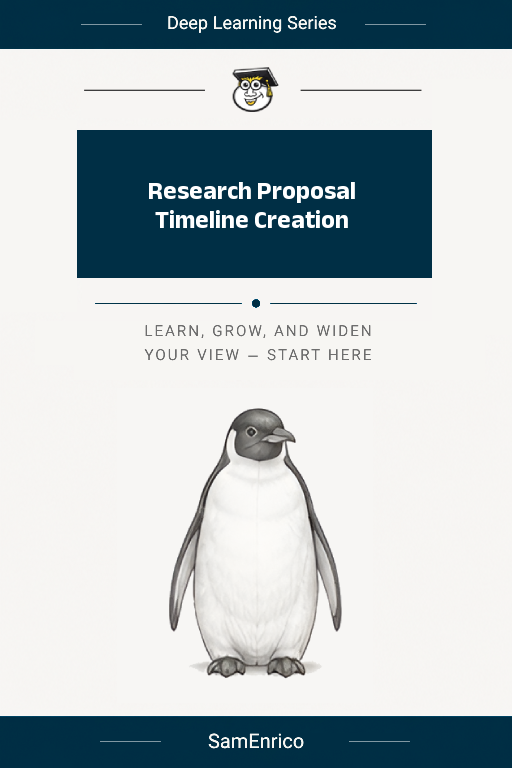
Research Proposal Timeline Creation Audiobook
Build realistic Gantt charts and milestones that d
Build realistic Gantt charts and milestones that demonstrate project feasibility to reviewers.
Formats
Free sample
Chapter 1: The Feasibility Trap--–- Every year, thousands of promising research proposals die not because the science is weak, not because the methodology is flawed, and not because the budget is unreasonable. They die because the timeline looks like it was written by someone who has never actually done research before. The work is brilliant, the team is qualified, the question is important—but the timeline is a work of fiction. And reviewers know it.Let that sink in for a moment. You can have a groundbreaking hypothesis, a rigorous experimental design, and a perfectly justified budget, but if your timeline triggers a reviewer's skepticism in the first thirty seconds of their fifteen-minute scan, your proposal is already in the "maybe not" pile.
Reviewers are overworked, underpaid (most are unpaid), and typically reading your proposal at 11 PM after a full day of teaching, grading, and their own research. They are not looking for reasons to fund you. They are looking for reasons to eliminate you. And nothing eliminates a proposal faster than a timeline that screams, "This person has no idea how long anything actually takes."This chapter is about understanding that silent killer. It is about getting inside the reviewer's head, understanding their cognitive limits, and learning why feasibility often trumps brilliance in the funding game.
By the end of this chapter, you will never look at a timeline the same way again. You will understand that your timeline is not a formality—it is perhaps the most persuasive document in your entire proposal.The Fifteen-Minute Review: A Reality Check Let me paint a picture for you. The National Science Foundation receives approximately 40,000 proposals per year. The National Institutes of Health receives over 50,000. Each proposal is assigned to a panel of reviewers who are expected to read, evaluate, and score anywhere from ten to twenty proposals in a single sitting.
Do the math. Even if a reviewer spends a full hour on each proposal—which they don't—that is ten to twenty hours of reading. In reality, most reviewers spend fifteen to twenty minutes on the initial read of a proposal. That is it.Fifteen minutes.In fifteen minutes, a reviewer needs to understand your research question, assess your methodology, evaluate your budget, judge your team's qualifications, and decide whether your project is feasible. That is an enormous cognitive load.
And the human brain, when overloaded, takes shortcuts. Those shortcuts are called heuristics, and in the world of grant reviewing…
This is the end of the free sample. Get the Audiobook to keep going. Buy now
About this book
Details
- Author
- Randolph Maurita
- Publisher
- SamEnrico
- Language
- English
- Genre
- research, Student's Shortcut
- Released
- 2026-05-30
- Pages (approx.)
- 153
- Available as
- eBook, Audiobook

Listen in the VoxFlicks app
Audiobooks and audio dramas wherever you go. Sign in with your SamEnrico account and press play.
More by Randolph Maurita
 The Nap Soundscape GuideRandolph Maurita$11.99
 Parent Loss and FriendshipsRandolph Maurita$11.99
 Zumba Aqua FitnessRandolph Maurita$11.99
 Lamotrigine For BipolarRandolph Maurita$11.99
 Pain Meditation ChecklistRandolph Maurita$11.99
 Bipolar Anxiety ManagementRandolph Maurita$11.99
 Alibaba Order Tracking GuideRandolph Maurita$11.99
 Child Loss And Physical HealthRandolph Maurita$11.99
 Assertiveness For The ElderlyRandolph Maurita$11.99
 The Golden Contract: The Untold Story of Middle Eastern Football's First Super AgentRandolph Maurita$11.99
 Shadow of Power: The Untold Story of Nelson Rockefeller's Rise and FallRandolph Maurita$11.99
 The Curse of the Forgotten Pharaoh’s ShadowRandolph Maurita$11.99
You may also like
 Scientific Research On TM GuideMartens Nathanial$11.99
 Research Proposal Methodology Section MasteryPauley Debroah$11.99
 Research Proposal Appendix CompilationRaines Tyisha$11.99
 Academic Researcher Distraction GuideFord Virgil$11.99
 TM Research and ScienceCovert Nicki$11.99
 Social Anxiety Research ReviewRoberge Cole$11.99
 Research Proposal Significance Section GuideBock Tory$12.99
 Research Proposal Reviewer PsychologyLugo Tawanda$11.99
 Research Proposal Research Questions DesignLara Robbi$11.99
 Research Proposal References and CitationsPatten Shanice$11.99
 Research Proposal Mixed Methods DesignCameron Omega$11.99
 Research Proposal Data Management PlanAnderson Roberto$12.99