
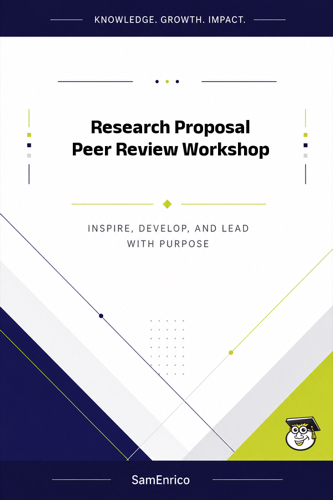
researchStudent's ShortcutPeer Feedback
Research Proposal Peer Review Workshop
Give and receive constructive feedback on draft pr
Give and receive constructive feedback on draft proposals.
Formats
About this book
Free sample
Chapter 1: The Politeness Trap--–- The email arrived on a Tuesday. "Great draft! A few small comments attached." The attachment contained thirty-seven tracked changes, twenty-three margin notes, and exactly zero actionable suggestions. "Consider strengthening the methods section." "Maybe add more recent citations." "This is interesting but needs work." The graduate student, let's call her Priya, spent four hours trying to decode what her peers actually meant. She changed three commas, added two citations at random, and submitted her proposal to the IRB.
Three months later, it was rejected for problems everyone had noticed but no one had named. The peer reviewers had been polite. Politeness, in this case, was a form of cruelty.This chapter opens with that scenario not because it is exceptional, but because it is painfully ordinary. In research proposal peer review workshops across every discipline and every institution, the same silent drama unfolds. Participants gather.
Drafts are distributed. Feedback is given. And almost nothing useful is said. The problem is not bad intentions. The problem is a deeply ingrained culture of performative politeness driven by three forces: fear of conflict, ignorance of how to critique, and a fundamental confusion between personal kindness and scholarly rigor.If you have ever left a peer review session feeling vaguely unsettled—unsure whether your proposal was actually good or if people were just being nice—this chapter is for you.
If you have ever written "This is interesting" on a draft because you could not figure out how to say "Your argument does not follow from your evidence"—this chapter is also for you. The goal is not to make you mean. The goal is to make you useful. And the first step is understanding why politeness fails, why it fails so consistently, and what to put in its place.The Quiet Catastrophe of Nice Feedback Let us begin with a definition. Performative politeness is feedback offered not to improve the work but to maintain social harmony.
It prioritizes the reviewer's comfort over the author's development. It says "Looks good!" when what it means is "I did not read past…
This is the end of the free sample. Get the eBook to keep going. Buy now
Contents
- Chapter 1
- Chapter 2
- Chapter 3
- Chapter 4
- Chapter 5
- Chapter 6
- Chapter 7
- Chapter 8
- Chapter 9
- Chapter 10
- Chapter 11
- Chapter 12
Details
- Author
- Greenfield Josef
- Publisher
- SamEnrico
- Language
- English
- Genre
- research, Student's Shortcut, Peer Feedback
- Released
- 2026-06-09
- Pages (approx.)
- 132
- Available as
- eBook, Audiobook

Read better in the ZLOADR app
Your eBooks on your phone or tablet. Sign in with your SamEnrico account and start reading.
More by Greenfield Josef
 Sector Interview PreparationGreenfield Josef$11.99
 Indian Family Reunification JourneyGreenfield Josef$11.99
 Rent Control AnalysisGreenfield Josef$11.99
 Self Esteem for Aging ArtistsGreenfield Josef$11.99
 Cannabis Use in Teens GuideGreenfield Josef$11.99
 Self Hypnosis for GolfGreenfield Josef$11.99
 Shenandoah Trail VanishedGreenfield Josef$11.99
 The Temptations: My Girl, Our MovementGreenfield Josef$11.99
 The Habsburgs and the High Seas: Austria-Hungary’s Forgotten Naval LegacyGreenfield Josef$11.99
 The Billionaire's Secret War: How One Man Outspent a NationGreenfield Josef$11.99
 Cybersecurity FundamentalsGreenfield Josef$11.99
 South Africa Business Credit MythsGreenfield Josef$12.99
You may also like
 Scientific Research On TM GuideMartens Nathanial$11.99
 Research Proposal Methodology Section MasteryPauley Debroah$11.99
 Research Proposal Appendix CompilationRaines Tyisha$11.99
 Academic Researcher Distraction GuideFord Virgil$11.99
 TM Research and ScienceCovert Nicki$11.99
 Social Anxiety Research ReviewRoberge Cole$11.99
 Research Proposal Significance Section GuideBock Tory$12.99
 Research Proposal Reviewer PsychologyLugo Tawanda$11.99
 Research Proposal Research Questions DesignLara Robbi$11.99
 Research Proposal References and CitationsPatten Shanice$11.99
 Research Proposal Mixed Methods DesignCameron Omega$11.99
 Research Proposal Data Management PlanAnderson Roberto$12.99