
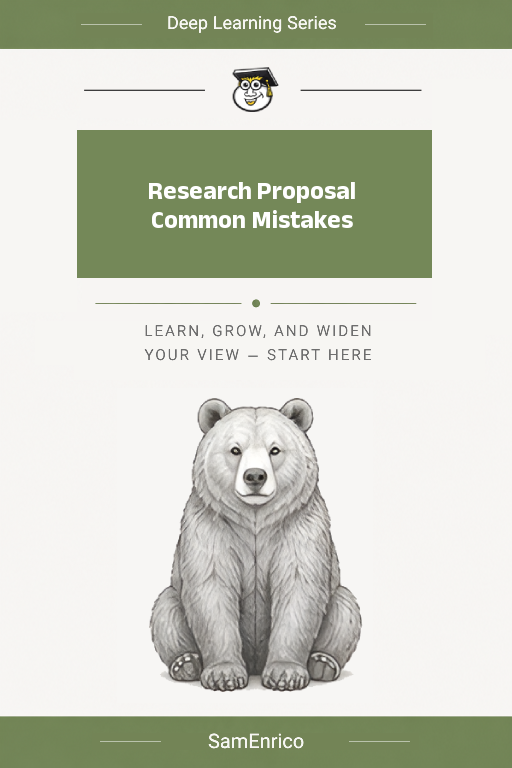
Research Proposal Common Mistakes eBook
Avoid fatal errors that cause proposals to be reje
Avoid fatal errors that cause proposals to be rejected by review committees.
Formats
Free sample
Chapter 1: The 90-Second Kill...--–- It was 11:47 PM on a Tuesday when Dr. Sarah Chen, a tenured associate professor with three R01s and seventeen publications, clicked "Submit" on what she believed was her magnum opus—a $2.4 million proposal to study neural plasticity in adolescent anxiety disorders. She had spent eight months writing it. Her lab had run pilot studies. She had hired a professional grant editor.
She had followed every guideline. She was certain, absolutely certain, that this proposal would be funded.Six weeks later, she received the worst email of her academic career.Not a rejection—that would have been disappointing but manageable. Worse: a desk reject. The program officer hadn't even sent it out for peer review. The email contained four sentences.
The fourth sentence read: "The proposal does not adequately establish the significance of the proposed research."Dr. Chen stared at her screen for twenty minutes. She had written a twelve-page introduction. She had cited forty-seven papers. She had used the word "critical" eleven times.
How could anyone say she hadn't established significance?She never found out. The program officer didn't offer feedback. The reviewers never saw her work. Eight months of labor, $12,000 in pilot study costs, and the emotional investment of her entire lab—all terminated by a bureaucrat who spent less time on her proposal than she spent choosing her morning coffee.Here is the truth that no one tells you in graduate school, that no mentor warns you about, that no grant-writing workshop adequately prepares you for: Your proposal will be judged in the first ninety seconds.Not ninety minutes. Not ninety pages.
Ninety seconds.And if you fail that test, nothing else matters. Not your brilliant methodology. Not your perfect sample size. Not your innovative statistical approach. Not your twenty-five figures.
Not your letters of support from Nobel laureates. The reviewer will never read any of it. Your proposal will join the pile of "unfundable" before you have a chance to defend yourself.This chapter is about why that happens, how to prevent it from happening to you, and why the remaining eleven chapters of this book exist at all. Because once you understand the ninety-second kill, you will never write a proposal the same way again.The Myth of the Careful Reader Let me disabuse you of a dangerous fantasy.Most researchers believe that grant reviewers read proposals carefully, thoroughly, and fairly. They imagine a distinguished professor sitting in a leather armchair, steaming mug of tea in hand, reading each word with the same meticulous attention they would give to a doctoral dissertation.
They believe that reviewers evaluate proposals on their scientific merits alone, that the process is a pure meritocracy of ideas.This is delusional.Here is what actually happens. A program officer at NIH, NSF, or a private foundation sends out a batch of proposals to reviewers who are, almost without exception, overcommitted, underpaid, and deeply resentful of the time this takes. Each reviewer receives fifteen to thirty proposals. They have, on average, two weeks to review them. They also have their own labs to run, their own students to mentor, their own grants to manage, their own papers to review, their own classes to teach, and their own families to feed.They are not reading your proposal in a leather armchair with tea.
They are reading it at 10:30 PM on a Sunday, in bed, on a laptop, after putting their children to sleep, while vaguely resenting that they said yes to this review assignment. Or they are reading it on an airplane between connections, or in the fifteen minutes between back-to-back Zoom meetings, or while waiting for a PCR run to finish.And they are looking for reasons to say no.Not because they are evil. Not because they hate you. Because they have to reduce a pile of thirty proposals to three or four that they will recommend for funding. The most efficient way to do that is to eliminate proposals quickly.
The fastest way to eliminate a proposal is to find a fatal flaw in the first few pages—preferably in the first few paragraphs.This is what I call the 90-Second Kill.The reviewer scans your title. They read your abstract. They skim your specific aims or introduction. And within ninety seconds, they have formed a preliminary judgment: fundable, maybe fundable after revisions, or reject. If the judgment is reject, the remaining thirty pages are just confirmation bias.
They will find additional reasons to justify their initial instinct, but the decision has already been made.I have served on nine grant review panels for three different federal agencies. I have watched this happen in real time. I have seen a reviewer pick up a proposal, read the first paragraph, and say "Next" before turning to the second page. I have seen an entire study section dismiss a proposal because the title was grammatically awkward. I have seen a $500,000 proposal rejected because the investigator wrote "affect" when they meant "effect" in the second sentence of the abstract.You think I am exaggerating.
I am not.The Cost of a Mistake Before we go further, let me quantify what is at stake. Because researchers who have never lost a major grant application often underestimate the true cost of rejection.The Direct Financial Cost A typical NIH R01 proposal represents between 250,000and250,000 and 250,000and500,000 per year, usually for three to five years. A single funded proposal can therefore be worth 1.5millionto1.5 million to 1.5millionto2.5 million. An NSF standard grant averages 150,000to150,000 to 150,000to300,000 per year. A private foundation grant might be smaller—50,000to50,000 to 50,000to100,000—but those are often make-or-break for early-career researchers.When your proposal is rejected, you lose not only the funding but also the time you invested in writing it.
A typical investigator spends 200 to 400 hours on a major proposal. If you value your time at a modest 75perhour(whichislessthanwhatapostdoccosts,letalonea PI),thatis75 per hour (which is less than what a postdoc costs, let alone a PI), that is 75perhour(whichislessthanwhatapostdoccosts,letalonea PI),thatis15,000 to 30,000ofuncompensatedlabor.Multiplythatbythreeresubmissions,andyouhaveinvested30,000 of uncompensated labor. Multiply that by three resubmissions, and you have invested 30,000ofuncompensatedlabor.Multiplythatbythreeresubmissions,andyouhaveinvested90,000 of your own time in a single proposal that may never be funded.The Career Cost The indirect costs are even larger. In many universities, promotion and tenure decisions hinge on extramural funding. An associate professor who cannot secure a research grant will not become a full professor.
A postdoc who does not bring in funding will not get a faculty position. A graduate student whose advisor loses grant support may be forced to master out.I have watched brilliant researchers leave academia not because their science was weak, but because they could not write a fundable proposal. They were excellent at running experiments, analyzing data, and interpreting results. They were terrible at signaling significance in the first ninety seconds. And the system ate them alive.The Emotional Cost Do not underestimate the psychological toll of repeated rejection.
Grant writing is a high-stakes, low-success-probability endeavor. The average success rate at NIH is about 20% for new investigators. At NSF, it hovers around 25%. That means for every funded proposal, three or…
This is the end of the free sample. Get the eBook to keep going. Buy now
About this book
Details
- Author
- Kasper Myriam
- Publisher
- SamEnrico
- Language
- English
- Genre
- research, Student's Shortcut
- Released
- 2026-05-28
- Pages (approx.)
- 141
- Available as
- eBook, Audiobook

Read better in the ZLOADR app
Your eBooks on your phone or tablet. Sign in with your SamEnrico account and start reading.
More by Kasper Myriam
 Deep Work Interruption Shield GuideKasper Myriam$11.99
 Zumba for Wedding PrepKasper Myriam$11.99
 Conversation Starters for StutterersKasper Myriam$11.99
 The Diplomat's House NightmareKasper Myriam$11.99
 Wunderlist Legacy GuideKasper Myriam$11.99
 Bipolar Advanced DirectiveKasper Myriam$11.99
 Study Group EfficiencyKasper Myriam$11.99
 Stepchild Death GriefKasper Myriam$11.99
 Social Skills EQ Improvement GuideKasper Myriam$11.99
 The Mozart Gambit: A Maestro's MasterstrokeKasper Myriam$11.99
 The 2008 Lehmans: How One Bank’s Fall Shook the WorldKasper Myriam$11.99
 The Golden Apple: The Untold Betrayal of the Trojan HorseKasper Myriam$11.99
You may also like
 Harvard Extension School Research OpportunitiesSykes Olimpia$11.99
 Translational Research Potential Without PubsGibbs Wm$12.99
 Research Supervision Models ComparedPonder Peg$12.99
 Research Replication Projects Without PubsMilam Susanna$12.99
 Research Proposal That Hides No PublicationsPatel Maisha$12.99
 Research Proposal Scoring RubricOsullivan Mammie$12.99
 Research Proposal Sample AnalysisJasper Faustino$12.99
 Research Proposal Revision Strategies ManualWhiting Mavis$12.99
 Research Proposal Revision ProcessWhalen Dayna$12.99
 Research Proposal Problem Statement ManualRunyon Aja$12.99
 Research Proposal Peer Review Process GuideTurnbull Almeda$12.99
 Research Proposal Peer Review GuideCullen Danyel$12.99