
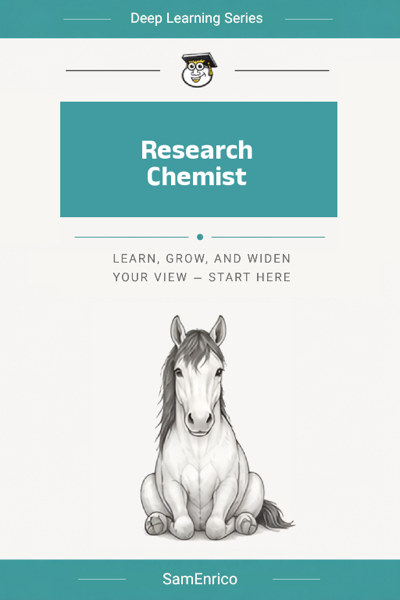
researchInformativeEducational
Research Chemist eBook
A Coursebook on Research Chemist
A Coursebook on Research Chemist
Formats
Free sample
Chapter 1: The Meritocracy Lie--–- Alex checked his NMR data for the third time. The coupling constants matched. The integration was perfect. The purity was 98.6 percent. He had synthesized a novel inhibitor of KRAS G12C, a target that had eluded his pharmaceutical company’s best chemists for eighteen months.
His manager would be thrilled. His director would finally notice him. His promotion was all but guaranteed.–- Six months later, Alex was still at the same desk, same title, same salary. The person who got promoted was Priya, who had contributed a less elegant synthesis, made more mistakes, and spent what Alex considered an excessive amount of time in meetings and at conferences. Alex was furious.
He had done the real work. He had been the smartest person in the lab. And the system had failed him.–- Or had it?–- This chapter dismantles the most destructive myth in research science: that technical brilliance alone determines career success. If you believe that being the smartest person in the room is enough, this chapter will challenge everything you think you know about how careers actually work.The Myth of Pure Meritocracy–- Every research chemist enters the profession believing in a simple, seductive equation: technical excellence equals career advancement. You were trained to believe this.
Your Ph D advisor implicitly promised it. The entire academic system reinforces it. Do good science. Get good results. Be rewarded.–- The problem is that this equation is wrong.–- In thirty years of studying chemistry careers, John Fetzer documented what thousands of chemists have learned the hard way: technical skill is the price of entry, not the path to the top.
The American Chemical Society’s corporate members consistently rank communication, teamwork, and strategic thinking as more important than synthetic expertise for career advancement above the entry level.–- Think about the most successful research chemists you know. Are they the absolute best at the bench? Sometimes. But often, they are not. What they share is something else: they are visible, they are connected, and they know how to make their work matter to people who make decisions.–- This is not anti-intellectual.
This is not saying that chemistry doesn’t matter. It is saying that chemistry alone is insufficient.The Three-Legged Stool: Introducing the Complete Chemist–- Over the next twelve chapters, you will learn a complete system for building a research career that is both technically excellent and strategically successful. That system rests on a single model: the Complete Chemist.–- Imagine a three-legged stool. If any leg is missing or weak, the stool collapses. The Complete Chemist has three equal legs:–- Leg One: Technical Excellence.
Your ability to design experiments, execute them safely, interpret data correctly, and solve chemical problems. This is what you trained for. This is what got you hired. And this is the only leg that most chemists ever develop.–- Leg Two: Strategic Visibility. Your ability to make your work known to the people who control resources, promotions, and opportunities.
This is not bragging. This is not self-promotion. This is the professional obligation to ensure that your contributions are seen and understood by decision-makers.–- Leg Three: Interpersonal Skills. Your ability to collaborate, communicate, and influence across teams, functions, and hierarchies. This includes networking, managing up, resolving conflict, and building trust with people who do not share your technical background.–- The central argument of this book is that early-career chemists almost always over-invest in Leg One while neglecting Legs Two and Three.
They assume that good work speaks for itself. It does not. They assume that their manager is tracking their contributions. They are not. They assume that being right is enough to win arguments.
It is not.The Case Studies: Maya and Raj–- To understand how these three legs interact in real careers, consider two hypothetical Ph D chemists who join the same medicinal chemistry group at the same time.–- Maya is a brilliant synthetic chemist. Her reaction scouting is creative. Her purifications are elegant. She can look at a challenging target and design a route that others miss. She works sixty hours a week, stays heads-down at the bench, and assumes that her results will speak for themselves.
She rarely speaks up in meetings, never sends updates to her director, and views networking as a waste of time that takes her away from real science.–- Raj is a competent but not exceptional synthetic chemist. His routes work, but they are not elegant. His yields are acceptable, but not impressive. He works forty-five hours a week. But Raj does three things that Maya does not.
First, he sends a one-page summary of his progress to his manager every Friday afternoon. Second, he has coffee once a month with a scientist from the biology group to understand how his compounds are being tested. Third, he volunteered to present his project at the departmental meeting, even though he was nervous.–- After two years, Raj is promoted to Senior Scientist. Maya is not. Maya is furious.
She files a complaint. She updates her CV. She threatens to leave. And when she does leave, she goes to another company where the same pattern repeats, because she has never learned what Raj understood intuitively: technical excellence is necessary but not sufficient.–- This book is not about becoming Raj. It is about becoming Maya plus Raj’s strategic skills.
The goal is not to sacrifice technical excellence but to surround it with visibility and interpersonal competence.Leg One: Technical Excellence – What You Already Know (And What You Don’t)–- Let us be clear: Leg One matters. Without technical excellence, you cannot be a research chemist at all. Chapters 2 and 3 will deepen your technical foundations in three specific areas that are often neglected in academic training:–- Experimental design (Chapter 2): Most chemists design experiments reactively, running one reaction, analyzing the result, and then guessing the next step. This chapter introduces blocking, randomization, controls, and design of experiments as practical tools, not statistical abstractions.–- Safety as a creative parameter (Chapter 2): Safety is not a bureaucratic burden. It is a constraint that sharpens your thinking and eliminates non-viable routes before you waste months on them.–- Literature and data management (Chapters 2 and 3): Knowing how to find what has already been done, and how to document what you have done, is the foundation of reproducibility and legal defensibility.–- But here is the hard truth that no Ph D program will tell you: technical excellence has diminishing returns.
The difference between a 50% yield and a 70% yield is meaningful. The difference between a 70% yield and a 90% yield is smaller. The difference between a 90% yield and a 95% yield is negligible for most career outcomes. Once you are competent, additional technical improvement yields less career benefit than investing that same time in visibility or interpersonal skills.–- This is not an argument for mediocrity. It is an argument for strategic allocation of your most有限 resource: your time and attention.Leg Two: Strategic Visibility – Making Your Work Unignorable–- Strategic visibility is the most misunderstood leg of the Complete Chemist.
Many chemists hear “visibility” and think of self-promotion, bragging, or political games. That is not what this means.–- Strategic visibility…
This is the end of the free sample. Get the eBook to keep going. Buy now
About this book
Details
- Author
- Richey Bailey
- Publisher
- SamEnrico
- Language
- English
- Genre
- research, Informative, Educational
- Released
- 2026-05-04
- Pages (approx.)
- 145
- Available as
- eBook, Audiobook

Read better in the ZLOADR app
Your eBooks on your phone or tablet. Sign in with your SamEnrico account and start reading.
More by Richey Bailey
 LSE Online Graduate TestimonialsRichey Bailey$11.99
 Voyageurs National Park MissingRichey Bailey$11.99
 IBS And Anxiety Cycle GuideRichey Bailey$11.99
 Sexual Anorexia Warning SignsRichey Bailey$11.99
 The Last Queen of Sheba: A Journey Through Myth and EmpireRichey Bailey$11.99
 The Crown and the Codebreaker: How a Math Genius Cracked the Royal SecretsRichey Bailey$11.99
 Stablecoin Payment OutlookRichey Bailey$12.99
 Facebook Group Launch PrimerRichey Bailey$12.99
 Understanding Hunter–carpenter–McDonald SyndromeRichey Bailey$17.99
 How to Start a Shrimp Production (post-larvae), Freshwater Business (Beginners Guide)Richey Bailey$11.99
You may also like
 Scientific Research On TM GuideMartens Nathanial$11.99
 Research Proposal Methodology Section MasteryPauley Debroah$11.99
 Research Proposal Appendix CompilationRaines Tyisha$11.99
 Academic Researcher Distraction GuideFord Virgil$11.99
 TM Research and ScienceCovert Nicki$11.99
 Social Anxiety Research ReviewRoberge Cole$11.99
 Research Proposal Significance Section GuideBock Tory$12.99
 Research Proposal Reviewer PsychologyLugo Tawanda$11.99
 Research Proposal Research Questions DesignLara Robbi$11.99
 Research Proposal References and CitationsPatten Shanice$11.99
 Research Proposal Mixed Methods DesignCameron Omega$11.99
 Research Proposal Data Management PlanAnderson Roberto$12.99