
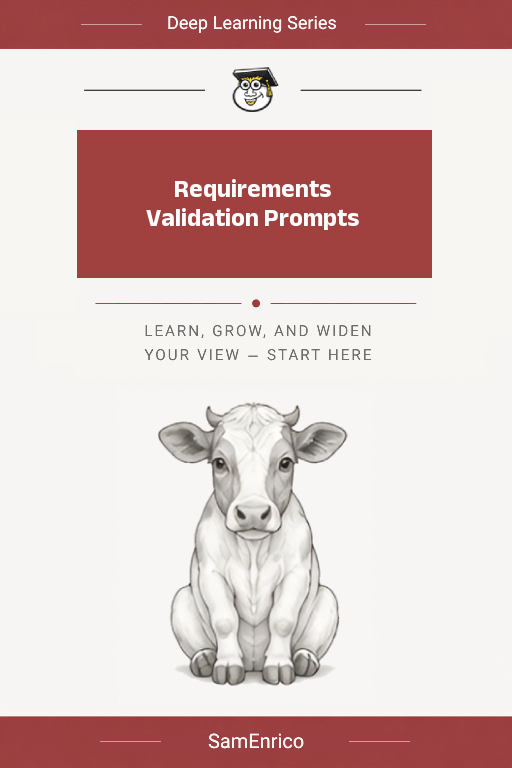
Requirements Validation Prompts eBook
Check requirements for ambiguity, inconsistency, a
by Bourne Ozell
Check requirements for ambiguity, inconsistency, and completeness using prompts that apply validation rules and quality heuristics.
Formats
Free sample
Chapter 1: The Million-Dollar Mistake--–- Every failed software project has a moment, usually invisible to everyone except the post-mortem investigators, where the catastrophe became inevitable. It is rarely the coding error that crashed the system at 3:00 AM, or the server that failed under unexpected load, or the integration that broke during deployment. Those are symptoms. The root cause, in nearly eighty percent of cases, lives much earlier in the lifecycle—in the requirements. A single ambiguous phrase like “the system shall respond quickly,” an inconsistent pair of statements like “user can cancel anytime” and “orders cannot be canceled after shipping,” or an incomplete conditional like “if payment succeeds, then ship product” without its deadly silent partner “else…”—these are the landmines buried in specifications.
And they detonate weeks or months later, when developers interpret one way, testers another, and stakeholders a third. The cost is staggering: rework, missed deadlines, damaged trust, and in extreme cases, lawsuits and bankruptcy. This book exists because that cycle is not inevitable. It can be broken not by working harder at manual reviews, but by changing the fundamental tool of validation: the prompt.For decades, the requirements engineering community has known the three horsemen of project failure—ambiguity, inconsistency, and incompleteness. The IEEE Standard 830, the BABOK Guide, and every major textbook on software requirements agree on this diagnostic.
Where they disagree, or rather where they fall silent, is on the practical, repeatable, scalable method for detecting these defects before they reach development. Manual reviews, the industry’s workhorse, suffer from what cognitive psychologists call confirmation bias: reviewers see what they expect to see. Walkthroughs become social performances where the loudest voice wins. Inspections, despite their rigorous pedigree, require hours of preparation per page of requirements and scale poorly to the thousands of requirements in a real system. The result is that defects slip through, and the project pays later—often at a factor of one hundred times the cost of fixing the requirement at the time it was written.This book introduces a different approach, one that has become possible only in the last few years with the maturation of large language models and the rediscovery of an old idea from the early days of artificial intelligence: that structured natural language queries, or prompts, can act as executable quality heuristics.
A prompt is not a vague instruction like “please check this for errors.” A prompt is a precise, repeatable, automatable interrogation of a requirement. It asks a specific question: “Does this sentence contain any weasel word from a defined list?” “Do any two numeric constraints in this set contradict each other?” “For every conditional statement, is there an explicit else branch?” These prompts can be run by a human analyst reading a document, but they can also be automated, embedded into requirement management tools, and run continuously as specifications evolve. They transform validation from an art into an engineering discipline.The argument of this chapter, and of this book, is simple but profound. First, the three defect types—ambiguity, inconsistency, and incompleteness—account for the vast majority of requirement errors that reach development. Second, these defects can be detected through a finite, learnable set of quality heuristics.
Third, each heuristic can be expressed as one or more prompts. Fourth, those prompts can be applied systematically, scaled across large specifications, and integrated into continuous quality assurance. The rest of this chapter lays the groundwork: establishing the eighty-twenty rule with evidence, diagnosing the failures of manual methods, defining prompt-driven validation, presenting the unified heuristics framework that will guide the entire book, and giving readers their first two prompts to use immediately.The Eighty-Twenty Rule of Requirements Defects If you ask a hundred project managers to name the most common cause of requirement-related rework, you will hear variations of the same answer: “people didn’t say what they meant.” That answer, while true, is too vague to act upon. The useful formulation comes from analyzing thousands of requirement defects logged in industrial projects over three decades. Researchers at the University of Maryland, Hewlett-Packard, and later NASA’s Software Engineering Laboratory independently arrived at a remarkably consistent distribution.
Approximately forty percent of requirement defects trace to ambiguity—phrases that can be interpreted in more than one way. Another thirty percent trace to incompleteness—missing information, unhandled exceptions, undefined states. The remaining ten to fifteen percent trace to inconsistency—contradictions between requirements. The other fifteen percent are distributed across other defect types like incorrect fact, non-verifiability, and gold-plating. That is the eighty-twenty rule for requirements: roughly eighty percent of defects come from ambiguity, inconsistency, and incompleteness.Let us make this concrete.
Consider a real requirement from a transportation logistics project, anonymized but otherwise unchanged: “The system shall provide timely notification to the user when a shipment is delayed.” This single sentence contains multiple defects. “Timely” is an ambiguous weasel word. Does it mean within one minute? Within one hour? Before the shipment’s original estimated arrival?
“User” is ambiguous: the shipper, the recipient, or the dispatcher? “Delayed” relative to what—the original promise, the last update, or an internal schedule? A developer asked to implement this will make assumptions. A tester asked to verify it will make different assumptions. The stakeholder who wrote it had a third set in mind.
The result is rework, argument, or silent failure. If the project had twenty such ambiguous requirements, the team might survive. If it had two hundred, the project would be in crisis.The forty percent figure for ambiguity is not uniform across industries. Safety-critical systems in aviation and medical devices show lower ambiguity rates because of rigorous reviews, but higher inconsistency rates because of the sheer volume of cross-referenced requirements. Agile projects show higher incompleteness rates because user stories often omit exception handling.
The specific numbers vary, but the pattern does not: these three defect types dominate everywhere. This book does not require you to accept a precise statistic. It only requires you to accept that if you systematically eliminate ambiguity, inconsistency, and incompleteness from your requirements, you will remove the overwhelming majority of requirement defects. Everything that follows is a method for doing exactly that.The Limits of Manual Validation If the problem has been known for decades, why has it not been solved? The answer is not a lack of effort or intelligence.
The answer is that manual validation methods have inherent, structural limitations that no amount of training or diligence can fully overcome. Understanding these limitations is essential because prompt-driven validation is not a replacement for human judgment. It is a tool that amplifies human judgment by automating what humans are bad at and leaving what humans are good at.Manual reviews, in which one or more analysts read a requirements document and look for defects, suffer from three fatal flaws. The first is attention decay. The average professional can maintain focused attention on a text for about twenty minutes before the error detection rate drops significantly.
A requirements specification of fifty pages, which is modest by industry standards, would require several hours of sustained reading. By page thirty, the reviewer is missing defects that they would have caught on page five. This is not a personal failing…
This is the end of the free sample. Get the eBook to keep going. Buy now
About this book
Details
- Author
- Bourne Ozell
- Publisher
- SamEnrico
- Language
- English
- Genre
- Non-Fiction, AI Operator
- Released
- 2026-05-29
- Pages (approx.)
- 154
- Available as
- eBook, Audiobook

Read better in the ZLOADR app
Your eBooks on your phone or tablet. Sign in with your SamEnrico account and start reading.
More by Bourne Ozell
 Female Everest SummiteersBourne Ozell$11.99
 Malaysia Green Tax GuideBourne Ozell$11.99
 Caregiver Isolation SolutionsBourne Ozell$11.99
 Cannabis Use Disorder and Anxiety DisordersBourne Ozell$11.99
 Bhagwan Air Conditioning ObsessionBourne Ozell$11.99
 Implant Side EffectsBourne Ozell$11.99
 Creator Mode GuideBourne Ozell$11.99
 The Celestial Dance of Shiv-Shakti: A Divine Love UnbrokenBourne Ozell$11.99
 The Last Breath of the LeviathanBourne Ozell$11.99
 How to Produce Garden ToolsBourne Ozell$11.99
 How to Start a Emu Raising and Breeding Business (Beginners Guide)Bourne Ozell$11.99
 Academic Transcript Improvement GuideBourne Ozell$12.99
You may also like
 Hong Kong Handover 1997Dunn Johnnie$11.99
 Zumba For Postnatal Recovery CourseNeal Christian$11.99
 Zumba for BeginnersLadner Nikia$11.99
 YouTube Comment Mining GuideHumes Pandora$12.99
 Worry Box MeditationCarlin Rudy$11.99
 Workplace Stress MeditationNguyen Lynn$11.99
 Workplace Stress and Sleep RepairHawley Ivory$11.99
 Workplace Perfectionism CureDelaney Jeffry$11.99
 Workplace Injustice Anger GuideWallen Isabelle$11.99
 Work Addiction and Burnout LinkGreenwood Ester$11.99
 Women in Yoga and WellnessBeattie Galina$11.99
 Women in Stand Up ComedyChun Evangeline$11.99