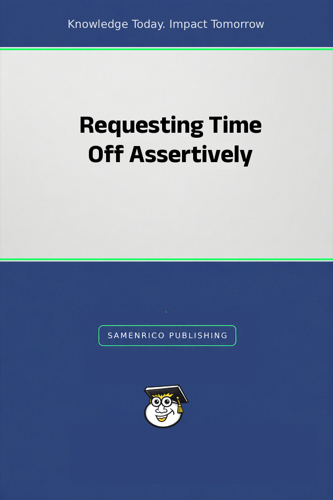
Requesting Time Off Assertively eBook
Teaches stating leave needs without over-justifyin
by Sapp Letty
Teaches stating leave needs without over-justifying or apologizing.
Formats
Free sample
Chapter 1: The Guilt Economy--–- Sara had been staring at her screen for seventeen minutes. The cursor blinked in the "Subject" line of an otherwise blank email. She had already typed and deleted "PTO Request" three times. Each version felt wrong—too demanding, too vague, too honest. Her vacation was approved in the system.
She had the days banked. Her team had been told weeks ago. And yet, here she was, drafting what amounted to a confession rather than a notification.This is not a story about a weak employee. Sara is a senior marketing director with twelve years of experience, consistently top-rated in performance reviews, and widely respected by her peers. She has not missed a deadline in four years.
She answers emails at 10 PM. And she cannot bring herself to tell her boss she is taking five days off without first explaining, justifying, and apologizing.Sara is not the problem. The problem is what this chapter calls the Guilt Economy—an invisible system of psychological debt that makes employees feel they must pay for time off with anxiety, over-explanation, and self-punishment. Understanding this system is the first and most important step toward requesting time off assertively. Because until you see the architecture of your guilt, you will keep building more of it.The Guilt Economy operates on a simple but devastating premise: rest is treated as a withdrawal from an emotional bank account, while overwork is treated as a deposit.
In this economy, taking what you have already earned feels like stealing. Asking for what you need feels like begging. And stating a fact about your own schedule feels like an act of rebellion.This chapter will dissect the Guilt Economy in five parts. First, we will explore where this guilt actually comes from—because it is not all in your head. Second, we will name the three hidden taxes the Guilt Economy extracts from every worker.
Third, we will examine the surprising demographic patterns of leave guilt, including who pays the highest price. Fourth, we will introduce the distinction between earned leave and requested grace, a framework that will reappear throughout this book. Finally, we will walk through an exercise that transforms guilt into data—so you can see, for the first time, exactly what you are apologizing for that requires no apology at all.The Architecture of Leave Guilt: It's Not Just You Before we fix the problem, we must stop blaming ourselves for having it. The vast majority of employees who struggle to request time off assertively believe their guilt is a personal failing. I am too anxious.
I am too nice. I am not confident enough. While personality factors play a role, research across organizational psychology, sociology, and behavioral economics suggests something larger is at work.The Protestant Work Ethic Hangover Max Weber, the German sociologist, identified what he called the Protestant work ethic in 1905: the idea that hard work is a moral duty and that idleness (including rest) is a sign of moral failure. While few of us consciously believe this today, the cultural residue remains. Studies show that Americans, on average, leave over 50% of their paid time off unused each year.
Not because they cannot take it—but because they feel wrong taking it. In a 2022 survey of over 5,000 workers, 68% agreed with the statement "I feel guilty when I am not working, even during approved time off." This is not a personality disorder. This is a cultural inheritance.The Visibility Trap Modern workplace technology has created what social scientists call "ambient visibility"—the sense that someone could be watching at any time. Even when no one is checking, employees report feeling that being offline sends a signal of low commitment. This is not paranoia; it is a rational response to decades of hustle culture messaging.
When Elon Musk tweets that "nobody ever changed the world on 40 hours a week," he is not stating a fact. He is reinforcing a norm. And norms become guilt.The Scarcity Mindset Implant Organizations rarely frame PTO as an earned benefit. Instead, they frame it as something you request (permission language) rather than something you use (entitlement language). This semantic difference is profound.
When you request something, you are asking for a favor. When you use something, you are exercising a right. The Guilt Economy implants the scarcity mindset so deeply that even when you have unlimited PTO (as many tech companies offer), employees take less time off because there is no clear boundary telling them what is acceptable.The Comparison Machine Finally, guilt thrives on comparison. You are not just comparing yourself to an abstract standard; you are comparing yourself to colleagues who appear to work more, complain less, and never seem to leave. The problem is that you are comparing your internal reality (exhaustion, anxiety, desire for rest) to their external performance (a calm face, a full inbox, a cheerful Slack status).
This is what the psychologist Leon Festinger called social comparison theory, and in the Guilt Economy, it is rigged against you. You always lose.The Three Hidden Taxes of the Guilt Economy Every time you take time off in the Guilt Economy, you pay three invisible taxes. These taxes do not appear on any paycheck, but they extract real psychological and professional costs. Naming them is the first step to refusing to pay them.Tax #1: The Justification Tax The first tax is the time and energy you spend constructing a narrative that makes your leave acceptable. This includes:Writing and rewriting time-off emails to sound less demanding Inventing "better" reasons for taking time (medical appointments instead of rest, family obligations instead of personal need)Calculating how long you have waited since your last leave to prove you are "not abusing the system"Preemptively offering to check email or work during your time off In a study of 1,200 office workers, the average employee spent 22 minutes drafting a time-off request for a single day of leave.
For a one-week vacation, the average was 47 minutes of drafting, revising, and anxiety. This is not writing. This is unpaid labor that you perform to justify using your own earned benefit.Tax #2: The Performance Tax The second tax is the invisible work you perform before and after leave to "make up" for being gone. This includes:Working extra hours in the week before leave to create a surplus of productivity Checking email during leave (which studies show reduces the restorative benefit of time off by up to 60%)Working extra hours after returning to "catch up," effectively nullifying the rest you just took Apologizing to colleagues for the burden of covering for you, even when coverage is their job The performance tax is particularly insidious because it feels voluntary. "I'm just being responsible," you tell yourself.
But the data say otherwise. Employees who work before and after leave report the same burnout levels as employees who took no leave at all. In other words, the Guilt Economy turns your vacation into theater. You perform rest without receiving its benefits.Tax #3: The Reputation Tax The third tax is the most hidden and the most damaging: the subtle erosion of your professional reputation caused by apologetic leave requests. Research on workplace assertiveness…
This is the end of the free sample. Get the eBook to keep going. Buy now
About this book
Details
- Author
- Sapp Letty
- Publisher
- SamEnrico
- Language
- English
- Genre
- Non-Fiction, Self-Help, Work-Life
- Released
- 2026-06-06
- Pages (approx.)
- 135
- Available as
- eBook, Audiobook

Read better in the ZLOADR app
Your eBooks on your phone or tablet. Sign in with your SamEnrico account and start reading.
More by Sapp Letty
 Talking About Vasectomy Or Tubal LigationSapp Letty$11.99
 The Distraction Habit Loop WorkbookSapp Letty$11.99
 Eat Before You Drive RuleSapp Letty$11.99
 Battle Of Friedland AccountSapp Letty$11.99
 Sacroiliac Joint Stabilization ExercisesSapp Letty$11.99
 The Learning Block StrategySapp Letty$11.99
 The Freelance Time Audit MethodSapp Letty$11.99
 Public Speaking ScriptsSapp Letty$11.99
 The Unlikely Spy: How a Janitor Outsmarted the CIASapp Letty$11.99
 The Mamluks Strike: Baybars' Crusader Annihilation (1260 AD)Sapp Letty$11.99
 Frozen Echoes: The Last Flight of the Doomed DC-3Sapp Letty$11.99
 How to Start a Radio Stations BusinessSapp Letty$11.99