
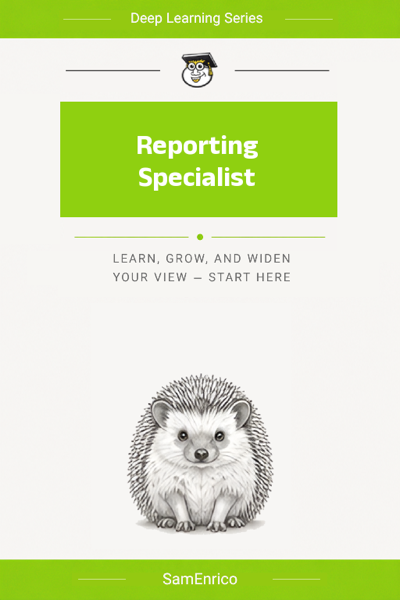
Non-FictionInformativeEducational
Reporting Specialist eBook
A Coursebook on Reporting Specialist
A Coursebook on Reporting Specialist
Formats
Free sample
Chapter 1: The Hidden Observer...--The memo arrived at 4:47 PM on a Friday. Three paragraphs, unremarkable formatting, no urgent flags. It requested a simple update on customer support ticket resolution times—routine data, the kind pulled from a dashboard in thirty seconds. The Reporting Specialist assigned to the task, a competent mid-level analyst named Priya, pulled the numbers, formatted them neatly, and sent them off by 5:15 PM. She went home satisfied, having closed the week cleanly.On Monday morning, the CEO’s office called.
The board had reviewed the memo over the weekend. A single number—a 12% increase in unresolved tickets over the previous quarter—had triggered a cascade: a shareholder inquiry, a compliance review, and an emergency operations meeting. The Reporting Specialist was asked to explain not the data, but the absence of context. Why hadn’t the report mentioned the failed software update that had caused the spike? Why hadn’t anyone flagged that the increase was concentrated in a single product line under regulatory review?
Why had “just the facts” been delivered without the story behind them?Priya had done nothing wrong by the standards of her job description. She had reported accurately. She had met the deadline. But she had failed as a Reporting Specialist because she had mistaken reporting for transcription. She had assumed that delivering numbers was the same as delivering understanding.
By the time she finished explaining herself to three different committees, she had learned a lesson that this chapter distills into a single sentence: You are not paid to report what happened. You are paid to help decision-makers understand what matters.This book is built on that distinction. The traditional journalist writes for the masses, aiming for broad distribution and general interest. The Reporting Specialist writes for decision-makers—executives, regulators, auditors, project leads, compliance officers—people who cannot afford to read twenty pages to find one actionable insight. They need the truth, yes.
But more than that, they need the truth in context, with consequence, and with a clear line from finding to action.If you take only one idea from this chapter, let it be this: the Reporting Specialist is not a scribe. The scribe records. The Reporting Specialist interprets. The scribe is replaceable by a template. The Reporting Specialist is indispensable because only a human can weigh competing signals, recognize what is missing, and judge when a number matters.This chapter defines the role from the ground up.
It establishes the four pillars of Reporting Specialist competence—Investigator, Analyst, Writer, and Self-Editor—and explains how each pillar transforms raw information into strategic intelligence. It distinguishes the Generalist (who covers many domains lightly) from the Specialist (who masters one domain deeply) and shows why the modern Reporting Specialist must be both, switching modes as the situation demands. It dismantles the myth that “just the facts” is a defensible standard and replaces it with a framework for adding context, consequence, and narrative to every report. And it ends with a practical deliverable: a Role Charter that you can use immediately to clarify your authority, your stakeholders, and the unique value you bring to your organization.By the end of this chapter, you will no longer think of yourself as someone who “writes reports.” You will think of yourself as someone who enables better decisions. Those are not the same thing.The Myth of the Neutral Scribe Organizations love the idea of neutral reporting.
They want numbers without interpretation, data without bias, facts without the messiness of human judgment. This desire is understandable. It is also impossible.Every reporting decision involves interpretation. Choose to include one number and exclude another? That is a judgment about relevance.
Put one finding before another in the sequence of a report? That is a judgment about priority. Describe a variance as “modest” or “concerning”? That is a judgment about severity. The Reporting Specialist who pretends to neutrality is simply hiding their judgments behind formatting.Consider a simple example.
A weekly sales report shows that revenue is $2.1 million against a forecast of $2.3 million. A scribe would write: “Revenue was $2.1 million, below forecast by $200,000.” This statement is true. It is also useless.A Reporting Specialist would ask three additional questions before writing a single word. First: What is the context? Is this the third consecutive week of shortfall, or the first?
Is the shortfall concentrated in one region or product, or spread evenly? Second: What is the consequence? Will this shortfall affect quarterly targets? Does it trigger any contractual obligations or compliance thresholds? Third: Who needs to know?
Does the sales team need a different forecast? Does the supply chain team need to adjust inventory? Does the CFO need to revise guidance?With those answers, the Reporting Specialist writes something entirely different: “Revenue was $2.1 million, 8% below forecast for the third consecutive week. The shortfall is concentrated in the Northeast region, where a stockout of the flagship product has persisted since March 12. If the stockout continues through month end, Q3 revenue will miss target by an estimated $400,000, triggering a compliance review under the terms of the regional distribution agreement.
Recommendation: Expedite the Northeast resupply and update the Q3 forecast to reflect a $400,000 downside risk.”The scribe delivered a fact. The Reporting Specialist delivered a decision-enabling insight. That is the difference.The myth of the neutral scribe persists because it is comfortable. It absolves the reporter of responsibility for outcomes. “I just gave you the numbers,” the scribe can say.
“What you did with them is your problem.” But organizations do not pay Reporting Specialists to avoid responsibility. They pay them to reduce uncertainty for decision-makers. That is an active, interpretive, and deeply responsible role.The Four Pillars of the Reporting Specialist The Reporting Specialist is not one thing. The role is a hybrid, requiring competence across four distinct domains. Think of these as the legs of a table.
Remove any one, and the structure collapses.Pillar One: Investigator The Investigator does not wait for data to arrive. The Investigator goes looking.In most organizations, data arrives filtered, summarized, and sanitized. The database contains what was recorded, not necessarily what happened. The email chain contains what was said, not necessarily what was meant. The meeting minutes contain what was agreed, not necessarily what was done.
The Investigator’s job is to find the gap between the official record and operational reality.This means developing a nose for anomalies. Why did that KPI improve sharply just before the audit? Why did that expense drop to zero for three months? Why does that process have no documentation despite being fifteen years old? These questions are not accusations.
They are starting points.The Investigator also cultivates sources. Not in the cloak-and-dagger sense, but in the practical sense of building relationships with people who know things. The warehouse supervisor who notices that inventory counts never match the system. The compliance officer who has been flagging the same risk for eighteen months. The junior analyst who knows that the “automated” report still requires three hours of manual cleanup every week.
These people are not conspiracy theorists. They are early warning systems. The Investigator listens to them.Practical technique: Keep an Investigation Log. Every time you encounter an unexplained…
This is the end of the free sample. Get the eBook to keep going. Buy now
About this book
Details
- Author
- Spriggs Glenn
- Publisher
- SamEnrico
- Language
- English
- Genre
- Non-Fiction, Informative, Educational
- Released
- 2026-06-03
- Pages (approx.)
- 140
- Available as
- eBook, Audiobook

Read better in the ZLOADR app
Your eBooks on your phone or tablet. Sign in with your SamEnrico account and start reading.
More by Spriggs Glenn
 Remote Company Retreats Sustainability GuideSpriggs Glenn$11.99
 Appetite Loss Divorce GuideSpriggs Glenn$11.99
 Mi'kmaq Mawiomi GamulatioSpriggs Glenn$11.99
 Naturopathy for Kidney HealthSpriggs Glenn$11.99
 The Indian IT Talent MigrationSpriggs Glenn$11.99
 The Clockmakers of Switzerland: Precision and the Birth of Modern TimeSpriggs Glenn$11.99
 Understanding Segmental Vertebral AnomaliesSpriggs Glenn$17.99
 AI Master's Scholarships GuideSpriggs Glenn$12.99
 Franchise Customer Loyalty GlobalSpriggs Glenn$12.99
 How to Become a Polishing-pad MounterSpriggs Glenn$11.99
You may also like
 Hong Kong Handover 1997Dunn Johnnie$11.99
 Zumba For Postnatal Recovery CourseNeal Christian$11.99
 Zumba for BeginnersLadner Nikia$11.99
 YouTube Comment Mining GuideHumes Pandora$12.99
 Worry Box MeditationCarlin Rudy$11.99
 Workplace Stress MeditationNguyen Lynn$11.99
 Workplace Stress and Sleep RepairHawley Ivory$11.99
 Workplace Perfectionism CureDelaney Jeffry$11.99
 Workplace Injustice Anger GuideWallen Isabelle$11.99
 Work Addiction and Burnout LinkGreenwood Ester$11.99
 Women in Yoga and WellnessBeattie Galina$11.99
 Women in Stand Up ComedyChun Evangeline$11.99