
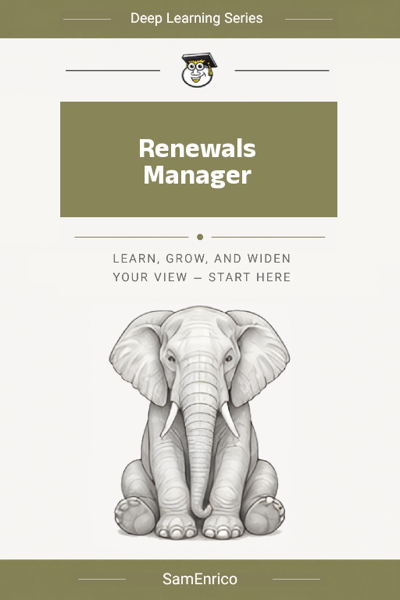
Non-FictionInformativeEducational
Renewals Manager eBook
A Coursebook on Renewals Manager
A Coursebook on Renewals Manager
Formats
Free sample
Chapter 1: The Retention Mandate--The email arrives on a Tuesday afternoon. The subject line reads: “Urgent: Customer calling for cancellation.” Your heart rate ticks up. You open the message. The customer, a mid-sized enterprise that represents $1.2 million in annual recurring revenue, has sent a terse note to your CEO: “We are not renewing. Please provide off-boarding instructions.”Panic ripples through the organization.
Sales blames Customer Success. Customer Success blames Product. Finance recalculates the quarterly forecast downward. The CEO demands answers. And somewhere in the middle of this chaos sits the Renewals Manager—if the company has one.
More often than not, they do not. Instead, the responsibility falls to a fragmented coalition of account executives who would rather be hunting new logos, customer success managers who lack commercial training, or finance teams who treat the renewal as nothing more than an invoice to be processed.This book exists because that model is broken. And the companies that continue to operate that way are bleeding revenue they cannot afford to lose.The Saa S and subscription economy has fundamentally rewritten the rules of business growth. In the era of perpetual licenses, a sale was a destination. You closed the deal, recognized the revenue, and moved on to the next prospect.
Customer retention was a nice-to-have, but churn was merely an inconvenience—a leak in a bucket that could be filled by turning up the hose of new customer acquisition. That world is dead.Today, in the subscription economy, the sale is not a destination. It is the beginning of a relationship. And that relationship must be managed, nurtured, and renewed—or the entire business model collapses.The numbers tell a stark story. According to industry benchmarks, a typical Saa S company loses between 5% and 15% of its recurring revenue to churn every single year.
For a company with $50 million in annual recurring revenue, that is between $2.5 million and $7.5 million in revenue that simply evaporates. Worse, the cost to replace that lost revenue is astronomical. Acquiring a new customer costs five to seven times more than retaining an existing one. Yet most companies invest the vast majority of their sales and marketing budgets on the front end of the funnel while treating the renewal as an afterthought.This is the great contradiction of the subscription economy. The business model depends on retention, but the organizational structure rewards acquisition.The Renewals Manager role emerged precisely to solve this contradiction.
It is a relatively new function, barely a decade old in most organizations, but it has rapidly become one of the most critical positions in the subscription economy. The Renewals Manager sits at the intersection of Customer Success, Sales, Finance, and Legal. They are the guardian of Gross Revenue Retention—the purest measure of whether customers believe they are receiving value commensurate with what they pay.Yet despite the importance of the role, it remains poorly defined, widely misunderstood, and chronically under-resourced. In some companies, the Renewals Manager is treated as a collections agent, chasing past-due invoices and begging customers to sign. In others, they are absorbed into Account Management, expected to both renew and expand while receiving credit for neither.
In still others, they are buried inside Customer Success, expected to discuss product adoption and commercial terms in the same conversation—a confusion that alienates customers and frustrates teams.This book offers a different vision.The Renewals Manager is not a collections agent. They are not a junior salesperson. They are not an administrative assistant to the Customer Success team. The Renewals Manager is a strategic commercial partner who owns the customer’s renewal journey from day one of the contract to the moment of signature—and beyond. They are responsible for ensuring that the customer receives value, that the customer recognizes that value, and that the customer pays fairly for that value.
They are the connective tissue between what the product does and what the customer pays.This chapter establishes the foundation for everything that follows. It explains why the renewal economy emerged, what the Renewals Manager actually does, how the role differs from adjacent functions, and what metrics define success. It introduces the RACI framework for clarifying accountability across Customer Success Managers (CSMs), Account Executives (AEs), and Renewals Managers (RMs). And it makes the case that Gross Revenue Retention—not Net Revenue Retention—is the true north metric for the Renewals Manager.By the end of this chapter, you will have a clear understanding of what the role entails, why it matters more than ever, and how to position yourself or your team for success.The Shift: From One-and-Done to Always-On To understand the Renewals Manager, you must first understand the economic revolution that created the role.For most of modern business history, software was sold as a product. You purchased a perpetual license, paid an upfront fee, and owned the software forever.
Maintenance and support were optional add-ons, typically priced at 15% to 20% of the license fee annually. If you decided not to renew maintenance, the software still worked—you simply stopped receiving updates and support. Churn was a manageable inconvenience because the upfront license fee had already been collected. The business model was transactional. The relationship ended at the point of sale.Then came software-as-a-service.Saa S replaced the upfront perpetual license with a recurring subscription fee.
Instead of paying $100,000 once, you paid $10,000 per month, every month, for as long as you used the software. The barriers to entry dropped dramatically. Customers could try the product with minimal commitment. Vendors gained predictable, recurring revenue. It seemed like a win-win.But there was a hidden consequence.In the perpetual license model, the vendor collected most of the customer’s lifetime value at the beginning of the relationship.
If the customer churned after two years, the vendor had already captured the vast majority of the revenue they would ever receive. In the Saa S model, the vendor collects revenue gradually over time. If the customer churns after two years, the vendor has captured only a fraction of the potential lifetime value. The economic incentive shifted from acquiring customers to retaining them.This was not immediately obvious to early Saa S companies. They had grown up in a sales-centric culture where new logos were the only metric that mattered.
They invested heavily in lead generation, outbound sales, and closing tactics. Renewals were handled by whoever happened to be available—often an administrative assistant or a junior finance analyst. The result was predictable: churn rates that made profitability impossible.The turning point came in the early 2010s, when investors and analysts began to realize that Saa S economics only worked if retention was high. A company with 90% gross revenue retention might need five years to recover the cost of customer acquisition. A company with 80% gross revenue retention might never become profitable.
The math was unforgiving. Every dollar of churn required three to five dollars of new logo revenue just to stay flat.This realization forced a structural change. Companies began to create dedicated renewal functions. At first, these were often one-person teams buried inside Finance. Then they moved into Sales Operations.
Then into Customer Success. Finally, in the most mature organizations, they emerged as their own department—Renewals Management.The title “Renewals Manager”…
This is the end of the free sample. Get the eBook to keep going. Buy now
About this book
Details
- Author
- Iverson Marcell
- Publisher
- SamEnrico
- Language
- English
- Genre
- Non-Fiction, Informative, Educational
- Released
- 2026-06-03
- Pages (approx.)
- 142
- Available as
- eBook, Audiobook

Read better in the ZLOADR app
Your eBooks on your phone or tablet. Sign in with your SamEnrico account and start reading.
More by Iverson Marcell
 OKRs for Meditation PracticeIverson Marcell$11.99
 Heygen Avatar Production HandbookIverson Marcell$11.99
 Pinterest Home Decor ComparisonIverson Marcell$11.99
 Widow Self Worth Recovery GuideIverson Marcell$11.99
 The Art of Saying No to DrinksIverson Marcell$11.99
 The Waltz of Emperors: Vienna's Golden Age of Music and MajestyIverson Marcell$11.99
 Understanding Idiopathic Facial PalsyIverson Marcell$17.99
 Micro Influencer Compliance ManualIverson Marcell$12.99
 AI Yield Prediction GuideIverson Marcell$12.99
 How to Start a Casting Machines for Foundries Business (Beginners Guide)Iverson Marcell$11.99
You may also like
 Hong Kong Handover 1997Dunn Johnnie$11.99
 Zumba For Postnatal Recovery CourseNeal Christian$11.99
 Zumba for BeginnersLadner Nikia$11.99
 YouTube Comment Mining GuideHumes Pandora$12.99
 Worry Box MeditationCarlin Rudy$11.99
 Workplace Stress MeditationNguyen Lynn$11.99
 Workplace Stress and Sleep RepairHawley Ivory$11.99
 Workplace Perfectionism CureDelaney Jeffry$11.99
 Workplace Injustice Anger GuideWallen Isabelle$11.99
 Work Addiction and Burnout LinkGreenwood Ester$11.99
 Women in Yoga and WellnessBeattie Galina$11.99
 Women in Stand Up ComedyChun Evangeline$11.99