
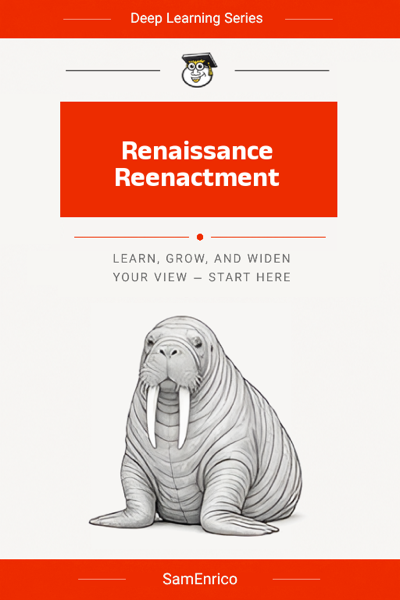
Non-FictionInformativeEducational
Renaissance Reenactment eBook
A Coursebook on Renaissance Reenactment
by Gil Buddy
A Coursebook on Renaissance Reenactment
Formats
Free sample
Chapter 1: The Second Person Present...--–- You are standing in the middle of a muddy field in upstate New York, wearing forty pounds of wool, linen, and leather, and a child of about seven years old is tugging on your sleeve. “Excuse me,” she says, “are you a real knight?” Behind her, her father is holding a smartphone and a turkey leg. To your left, a man in a neon safety vest is arguing with a man wearing a foam rubber codpiece. Somewhere in the distance, a cannon fires. You have exactly three seconds to decide who you are going to be in this moment – and that decision is the entire difference between a costume party and a living history.This is not a book about sewing techniques, though they are here.
It is not a book about sword fighting, though you will learn the names of cuts. It is not a book about the Medicis or the Tudors or the printing press, though all of those will appear in these pages. This is a book about a single, radical idea: that the past is not a place you visit, but a person you become.For the last twenty years, I have watched thousands of people – accountants, nurses, software engineers, retired military, high school teachers – step into the Renaissance with trembling hands and hopeful eyes. Some of them have been doing this for forty years. Some of them are holding a sewing needle for the first time.
But every single one of them, at some point, has faced that child in the muddy field. And every single one of them has had to answer, without a script and without a net: Who am I right now?The ones who succeed – the ones who transport that child out of the twenty-first century and into a world of velvet and valor, of spice routes and sonnets, of plague and passion – they do not succeed because their doublet is perfectly hand-stitched. They do not succeed because their period-authentic leather boots cost eight hundred dollars. They succeed because they have mastered what I call the Second Person Present.What the Second Person Present Is Not Let me be very clear about what this book is not offering. This is not a manual for Renaissance Faires as you have probably experienced them.
At the average commercial faire, the priority is entertainment, not education. The turkey legs are oversized, the fairies have glitter wings, and there is a non-zero chance you will see a man in a kilt playing a bagpipe version of “Sweet Child of Mine.” These events have their place – they are fun, they are accessible, and they have introduced millions of people to the aesthetic of the period. But they are not reenactment. They are Renaissance-themed entertainment.This book is also not a scholarly monograph. You will find no footnotes here, though you will find a thorough bibliography in the appendix.
The goal is not to impress other academics. The goal is to put you, the reader, into a situation where a seven-year-old believes – just for a moment – that you might actually have come from another century.And finally, this book is not a purity test. There is a certain kind of reenactor – every group has at least one – who believes that if your thread count is wrong, you should be publicly shamed. These people are not your friends. They are not helping.
They are, in fact, the single greatest obstacle to bringing new people into this hobby. We will discuss how to handle them in Chapter 12. For now, know this: the goal is not perfection. The goal is immersion.The Three-Legged Stool Every successful reenactment rests on three pillars, and they are not the ones you expect. After studying hundreds of reenactor-audience interactions and interviewing dozens of event organizers, I have identified the three core expectations that visitors bring to any living history event.
I call this the Three-Legged Stool.Leg One: Education. The visitor wants to learn something true. This seems obvious, but it is easily forgotten in the heat of performance. The child tugging your sleeve does not want to be fooled. She wants to know what knights actually did, what they ate, how they slept, whether they were scared.
If you cannot answer a basic factual question without breaking character, you have failed the first leg.Leg Two: Immersion. The visitor wants to believe, for a few minutes, that they have stepped backward in time. This is not the same as being fooled. It is a willing suspension of disbelief, the same feeling you get watching a good movie or reading a good novel. The visitor knows, intellectually, that you are not actually a 16th-century mercenary.
But they want to feel like one. They want the illusion to hold.Leg Three: Entertainment. The visitor wants a compelling story. This is the leg that academics often forget. Facts alone are dry.
Immersion alone is empty. You need narrative. You need conflict, resolution, surprise, humor, and heart.Here is the secret that separates great reenactors from mediocre ones: you cannot serve all three legs at once. Not really. Every interaction forces you to choose which leg to prioritize.
The child asking “are you a real knight” wants immersion – she wants to hear “yes, good morrow, young mistress” – but she also wants education, and the educational answer is “no, I am a reenactor portraying a knight.” You cannot give both answers simultaneously. You must choose.The rest of this chapter – indeed, the rest of this book – is about making that choice consciously, skillfully, and with joy.The Second Person Present Defined The technique that solves the Three-Legged Stool is the Second Person Present. The name comes from grammar, so let me explain.In English, we have three grammatical persons. First person: “I went to the market.” Second person: “You went to the market.” Third person: “He went to the market.” The present tense describes actions happening now: “I go,” not “I went.”Now apply this to reenactment. Most reenactors, especially beginners, speak in the third person past.
They say things like: “In the 16th century, people ate from trenchers.” Or: “Knights would have worn armor like this.” This is educational – it delivers facts – but it shatters immersion. You are not a 16th-century person telling me about your life. You are a 21st-century person giving me a lecture.The first person past is better but still flawed. “I used to go to the market with my father” suggests that you are remembering something, not living it. It creates distance.The third person present is almost never used: “He eats from a trencher while she watches.” This is narration, not conversation.
It is appropriate for a guide speaking about a diorama, not for a living person speaking to another living person.The second person present is the gold standard. You address the visitor directly, as if they have arrived in your world. You use present tense verbs. You invite them into the action. Examples:“Good morrow, friend.
You have come at a lucky hour – the printer has just pulled the first sheet.”“Mistress, you look weary. Will you sit by my fire and…
This is the end of the free sample. Get the eBook to keep going. Buy now
About this book
Details
- Author
- Gil Buddy
- Publisher
- SamEnrico
- Language
- English
- Genre
- Non-Fiction, Informative, Educational
- Released
- 2026-05-08
- Pages (approx.)
- 148
- Available as
- eBook, Audiobook

Read better in the ZLOADR app
Your eBooks on your phone or tablet. Sign in with your SamEnrico account and start reading.
More by Gil Buddy
 Subway Surfers Endless RunGil Buddy$11.99
 Keto Breads and MuffinsGil Buddy$11.99
 Sibling Adoption Reunion GuideGil Buddy$11.99
 Hamstring Recovery ProtocolGil Buddy$11.99
 The Engineer of Marlborough: John Churchill's Siegecraft RevolutionGil Buddy$11.99
 How to Produce Chemical Waste ProductsGil Buddy$11.99
 How to Start a Pipeline Design Business (Beginners Guide)Gil Buddy$11.99
 AI Journal Entry Automation GuideGil Buddy$12.99
You may also like
 Hong Kong Handover 1997Dunn Johnnie$11.99
 Zumba For Postnatal Recovery CourseNeal Christian$11.99
 Zumba for BeginnersLadner Nikia$11.99
 YouTube Comment Mining GuideHumes Pandora$12.99
 Worry Box MeditationCarlin Rudy$11.99
 Workplace Stress MeditationNguyen Lynn$11.99
 Workplace Stress and Sleep RepairHawley Ivory$11.99
 Workplace Perfectionism CureDelaney Jeffry$11.99
 Workplace Injustice Anger GuideWallen Isabelle$11.99
 Work Addiction and Burnout LinkGreenwood Ester$11.99
 Women in Yoga and WellnessBeattie Galina$11.99
 Women in Stand Up ComedyChun Evangeline$11.99