
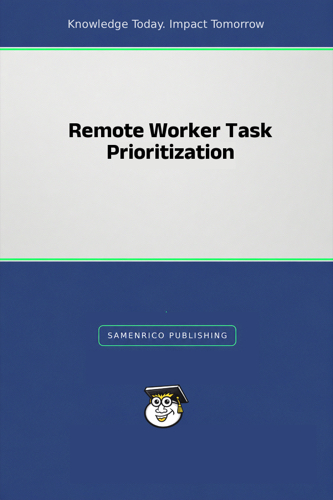
Remote Worker Task Prioritization eBook
Uses Eisenhower matrix for self-directed workload
Uses Eisenhower matrix for self-directed workload management.
Formats
Free sample
Chapter 1: The Autonomy Trap--–- At exactly 10:17 on a Tuesday morning, Sarah stared at her second cup of coffee growing cold on the desk of her home office. Her Slack sidebar showed seventeen unread messages across eight channels. Her email inbox displayed forty-three unopened threads. A calendar notification reminded her that a project proposal was due in forty-eight hours, and she had not written a single word. Instead, she had spent the last two hours responding to “quick questions,” reviewing a document that did not need her input, and reorganizing her digital folder structure for the third time this month.
She felt exhausted, anxious, and profoundly unproductive. And she was not alone.This is the hidden reality of remote work that job advertisements, Linked In influencers, and corporate wellness webinars rarely discuss. The promise was freedom. The delivery has been something else entirely. Remote work was sold as the great liberator—no commutes, no open-office distractions, no performative face time, no manager breathing down your neck.
You would finally have the autonomy to structure your day around your most productive hours, to focus deeply on meaningful work, and to achieve the mythical work-life balance that had eluded office workers for generations. But for millions of remote workers, the reality has been the opposite. They are working longer hours, feeling more scattered, and accomplishing less of what actually matters to them. They have traded the visible constraints of the office for an invisible cage of their own making, and they do not even realize the door exists.This chapter is about why that happens. It is about the psychological trap hidden inside the promise of flexibility, the two failure modes that most remote workers fall into, and the data that proves the average remote worker is logging more hours for less meaningful output.
Most importantly, this chapter introduces the single concept that explains everything: the Autonomy Gap. Understanding this gap is the first and most necessary step before any prioritization tool, time management technique, or productivity app can help you. Without closing this gap, the Eisenhower Matrix itself becomes just another complicated to-do list. With it, you gain something more valuable than any system: the ability to choose what matters.The Two Faces of Remote Failure Every remote worker eventually encounters a fundamental choice, though most do not recognize it as such. That choice is between two competing instincts: the urge to respond and the urge to retreat.
Neither works. Both lead to the same destination of burnout and underperformance, just by different roads.The first failure mode is reactivity. This worker starts their day with good intentions. They open their laptop, look at their prioritized task list, and intend to spend the morning on deep, strategic work. Then a Slack notification appears.
They tell themselves it will only take two minutes to answer. Forty minutes later, they have answered twelve messages, jumped into three threads, and forgotten what they were originally working on. The pattern repeats with email, then with calendar invites, then with a teammate who calls for “just a quick screen share.” By 5:00 PM, the reactive worker has been busy all day. Their fingers have moved constantly. Their brain has processed hundreds of inputs.
But when they look back at their original task list, nothing of significance is checked off. They have accomplished the urgent but not the important. They confuse motion with progress.The reactive worker is easy to spot. They are the ones who answer messages at 10:00 PM, who apologize for “falling behind” even though they worked through lunch, who describe themselves as “always available” as if that were a badge of honor rather than a cry for help. Their calendar is a patchwork of fifteen-minute meetings and thirty-minute focus blocks that are constantly interrupted.
They live in a state of low-grade panic, driven by every ping and notification as if each one were an emergency. The tragedy is that they are genuinely trying hard. They care about their work and their colleagues. But they have confused responsiveness with responsibility, and in doing so, they have handed control of their day to anyone who knows how to type a question.The second failure mode is hibernation. This worker also starts with good intentions, but their instincts run in the opposite direction.
They feel overwhelmed by the constant stream of inputs, so they withdraw. They close Slack. They ignore email. They put their phone on Do Not Disturb. They tell themselves they are protecting their focus, that they will catch up later.
And for an hour or two, this works. They make progress on a difficult task. They feel the satisfaction of deep work. But then they reopen their communication tools, and the dam breaks. Fifty unread messages.
Three missed meeting invites. A passive-aggressive comment from a manager asking if they are “still there.” A client wondering why they have not responded. The hibernating worker then spends the next several hours in a frantic catch-up mode, apologizing, explaining, and cleaning up the mess created by their absence. They feel anxious about checking messages, so they check them less often, which makes the backlog worse, which increases the anxiety. This is not a sustainable strategy; it is a slow-motion collapse.The hibernating worker is also easy to spot.
They are the ones who surface after two days of silence with a long apology and a list of excuses. They describe themselves as “not a notifications person” with a mixture of pride and embarrassment. Their calendar has large empty blocks labeled “Focus Time” that are constantly being overrun by fire drills that could have been prevented with basic communication. They are not lazy; they are overwhelmed. They have confused withdrawal with prioritization, and in doing so, they have alienated their colleagues and created a reputation for unreliability that will take months to repair.Here is what makes these two failure modes so insidious: they feel like opposites, but they are actually two expressions of the same underlying problem.
Both the reactive worker and the hibernating worker lack a framework for deciding what deserves their attention. The reactive worker outsources that decision to whoever makes the loudest noise. The hibernating worker tries to opt out of the decision entirely. Neither has a reliable, repeatable method for distinguishing the signal from the noise, the important from the urgent, the task that moves the needle from the task that just feels good to check off.The Data That Should Scare You If these failure modes were rare exceptions, they would not merit a book. But they are not rare.
They are the norm. A growing body of research on remote work productivity reveals a troubling pattern that most employers are either unaware of or unwilling to acknowledge.A longitudinal study conducted by researchers tracking knowledge workers before and after the shift to remote work found that the average remote worker logs between 1.5 and 2.0 additional hours per day compared to their office-based counterpart. On its face, this seems like good news. Remote workers are working more. But the same study found that despite working longer hours, remote workers reported completing fewer of their personally defined important goals.
In other words, they were busier and less effective. They were spending more time on low-value activities—email, chat, administrative tasks…
This is the end of the free sample. Get the eBook to keep going. Buy now
About this book
Details
- Author
- Trinidad Cristobal
- Publisher
- SamEnrico
- Language
- English
- Genre
- Non-Fiction, Self-Help, Prioritization
- Released
- 2026-06-10
- Pages (approx.)
- 141
- Available as
- eBook, Audiobook

Read better in the ZLOADR app
Your eBooks on your phone or tablet. Sign in with your SamEnrico account and start reading.
More by Trinidad Cristobal
 Vegan Diabetes Reversal CourseTrinidad Cristobal$11.99
 Resentment in Sibling RelationshipsTrinidad Cristobal$11.99
 Swimmer Lat and ShoulderTrinidad Cristobal$11.99
 Andrew Jackson People's PresidentTrinidad Cristobal$11.99
 Pixel and Peril: The Untold Story of Nintendo's 1993 'Play It Loud' CampaignTrinidad Cristobal$11.99
 The Sleepwalker's Secret: The Strange Case of the 19th Century Epidemic That Changed MedicineTrinidad Cristobal$11.99
 Salon ReceptionistTrinidad Cristobal$11.99
 High Ticket Sales ScriptTrinidad Cristobal$12.99
 UKIPO Patent Fee GuideTrinidad Cristobal$12.99
 Understanding Crossed PolysyndactylyTrinidad Cristobal$17.99
 How to Become a Tree CutterTrinidad Cristobal$11.99
You may also like
 The Remote Task Prioritization GuideGaddis Micaela$11.99
 The Eisenhower Block MatrixLedford Tanja$11.99
 Goal Prioritization MatrixSheets Cordell$11.99
 The Trigger Hierarchy MethodOsgood Cole$11.99
 The Remote Work Power ListCabral Bernita$11.99
 The Anger Budget WorkbookRollins Sherell$11.99
 The Remote Work Daily ThreeHoneycutt Bobbie$11.99
 Remote Worker Priority MatrixReece Fran$11.99
 Remote Work Eisenhower MatrixKrauss Carey$11.99
 Remote Dot Voting GuidePerrin Terese$11.99
 Priority Task First RuleNunn Rocky$11.99
 Collaborative Idea Shedding GuideMaxey Solange$11.99