
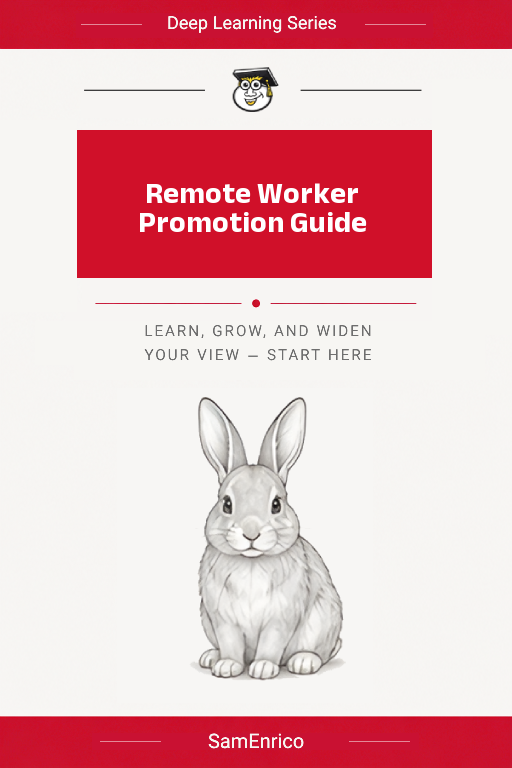
Non-FictionProfessional's Cheat SheetRemote
Remote Worker Promotion Guide eBook
Build a promotion case when you work remotely, emp
by Autry Ferne
Build a promotion case when you work remotely, emphasizing visibility, outcomes, and communication.
Formats
Free sample
Chapter 1: Breaking The Glass Screen--–- The email arrived on a Tuesday afternoon, and I still remember the specific ache of reading it. A colleague of mine—let’s call her Sarah—had just been passed over for a promotion she had been unofficially doing for eight months. She had led the project, mentored the junior staff, cleaned up the crisis, and delivered the numbers. But the promotion went to someone who sat two desks away from the manager in the office three times per week. Sarah worked remotely from a different state.
The official reason given was “visibility concerns.” Translation: out of sight, out of mind.Sarah’s story is not unusual. It is the story of millions of remote workers who wake up every day, do excellent work, and then watch their in-office peers climb the ladder while they stay stuck on the same rung. The data backs this up. Remote workers are 31 percent less likely to be promoted than their in-office counterparts, even when performance reviews are identical. Sixty-eight percent of managers admit that they base promotion decisions on physical presence rather than actual performance.
This bias has a name: proximity bias, and it is the single greatest threat to your remote career.But here is what I want you to understand before you read another word of this book. Proximity bias is real, but it is not invincible. The remote workers who do get promoted—and there are many of them—have figured out something that the rest have not. They have learned that working harder is a trap. They have learned that waiting to be recognized is a losing strategy.
They have learned that the path to promotion in a remote environment requires a completely different playbook than the one that worked in an office.This book is that playbook. And it starts with a simple but radical reframe: you cannot wait for visibility. You must build it.The Proximity Bias Problem Let me be precise about what proximity bias is and how it operates. Proximity bias is the unconscious tendency of managers to favor employees who are physically present over those who are not, regardless of actual performance. It is not malicious.
Most managers do not wake up thinking, “I will discriminate against my remote team today.” It is a cognitive shortcut. The human brain evolved to trust what it can see. When a manager sees an employee working hard in person, that image sticks. When a manager only sees an employee’s output on a screen, the effort behind that output fades into abstraction.The research on proximity bias is sobering. A study of over 10,000 employees at a large technology company found that remote workers received lower performance ratings than in-office workers doing the same work.
Another study found that remote workers were 50 percent less likely to be promoted into management roles. Even more troubling, the bias persists even when managers explicitly try to avoid it. In one experiment, managers were told to evaluate remote and in-office workers on objective metrics only. They still rated the in-office workers higher.Proximity bias shows up in three specific ways.First, there is the visibility gap. In-office workers are seen by default.
Their presence in meetings, hallways, and social events creates a constant stream of visibility that remote workers have to manufacture. This is not fair, but it is reality.Second, there is the attribution gap. When something goes well in the office, the manager sees who was working late. When something goes well remotely, the manager sees the result but not the process. This makes it harder for remote workers to claim credit for their contributions.Third, there is the relationship gap.
Promotions often come down to who the manager trusts and likes. In-office workers build that trust and liking through casual interactions—coffee breaks, lunch conversations, side comments before meetings. Remote workers have to build those relationships intentionally, without the natural context of shared physical space.The good news is that each of these gaps can be closed. Not by working harder, but by working smarter.The V.O.C. Framework Over the past decade, I have studied hundreds of remote workers who successfully earned promotions.
I have analyzed their habits, their communication patterns, and their career trajectories. What emerged from this research is a simple framework that I call V.O.C.: Visibility, Outcomes, Communication.Visibility is the deliberate practice of making your contributions known to the right people at the right time. It is not about being seen by everyone—that is noise. It is about being seen by decision-makers in ways that matter.Outcomes are the measurable results of your work. Too many remote workers focus on activity—hours logged, tasks completed, emails sent.
Promotable remote workers focus on outcomes—problems solved, revenue generated, costs saved, time reduced.Communication is the bridge between visibility and outcomes. You can produce excellent outcomes, but if you communicate them poorly, they will not lead to promotion. You can build visibility, but if you have no outcomes to point to, the visibility will fade.The V.O.C. framework is not a checklist. It is a system.
Each component reinforces the others. Good communication makes your outcomes visible. Visible outcomes build trust. Trust leads to more autonomy. More autonomy enables bigger outcomes.
The cycle feeds itself.This book is organized around the V.O.C. framework. Part I covers the new rules of engagement that every remote worker must master. Part II shows you how to document outcomes so powerfully that your promotion case builds itself. Part III teaches high-fidelity communication that eliminates misunderstandings and builds trust at a distance.
Part IV walks you through the promotion campaign from the first conversation to the signed offer letter.Why Working Harder Fails Before I dive into the solution, I want to spend a moment on why the most common remote work strategy is also the most ineffective. The strategy I am talking about is quiet overwork: the belief that if you just put in enough hours, produce enough output, and never complain, someone will notice and reward you.Quiet overwork fails for three reasons.First, remote work is invisible by default. When you work late in an office, someone sees the lights on. When you work late at home, no one knows. You could work eighty hours a week, but if those hours happen in your home office with no witnesses, they might as well have never happened.
Hard work that no one sees is not a promotion strategy. It is a recipe for burnout.Second, activity is not the same as value. Managers do not promote people because they worked hard. They promote people because they solved problems that mattered. The remote worker who spends ten hours a week on strategic projects is more promotable than the one who spends fifty hours a week on urgent but unimportant tasks.
Effort is input. Value is output. Promotion decisions are based on output.Third, quiet overwork trains your manager to expect more for the same compensation. When you quietly work extra hours without asking for recognition or resources, your manager learns that you will produce above-average results for…
This is the end of the free sample. Get the eBook to keep going. Buy now
About this book
Details
- Author
- Autry Ferne
- Publisher
- SamEnrico
- Language
- English
- Genre
- Non-Fiction, Professional's Cheat Sheet, Remote
- Released
- 2026-06-01
- Pages (approx.)
- 139
- Available as
- eBook, Audiobook

Read better in the ZLOADR app
Your eBooks on your phone or tablet. Sign in with your SamEnrico account and start reading.
More by Autry Ferne
 Moderate Wine LongevityAutry Ferne$11.99
 The Wes Studi BiographyAutry Ferne$11.99
 Two Minute Rule GuideAutry Ferne$11.99
 Pain Relief through SoundAutry Ferne$11.99
 Mediterranean Diet MoodAutry Ferne$11.99
 Engineers Creative ConfidenceAutry Ferne$11.99
 Loma Linda AdventistsAutry Ferne$11.99
 Fairness Anger RestructuringAutry Ferne$11.99
 The Lost Fleet of Vasco da Gama: A New World ConqueredAutry Ferne$11.99
 The Lion of Macedon: Alexander the Great and the Birth of a Cosmopolitan EmpireAutry Ferne$11.99
 How to Start a Mineral Water Production Business (Beginners Guide)Autry Ferne$11.99
 The Essential Guide to Foreign CinemaAutry Ferne$11.99
You may also like
 Hong Kong Handover 1997Dunn Johnnie$11.99
 Zumba For Postnatal Recovery CourseNeal Christian$11.99
 Zumba for BeginnersLadner Nikia$11.99
 YouTube Comment Mining GuideHumes Pandora$12.99
 Worry Box MeditationCarlin Rudy$11.99
 Workplace Stress MeditationNguyen Lynn$11.99
 Workplace Stress and Sleep RepairHawley Ivory$11.99
 Workplace Perfectionism CureDelaney Jeffry$11.99
 Workplace Injustice Anger GuideWallen Isabelle$11.99
 Work Addiction and Burnout LinkGreenwood Ester$11.99
 Women in Yoga and WellnessBeattie Galina$11.99
 Women in Stand Up ComedyChun Evangeline$11.99