
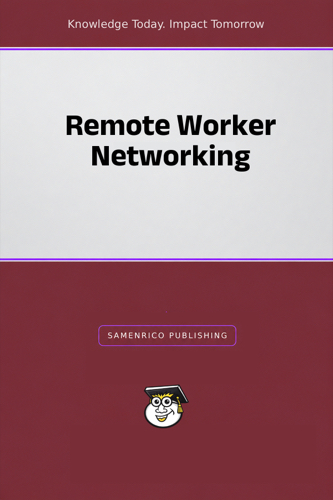
Remote Worker Networking eBook
Build meaningful professional connections without
Build meaningful professional connections without water cooler moments.
Formats
Free sample
Chapter 1: The Proximity Trap--–- On a Tuesday morning in March 2021, two employees at the same software company had identical performance reviews. Both exceeded targets. Both received “exceeds expectations” in four out of five categories. Both were up for promotion. One worked from the office three days a week.
The other had moved to Boise during the pandemic and never came back. Six months later, the office-based employee was promoted to senior manager. The remote employee received a “cost-of-living adjustment” and a polite note about “visibility challenges.” The remote worker had been outperforming the office worker on every quantitative metric. It did not matter.This is the proximity trap. It is not a conspiracy.
It is not malicious. It is a cognitive bias baked into human evolution: we trust, remember, and reward people we see. For 100,000 years, proximity was the only signal of safety. The tribe member who sat beside the fire was the tribe member who survived. The cave painter who showed up every day was the one who got credit for the murals.
Remote work has not repealed this biology. It has simply removed the fire. And most remote workers have no idea how to build a new one.This book is not about productivity. It is not about Zoom backgrounds or time tracking or async documentation. Those are tactics.
This book is about survival. Specifically, it is about the single most underestimated risk of remote work: the slow, silent, completely invisible decay of your professional network. If you are a remote worker and you are not deliberately, systematically, and aggressively building connections, you are falling behind. Not because you are bad at your job. Because the game has changed and no one gave you the new rules.The primary villain of this book is not your boss, not your company’s return-to-office policy, and not your own introversion.
The primary villain is a belief. It is the illusion of passive networking. This is the deeply comforting, completely wrong idea that if you do good work, people will notice. That if you are helpful, reliable, and skilled, your reputation will spread organically. That networking is something that happens to you, not something you do.The office environment sustained this illusion for decades.
In a physical workplace, passive networking worked well enough. You sat near a decision-maker. You shared an elevator. You made coffee while the VP was refilling their mug. These moments were not intentional.
They were incidental. And they were sufficient to keep you visible, memorable, and promotable. Remote work has eliminated incidental visibility entirely. There is no elevator. There is no coffee machine.
There is no hallway. There is only the cold, empty space between your camera lens and theirs.This chapter is called “The Proximity Trap” because proximity was never a strategy. It was a crutch. And remote work has kicked the crutch out from under you. The good news is that deliberate networking — the kind this book teaches — is actually more effective than passive proximity ever was.
The bad news is that most remote workers never learn it. They wait for the virtual water cooler to appear. It never does. And three years later, they wonder why their career stalled while their office-based peers advanced.Let us begin by understanding exactly how the trap works, why your brain is wired to fall into it, and what you must do today to start climbing out.The Zero-Serendipity Problem In the physical office, serendipity was baked into the architecture. Open floor plans, shared kitchens, and centralized printers created forced interactions between people who would never have chosen to meet.
A 2018 study by Harvard Business School tracked email and meeting data from a large multinational before and after a move to an open-plan office. The result? Cross-departmental communication increased by 52 percent purely through proximity. People were not trying to network. They were just walking past each other.Remote work has zero serendipity baked in.
Your Zoom link does not accidentally connect you to someone from finance. Your Slack channel does not force you to wait for the microwave next to a product manager. Every single interaction in a remote environment requires a trigger — a reason to reach out — and a tool — a platform to do it. If either is missing, the interaction does not happen.This is what I call the Zero-Serendipity Problem. It is the single largest structural difference between office and remote work.
And it is invisible. You do not notice the conversations that never happened. You do not mourn the elevator ride you did not take. You simply arrive at your one-year remote anniversary and realize, with a sick feeling, that you have made exactly zero new connections outside your immediate team.The data is stark. A 2022 study of 10,000 remote workers found that those who had been remote for more than 18 months had, on average, 47 percent fewer weak ties (acquaintances outside their direct reporting line) than their office-based peers.
Weak ties are the most important predictor of career mobility. They are how you hear about new roles, learn about internal transfers, and get recommended for promotions. Weak ties are the grease on the gears of your career. Remote work dries them out.Consider Sarah, a senior designer at a mid-sized tech company. Before the pandemic, she worked in an office with 200 people.
She knew the head of product because they took the same train. She knew the CMO because their desks were on the same floor. She knew three engineers from the marketing team because they always ate lunch at the same time. She did not try to meet any of these people. She just showed up.
When Sarah went fully remote in 2020, she assumed her network would persist. It did not. Within nine months, the head of product had forgotten her name. The CMO had never heard of her. The engineers had moved to different teams.
Sarah had the same skills, the same output, and the same title. But her career capital had evaporated like water on a hot sidewalk.The Zero-Serendipity Problem is not your fault. But it is your problem to solve.Reframing Networking: From Transaction to Intel Most people hate networking because they think it means using people. The classic networking advice — “collect business cards,” “follow up within 48 hours,” “offer value before you ask for anything” — feels manipulative because it is. It treats relationships as transactions and humans as resources.
No wonder people avoid it.This book rejects that framework entirely. Drawing on Rachel Simon’s excellent work in “Relationships at Work,” I want you to reframe networking from “using people for gain” to “gathering organizational intel.” Networking is not about what you can get. It is about understanding how the organization actually works. Who makes decisions? How do projects really get approved?
What are the unspoken rules that determine who gets promoted? These are not secrets. They are just information that lives inside other people’s heads. Networking is the act of asking.When you reframe networking as curiosity rather than transaction, everything changes. You are not asking for a favor.
You are asking for understanding. You are not trying to impress anyone. You are trying to learn. This shift in…
This is the end of the free sample. Get the eBook to keep going. Buy now
About this book
Details
- Author
- Marks Sharolyn
- Publisher
- SamEnrico
- Language
- English
- Genre
- Non-Fiction, Self-Help, Remote Work
- Released
- 2026-06-07
- Pages (approx.)
- 130
- Available as
- eBook, Audiobook

Read better in the ZLOADR app
Your eBooks on your phone or tablet. Sign in with your SamEnrico account and start reading.
More by Marks Sharolyn
 Postnatal Depletion Self CareMarks Sharolyn$11.99
 Kurosawa Epic StorytellingMarks Sharolyn$11.99
 Pokemon GO Location CompulsionMarks Sharolyn$11.99
 DoorDash Peak Pay Evaluation GuideMarks Sharolyn$11.99
 The Shanghai Ghost Hackers: Digital Heists in the Age of Opium and CodeMarks Sharolyn$11.99
 Understanding MeningoencephaloceleMarks Sharolyn$17.99
 RingetteMarks Sharolyn$11.99
 How to Become a Tube DrawerMarks Sharolyn$11.99
 Cultural Intelligence Skills GuideMarks Sharolyn$12.99
 Project Management Common MistakesMarks Sharolyn$12.99
You may also like
 Remote Work Anger ManagementClay Marlo$11.99
 Weekly Review for Remote WorkersReid Dustin$11.99
 Virtual Networking Success GuideWilloughby Eun$11.99
 Virtual Body Language GuideGilman Marx$11.99
 Virtual Assistant Deployment GuideGossett Kevin$11.99
 Remote Work Self Esteem HandbookTucker Lillie$11.99
 Remote Work Loneliness GuideDennison Karon$11.99
 Remote Work Isolation GuideDurant Shea$11.99
 Remote Work Anger Management GuideCampos Ivey$11.99
 Remote Communication Skills GuideLoomis Billie$11.99
 Breath Awareness For Zoom FatigueParkinson Cassey$11.99
 Virtual Meeting Body Language GuideFeldman Lenna$11.99