
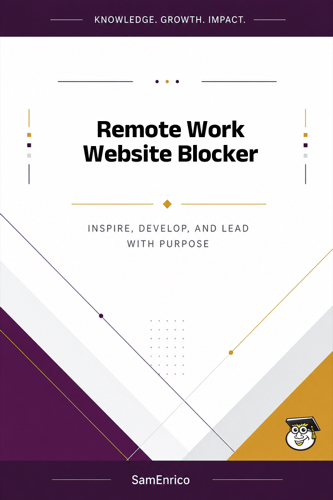
Non-FictionSelf-HelpWebsite BlockersFocus
Remote Work Website Blocker eBook
Block distracting websites during deep work sessio
Block distracting websites during deep work sessions using browser extensions.
Formats
Free sample
Chapter 1: The $10,000 Typo--–- The notification arrived at 2:47 PM on a Tuesday. Priya, a senior backend engineer at a midsize fintech company, was deep in a complex database migration. She had just triggered a 30-second build process—just enough time to check one thing. One quick glance at Twitter. Just to see what was happening.Twenty-five minutes later, she emerged from a rabbit hole of memes, political arguments, and a heated thread about whether pineapple belongs on pizza.
Her build had finished twenty-four minutes ago. In her inbox sat an urgent email from her boss, marked with three red exclamation points. A client had been overcharged $10,000 due to a pricing table error that Priya had been assigned to fix that morning. The deadline for the fix was 2:30 PM. It was now 2:52 PM.The client noticed before the company did.
The refund was processed with an apology. The account manager had to make a groveling call. Priya wasn't fired—she was too valuable for that—but she received a formal warning and was excluded from the next quarterly bonus pool. The $10,000 loss was real. But the true cost was invisible: the months of trust eroded, the late nights she would work to rebuild her reputation, and the quiet humiliation of explaining to her partner why their vacation fund was $3,000 lighter.The culprit wasn't laziness.
Priya worked sixty-hour weeks. The culprit wasn't incompetence; her code reviews were meticulous. The culprit wasn't even Twitter, which she rarely posted on. The culprit was something far more insidious, something that affects every remote worker in the age of the always-open browser. The culprit was attention residue.The Science of the Half-Finished Thought Attention residue is the term coined by Sophie Leroy, a business professor at the University of Washington, to describe what happens when you switch from Task A to Task B before completing Task A.
A portion of your attention remains stuck on the unfinished task, like a needle left in a record player, scratching and skipping while you try to listen to a new track.In Priya's case, she didn't switch from "waiting for build" to "checking Twitter." She switched from "waiting for build AND worrying about the pricing table error" to "checking Twitter while still worrying about the pricing table error." The 30-second build was never the problem. The problem was that her brain had already moved on to the next task before the current one was complete, and Twitter provided the perfect escape hatch for that restless energy.Leroy's research, published in the Academy of Management Journal, found that people who switch tasks before completing the first one perform significantly worse on both tasks—not because they lack skill, but because their cognitive bandwidth is split. The effect persists even after the switch. In one study, participants who were interrupted mid-task took 40% longer to complete the second task and made twice as many errors as those who completed the first task before moving on.Forty percent longer. Twice as many errors.
Those numbers are not minor inefficiencies. They are the difference between a profitable quarter and a missed deadline. Between a promotion and a warning letter. Between finishing your work at 5 PM and dragging yourself to the laptop at 10 PM to finish what you should have done hours ago.Deep Work vs. The Cult of Busy This brings us to a concept that will serve as the backbone of this entire book: Deep Work.
Cal Newport, a computer science professor at Georgetown and the author of the bestselling book Deep Work, defines it as follows:"Professional activities performed in a state of distraction-free concentration that push your cognitive capabilities to their limit. These efforts create new value, improve your skill, and are hard to replicate."Notice what Deep Work is not. It is not answering emails. It is not attending Zoom meetings. It is not updating a spreadsheet or rearranging your calendar or responding to Slack messages.
Those activities are what Newport calls Shallow Work: logistical, non-cognitively demanding tasks that are often performed while distracted and that create little new value.The brutal truth that most remote workers refuse to accept is this: Shallow Work makes you feel busy. Deep Work makes you valuable.Let that land for a moment. Your inbox can be full, your calendar can be packed, your Slack status can be set to "active" for ten hours straight, and you can still produce almost nothing of lasting value. Meanwhile, a novelist who writes for three uninterrupted hours each morning creates a book. A software engineer who closes Slack for two hours ships a feature.
A marketer who turns off notifications for ninety minutes writes a campaign that generates six figures.The difference is not hours worked. The difference is attention invested.Priya was busy. She answered every Slack message within four minutes. She never let an email go unanswered for more than an hour. She attended every meeting she was invited to.
By every shallow metric, she was a model employee. But she missed a $10,000 error because she couldn't hold her focus for thirty seconds. Her busyness was a performance. Her deep work—the actual work that justified her salary—was being silently assassinated by a thousand small distractions.The Math of the Stolen Year Let's make this concrete. Assume you are a knowledge worker who attempts to focus for eight hours per day.
Now track where those eight hours actually go.The Average Remote Work Day (Realistic Estimate):Activity Time Email checking and response1.5 hours Slack/Teams communication1.5 hours Meetings (scheduled and impromptu)1.5 hours Context switching between tasks1 hour"Quick checks" of social media/news1 hour Administrative tasks (expenses, scheduling, etc.)0.5 hours Remaining for actual focused work1 hour One hour. Out of eight. That is not an exaggeration; it is the median finding from multiple workplace productivity studies conducted between 2020 and 2024. The average remote worker spends roughly 12% of their day in deep work. The other 88% is fragmentation.Now apply the attention residue penalty.
Even during that one hour of "focused" work, you are likely carrying residue from the emails you just checked, the Slack message you half-answered, and the meeting that ran five minutes over. Your effective deep work output is perhaps forty-five minutes per day.Now do the annual math:45 minutes of true deep work per day225 working days per year (after weekends, holidays, and PTO)Total annual deep work: 168.75 hours But what could you achieve? What if you protected just two hours per day of genuine, uninterrupted deep work?120 minutes of protected deep work per day225 working days per year Total annual deep work: 450 hours The difference is 281.25 hours per year. That is seven full work weeks. You are losing almost two months of your best cognitive output every single year to distraction and context switching.
And unlike a layoff or a pay cut, this loss is invisible. No one sends you a memo saying, "Congratulations, you have lost seven weeks of your life to scrolling." You simply close your laptop one December evening and wonder why you feel so exhausted and so unaccomplished.Why Willpower Is a Trap At this point, a certain kind of reader will be thinking: I just need to try…
This is the end of the free sample. Get the eBook to keep going. Buy now
About this book
Details
- Author
- Wesley Frieda
- Publisher
- SamEnrico
- Language
- English
- Genre
- Non-Fiction, Self-Help, Website Blockers, Focus
- Released
- 2026-06-09
- Pages (approx.)
- 149
- Available as
- eBook, Audiobook

Read better in the ZLOADR app
Your eBooks on your phone or tablet. Sign in with your SamEnrico account and start reading.
More by Wesley Frieda
 The Instagram Comparison TrapWesley Frieda$11.99
 Gambling Addiction for TradersWesley Frieda$11.99
 Financial Stress Homeowner GuideWesley Frieda$11.99
 The Lost Chronicles of Ibn Battuta: The Black Explorer Who Charted the WorldWesley Frieda$11.99
 NYL Sales ManagementWesley Frieda$11.99
 Managing Up Difficult Bosses GuideWesley Frieda$12.99
 How to Start a Bitumen Spreaders Business (Beginners Guide)Wesley Frieda$11.99
 Learn to Play the SarodWesley Frieda$11.99
You may also like
 Hong Kong Handover 1997Dunn Johnnie$11.99
 Zumba For Postnatal Recovery CourseNeal Christian$11.99
 Zumba for BeginnersLadner Nikia$11.99
 YouTube Comment Mining GuideHumes Pandora$12.99
 Worry Box MeditationCarlin Rudy$11.99
 Workplace Stress MeditationNguyen Lynn$11.99
 Workplace Stress and Sleep RepairHawley Ivory$11.99
 Workplace Perfectionism CureDelaney Jeffry$11.99
 Workplace Injustice Anger GuideWallen Isabelle$11.99
 Work Addiction and Burnout LinkGreenwood Ester$11.99
 Women in Yoga and WellnessBeattie Galina$11.99
 Women in Stand Up ComedyChun Evangeline$11.99