
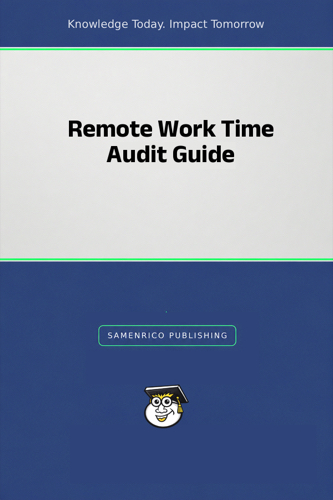
Remote Work Time Audit Guide eBook
Track your hours for one week to identify where ti
Track your hours for one week to identify where time actually goes.
Formats
Free sample
Chapter 1: The Performance Trap--You are working more hours than ever before, yet you feel less productive than when you sat in a cubicle. You close your laptop at 6 PM with a vague sense of exhaustion, but when asked what you actually accomplished, your mind goes blank. You moved your mouse at 11 PM to appear active. You answered a Slack message while brushing your teeth. You sat through a 90-minute meeting where nothing was decided, then spent another 45 minutes recovering your focus.
This is not a personal failing. This is the Performance Trap.The Performance Trap is the unconscious habit of substituting activity for achievement. It is the relentless pressure to look busy in an environment where visibility has replaced trust. In a physical office, your presence was your proof of work. Your boss could see you at your desk, typing, frowning at a spreadsheet, walking to a conference room.
That visual evidence—however superficial—provided a sense of productivity. But remote work stripped away that visibility. In its place, remote workers have constructed a new form of proof: digital performativity.You jiggle the mouse to keep your Slack status green. You send emails at 9:47 PM to show dedication. You type furiously during Zoom calls to demonstrate engagement.
You open documents you have no intention of reading, just to add to your "active time" log. These are not signs of laziness. They are survival strategies in a system that has not yet learned how to measure output rather than input.But here is the truth that this book will prove to you over the next seven days: busyness is a defense mechanism, and the audit will expose it. And that exposure is not punishment. It is the first step toward freedom.The Myth of the 10-Hour Day Let us begin with a simple question: If you worked ten hours today, what did you produce?Not what did you do.
Not what tabs did you open, what emails did you send, what Slack channels did you scroll. What did you produce that moved your professional life forward in a meaningful way? One client proposal? Two hundred lines of code? A resolved customer complaint?
A strategic document that your team will use for months?For most remote workers, the answer is shockingly little relative to the hours logged. A growing body of research confirms this disconnect. A 2022 study of 10,000 knowledge workers found that while remote employees logged an average of 4.5 more hours per week than their in-office counterparts, their output—measured by completed tasks, revenue generated, or projects delivered—increased by less than 2 percent. The extra hours were not producing extra results. They were producing activity.This is the central illusion of the modern remote workday: hours worked and value created have decoupled.Consider an experiment conducted by a Fortune 500 technology company during the first year of widespread remote work.
The company tracked two groups of software engineers. Group A was told to work their normal schedule but to log their hours meticulously. Group B was told to work no more than six hours per day but to protect those hours from all interruptions—no Slack, no email, no meetings. After three months, Group B produced 23 percent more code, reported 40 percent less stress, and had zero increase in bugs or errors. Their managers could not tell which engineers were in which group based on output alone.
The only visible difference was that Group A's Slack status was green for fourteen hours a day, and Group B's was yellow for six.The lesson is uncomfortable but undeniable: presence is not productivity.The Birth of Performative Work The Performance Trap did not appear overnight. It evolved in response to three specific pressures of remote work.Pressure 1: The Visibility Vacuum In an office, your manager can see you working. This visual confirmation is not perfect—you could be shopping online while staring at a screen—but it provides a baseline sense of accountability. Remote work removed that visual confirmation entirely. In its place, remote workers began to signal their work through digital proxies: rapid Slack responses, after-hours emails, constant document edits, and an ever-green calendar.These signals are not work.
They are evidence of work. And once you begin producing evidence rather than output, the trap closes around you. You spend more time appearing busy than being productive. Your Slack response time becomes your performance review. Your email timestamp becomes your reputation.Pressure 2: The Always-On Expectation Remote work blurred the boundary between work and life, but it also blurred the boundary between work and performance.
When your laptop is always in your home, the expectation—explicit or implicit—is that you are always available. A Slack message at 9 PM feels urgent because you are physically near your computer. An email at 11 PM feels demanding because you can see the notification on your phone.This expectation is rarely stated by managers. It is absorbed from the culture. Colleagues who respond at midnight are celebrated as "dedicated." Those who log off at 5 PM are labeled as "disengaged." The result is a race to the bottom of performative availability, where the winner is the person who signals the most presence, not the person who produces the most value.Pressure 3: The Guilt of Flexibility Remote work offers genuine flexibility.
You can start late, take a long lunch, pick up your child from school, or run an errand in the middle of the day. This flexibility is one of the greatest benefits of working from home. But it comes with a hidden cost: guilt.When you take an hour to go to a doctor's appointment, you feel the need to make up that hour by working later. When you spend twenty minutes folding laundry between tasks, you feel the need to extend your evening work session. The flexibility that should reduce stress instead creates a debt economy of time.
You borrow hours from your evening and repay them with interest from your weekend. The accounting is invisible, but the ledger is always red.These three pressures combine to create the Performance Trap: a cycle of visibility-seeking, availability-signaling, and guilt-driven overwork that produces the appearance of productivity without the reality.The Cost of the Performance Trap The Performance Trap is not merely annoying. It is expensive in ways that most remote workers never calculate.The Financial Cost Take a moment to estimate your hourly rate. Not your official rate—your true rate based on the hours you actually work. If you earn $80,000 per year and work 40 hours per week for 50 weeks, your official rate is $40 per hour.
But if you are caught in the Performance Trap, you are not working 40 focused hours. You are working 55 hours of fragmented, interrupted, performative activity. Suddenly, your true rate drops to $29 per hour. You have lost $11 per hour to the Performance Trap. Over a year, that is more than $15,000 of your time—time you will never get back.This calculation becomes even more striking when you isolate deep work hours—the cognitively demanding, high-value tasks that actually move your career forward.
Most remote workers have between two and three deep work hours per day. The remaining hours are shallow work, admin, communication, and unconscious breaks. When…
This is the end of the free sample. Get the eBook to keep going. Buy now
About this book
Details
- Author
- Bradbury Winnie
- Publisher
- SamEnrico
- Language
- English
- Genre
- Non-Fiction, Self-Help, Time Audit
- Released
- 2026-06-09
- Pages (approx.)
- 137
- Available as
- eBook, Audiobook

Read better in the ZLOADR app
Your eBooks on your phone or tablet. Sign in with your SamEnrico account and start reading.
More by Bradbury Winnie
 Russian Mafia in AsiaBradbury Winnie$11.99
 Opioid Free Living Practical CourseBradbury Winnie$11.99
 Community Beekeeper GuideBradbury Winnie$11.99
 Grout Cleaner Bleach FumesBradbury Winnie$11.99
 Middle Passage Oral HistoriesBradbury Winnie$11.99
 Resilience For First Generation StudentsBradbury Winnie$11.99
 Barbell Basics GuideBradbury Winnie$11.99
 The Dragon Heads: China's Underworld DynastiesBradbury Winnie$11.99
 Beethoven's Immortal Ninth: The Symphony That Defied SilenceBradbury Winnie$11.99
 How to Produce Lotion and Sunscreen ApplicatorsBradbury Winnie$11.99
 A Collector's Handbook to the Mg TbBradbury Winnie$11.99
 How to Produce Watercraft Mufflers and PartsBradbury Winnie$11.99
You may also like
 Calendar Zero MethodEspino Esta$11.99
 Time Auditing for BlockersRafferty Jack$11.99
 Time Audit Priority ResetSpain Leonida$11.99
 Parent Time Audit GuideToledo Earlean$11.99
 Weekly Calendar AuditSwank Veola$11.99
 Remote Time Audit GuideWhitten Lashawna$11.99
 Time Auditing for Better BlocksLozano Jillian$11.99
 Time Audit And ResetHimes Carl$11.99
 Time Audit and BlockingBradford Dorthy$11.99
 The Time Auditing Tracking GuideStreet Chauncey$11.99
 The Parent Time Tracking WorksheetLemmon Erminia$11.99