
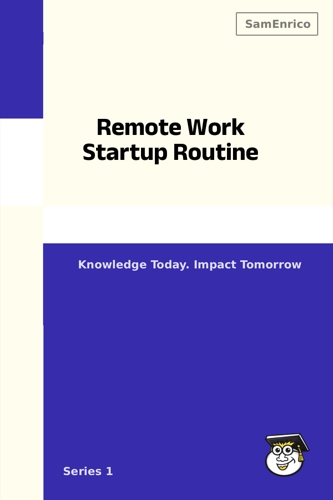
Non-FictionSelf-HelpMorning Routine
Remote Work Startup Routine eBook
Begin each workday with intention rather than roll
by Milton Sunny
Begin each workday with intention rather than rolling out of bed to laptop.
Formats
Free sample
Chapter 1: Your Bed Is Not Your Cubicle--–- The alarm shrieks. You grope for the phone, silence it, and immediately see seventeen Slack messages, three emails marked “URGENT,” and a calendar notification for a 9 AM standup. It’s 8:47 AM. You roll over, open your laptop from the pillow, and begin typing. This is not a morning routine.
This is a hostage situation.Welcome to the paradox of remote work. You were promised freedom: no commute, flexible hours, the ability to work in comfortable clothes. What you got instead is a strange, gnawing sensation that you never actually leave the office—because the office followed you into your bedroom. The very sanctuary designed for rest, intimacy, and sleep has become a stress zone. And the cost is higher than you think.The Context Shift Problem The human brain is a pattern-matching machine.
It learns through repetition and association. When you repeatedly answer emails from your pillow, your brain quietly rewires itself. It begins to associate the soft texture of your sheets with the sharp anxiety of a deadline. The smell of your pillow becomes linked to the dopamine spike of a Slack notification. Over time, you develop a condition that neuroscientists call “contextual confusion”: your brain no longer knows whether the bedroom is for sleeping or for stressing.This is not a metaphor.
It is a measurable neurological phenomenon. Researchers have documented that when people work from their bedrooms, their sleep quality degrades by an average of forty-seven minutes per night. They take longer to fall asleep, wake more frequently, and report feeling less rested even after eight hours in bed. Why? Because their brains never fully disengage from work mode.
The bedroom has become an extension of the office, and the office never closes.Consider the data point that shocked me during my research. The cognitive cost of switching directly from Delta wave sleep—the deep, restorative state where your body repairs itself—to Gamma wave stress—the high-frequency brain state associated with anxiety and hypervigilance—without any transitional ritual increases cortisol levels by over fifty percent in the first hour of waking. Cortisol is your body’s primary stress hormone. A little of it helps you wake up. Too much of it, too early, and you spend the entire day fighting a low-grade sense of panic.You feel this as morning dread.
That sinking sensation in your chest when you remember your to-do list. That urge to hide under the covers. That exhaustion that somehow arrives before you have done anything at all. It is not a character flaw. It is a neurological response to a broken environment.The Myth of Sleeping In Here is a confession that will sound familiar.
You set your alarm for 7:00 AM with every intention of starting the day with intention. But when the alarm goes off, you hit snooze. Then again. Then again. Finally, at 8:55 AM, you throw off the covers, open your laptop, and join the 9:00 AM standup with your camera off and your hair unbrushed.
You tell yourself that you “slept in” and that you needed the rest.But here is the uncomfortable truth: you did not sleep in. You never actually woke up.Sleeping until 8:55 AM for a 9:00 AM meeting feels terrible not because you are lazy, but because you never completed the biological process of waking. Waking is not a single event. It is a transition that takes the human body between fifteen and forty-five minutes to complete. During this transition, your body temperature rises, your cortisol naturally spikes (the healthy kind, not the stress-induced kind), and your brain shifts from slow-wave activity to the faster rhythms of conscious thought.
When you skip this transition—when you go directly from pillow to password—you bypass the entire waking process. You are not rested. You are simply upright.The Myth of Sleeping In convinces you that more sleep is the solution. But the remote workers I interviewed who reported the highest levels of morning energy were not the ones who slept until 8:55 AM. They were the ones who woke at 7:00 AM, even on days when they were tired, and spent thirty minutes transitioning intentionally before opening their laptops.
They slept fewer minutes but felt more rested. Because rest is not just about quantity. It is about quality. And quality requires separation between sleep and stress.The Designer Who Broke the Cycle Let me tell you about Maya. She is a freelance graphic designer who started working remotely in 2020 and never went back to an office.
By 2022, she was miserable. She loved her clients and her projects, but she dreaded mornings. She would wake up, check her phone from bed, see revision requests and frantic emails, and feel a wave of nausea. She started drinking coffee before brushing her teeth. She stopped exercising.
She gained weight. She fought with her partner about being “always working.” Her bedroom, once a cozy retreat, had become a source of anxiety.Maya tried all the standard advice. She bought a better mattress. She installed blackout curtains. She tried meditation apps.
Nothing worked because she was treating the symptoms rather than the cause. The cause was not her sleep hygiene. The cause was that her brain had learned to associate her bedroom with work stress.The turning point came when Maya did something simple but radical. She moved her laptop out of her bedroom. Not just onto a desk in the corner—out of the room entirely.
She put it on the kitchen table. She also moved her phone charger to the living room. For the first week, she felt anxious. What if a client needed something in the middle of the night? (They never did.) What if she woke up and wanted to check email?
(She did, but she had to get out of bed to do it, which made her more awake.)Within two weeks, the change was undeniable. Maya started sleeping through the night. She stopped waking up with a racing heart. She began looking forward to the first thirty minutes of her day—sitting at the kitchen table, drinking tea, reviewing her schedule without the weight of her pillow reminding her of the stress that awaited. She did not change her workload.
She did not change her clients. She changed only one thing: where she started her day. And that one change unlocked everything else.Maya’s story is not unique. In my research, I found that remote workers who physically separate their sleep space from their work space report thirty-eight percent lower morning anxiety and forty-two percent higher satisfaction with their work-life balance. The single most powerful intervention is not a fancy app or a complicated system.
It is distance. Physical, literal distance between where you sleep and where you work.The Case for the Work-Free Bedroom If you take nothing else from this chapter, take this: your bedroom must become a work-free zone. Not a “mostly work-free” zone. Not a “I’ll just check one email” zone. Completely, uncompromisingly work-free.Why such rigidity?
Because the brain does not understand exceptions. If you work from your bedroom once a week, your brain still learns that the bedroom is a potential work…
This is the end of the free sample. Get the eBook to keep going. Buy now
About this book
Details
- Author
- Milton Sunny
- Publisher
- SamEnrico
- Language
- English
- Genre
- Non-Fiction, Self-Help, Morning Routine
- Released
- 2026-06-09
- Pages (approx.)
- 142
- Available as
- eBook, Audiobook

Read better in the ZLOADR app
Your eBooks on your phone or tablet. Sign in with your SamEnrico account and start reading.
More by Milton Sunny
 Vinyl Shower Curtain DangersMilton Sunny$11.99
 The Retirement Housing Home SwapMilton Sunny$11.99
 Middle Passage Human CargoMilton Sunny$11.99
 Success Without Burnout for AccountantsMilton Sunny$11.99
 Assertive Legal AdvocacyMilton Sunny$11.99
 Town Librarian Legacy StoryMilton Sunny$11.99
 Exercise For Mental ImmunityMilton Sunny$11.99
 Tycho Brahe and the Celestial Clockwork: The Danish Astronomer Who Defied the HeavensMilton Sunny$11.99Tycho Brahe and the Celestial Clockwork: The Danish Astronomer Who Defied the HeavensMilton Sunny$11.99
 The Visionary Builders of Great Zimbabwe: Architects of the Stone KingdomMilton Sunny$11.99
 How to Produce Liquor and SpiritsMilton Sunny$11.99
 How to Become a Router TenderMilton Sunny$11.99
You may also like
 Hong Kong Handover 1997Dunn Johnnie$11.99
 Zumba For Postnatal Recovery CourseNeal Christian$11.99
 Zumba for BeginnersLadner Nikia$11.99
 YouTube Comment Mining GuideHumes Pandora$12.99
 Worry Box MeditationCarlin Rudy$11.99
 Workplace Stress MeditationNguyen Lynn$11.99
 Workplace Stress and Sleep RepairHawley Ivory$11.99
 Workplace Perfectionism CureDelaney Jeffry$11.99
 Workplace Injustice Anger GuideWallen Isabelle$11.99
 Work Addiction and Burnout LinkGreenwood Ester$11.99
 Women in Yoga and WellnessBeattie Galina$11.99
 Women in Stand Up ComedyChun Evangeline$11.99