
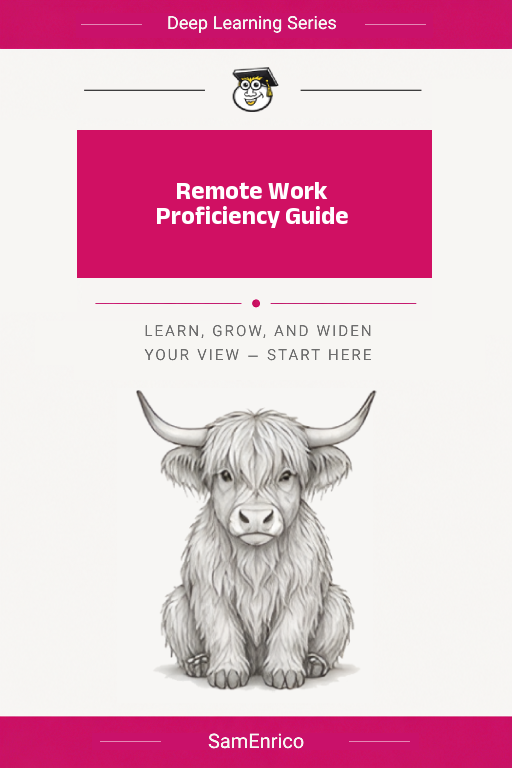
Non-FictionForecast & OutlookRemote Skills
Remote Work Proficiency Guide eBook
Discover asynchronous communication, self-manageme
by Casey Grace
Discover asynchronous communication, self-management, and digital collaboration tool mastery demand.
Formats
Free sample
Chapter 1: The Office Delusion--–- On a Tuesday morning in March 2021, a senior product manager at a Fortune 500 company did something that would forever change how she thought about work. She had just finished her third back-to-back Zoom meeting of the day—none of which required her active participation—when she looked at her Slack unread count: 847 messages. Her calendar showed six more meetings before 5 PM. She had not eaten lunch. She had not used the bathroom in four hours.
And she had not, in her own estimation, done any actual work.Her name was Priya, and she was considered a high performer. Her team had transitioned to remote work twelve months earlier, and in that time, her productivity metrics—tickets closed, emails sent, meetings attended—had all increased. But she felt exhausted, anxious, and strangely less effective than when she had commuted an hour each way to a cubicle. The numbers said she was doing more. Her body and brain said she was doing less of what mattered.Priya's experience is not unusual.
It is, in fact, the default outcome for most teams that attempt to replicate the office environment online. And it is the central problem this book exists to solve.The remote work revolution was supposed to liberate us from the tyranny of the commute, the performative busyness of open-plan offices, and the wasted hours of unproductive meetings. For many, it has delivered on some of those promises. But for a shocking number of workers and teams, remote work has become something else entirely: a 24/7 treadmill of notifications, back-to-back video calls, and an ever-expanding mountain of shallow work that feels urgent but produces little lasting value.This chapter makes a provocative claim: Most remote teams fail not because they lack the right tools or the right talent, but because they are trying to clone the office in a world where the office no longer exists. They have imported the worst features of synchronous work—interruption-driven communication, meeting culture, and the illusion of visibility through physical presence—into an environment where those features are actively harmful.The good news is that there is a better way.
It is called asynchronous-first work, and it is the foundation upon which every successful remote team is built. But before we can build that foundation, we must first demolish the myths that keep us tethered to the office mindset.The Great Illusion: Why We Keep Copying the Office Let us begin with an uncomfortable truth: The office was never as efficient as we remember it.Human memory is a notoriously unreliable narrator. When we look back at our time in physical offices, we tend to recall the productive collaboration, the spontaneous brainstorming sessions, the camaraderie of shared lunch breaks. What we conveniently forget are the two-hour meetings that could have been emails, the open-plan desk arrangements that made deep work impossible, the performative "busyness" of staying late to impress a manager, and the soul-crushing commute that drained energy before the day even began.The office had inefficiencies baked into its very structure. But we tolerated those inefficiencies because we had no choice.
You could not leave a meeting early without appearing rude. You could not ignore a colleague who walked up to your desk. You could not simply decide to work from a quiet room when the open floor plan became unbearable. The physical constraints of the office enforced a particular rhythm of work—one that prioritized availability over depth, presence over output, and real-time response over thoughtful reflection.When the pandemic forced millions of workers into their homes, something strange happened. Many people discovered that without the physical constraints of the office, they could actually focus.
The commute vanished, returning hours of time. The open-plan interruptions ceased. The performative busyness became obviously absurd when no one could see you.But then something else happened. Managers, accustomed to measuring productivity by visual cues—who arrived first, who stayed latest, who looked the most engaged in meetings—began to panic. Without the ability to see their teams, they defaulted to the only tool they had left: more communication.
More check-ins. More meetings. More Slack messages.And just like that, we rebuilt the office inside our computers.The Three Deadly Sins of Synchronous Mimicry What exactly goes wrong when teams try to replicate the office online? Based on research into hundreds of remote teams and interviews with knowledge workers across industries, I have identified three deadly sins that consistently destroy remote productivity.Sin Number One: The Meeting Sprawl In a physical office, meetings are constrained by room availability, travel time between buildings, and the simple fact that gathering ten people in one place requires coordination. Online, those constraints disappear.
You can schedule a meeting with fifteen people across four time zones with two clicks. And so you do. And so does everyone else.The result is what Cal Newport calls the "meeting doomsday curve." In a team of ten people, there are forty-five possible one-on-one pairs. If each pair meets for just one hour per week, that is forty-five hours of meetings—more than a full workweek for one person, distributed across the team. Add in team meetings, all-hands, cross-functional syncs, and emergency calls, and the math becomes absurd.But the real cost is not measured in hours alone.
It is measured in the fragmentation of attention. A single one-hour meeting in the middle of the morning does not just consume that hour. It destroys the two hours before—spent anticipating the meeting and avoiding deep work—and the hour after—spent recovering and reorienting. One meeting can effectively destroy half a day of productive capacity.Sin Number Two: The Instant Message Trap Slack, Microsoft Teams, and their competitors were designed as asynchronous communication tools—placeholders for messages that could be answered when convenient. But in practice, they have become prisons of real-time expectation.The problem is psychological.
When a message appears in a chat channel, it creates an implicit demand for a response. Even if no one explicitly says "I need this now," the notification itself triggers a sense of urgency. Our brains, wired for social connection, find it almost impossible to ignore an unread message from a colleague.This is not a character flaw. It is a design feature of the human brain, and it is ruthlessly exploited by communication tools optimized for engagement rather than productivity. The result is that knowledge workers now spend an average of four hours per day on email and chat, switching tasks every ten to fifteen minutes, and losing twenty to forty percent of their productive capacity to context switching.Sin Number Three: The Visibility Fallacy In an office, managers can see who is working.
They can walk past desks, observe body language, and form intuitive judgments about who is contributing. This visibility creates a sense of control, even if it is an illusion—how many times have you stared at a spreadsheet while thinking about dinner?In a remote environment, that visual feedback disappears. And many managers, faced with this loss of control, double down on what remains: activity metrics. How many emails did you send? How many Slack messages did you post?
How many hours were you "active" in the system?This is the visibility fallacy: the mistaken belief that measuring activity is…
This is the end of the free sample. Get the eBook to keep going. Buy now
About this book
Details
- Author
- Casey Grace
- Publisher
- SamEnrico
- Language
- English
- Genre
- Non-Fiction, Forecast & Outlook, Remote Skills
- Released
- 2026-05-30
- Pages (approx.)
- 148
- Available as
- eBook, Audiobook

Read better in the ZLOADR app
Your eBooks on your phone or tablet. Sign in with your SamEnrico account and start reading.
More by Casey Grace
 Emergency Room Doctor PriorityCasey Grace$11.99
 Hands On Activity AI DesignerCasey Grace$11.99
 The Peruvian Immigrant SuccessCasey Grace$11.99
 The HGH IGF 1 RatioCasey Grace$11.99
 The Upwork Freelancer Success GuideCasey Grace$11.99
 The Billion-Dollar Lie: How a Whistleblower Faced RuinCasey Grace$11.99
 Purchase Ledger ClerkCasey Grace$11.99
 Understanding Mehes SyndromeCasey Grace$17.99
 Asana Project Management Quick StartCasey Grace$12.99
 Ultimate Handbook Guide to Xuancheng : (China) Travel GuideCasey Grace$11.99
You may also like
 Hong Kong Handover 1997Dunn Johnnie$11.99
 Zumba For Postnatal Recovery CourseNeal Christian$11.99
 Zumba for BeginnersLadner Nikia$11.99
 YouTube Comment Mining GuideHumes Pandora$12.99
 Worry Box MeditationCarlin Rudy$11.99
 Workplace Stress MeditationNguyen Lynn$11.99
 Workplace Stress and Sleep RepairHawley Ivory$11.99
 Workplace Perfectionism CureDelaney Jeffry$11.99
 Workplace Injustice Anger GuideWallen Isabelle$11.99
 Work Addiction and Burnout LinkGreenwood Ester$11.99
 Women in Yoga and WellnessBeattie Galina$11.99
 Women in Stand Up ComedyChun Evangeline$11.99