
Non-FictionSelf-HelpLeadership
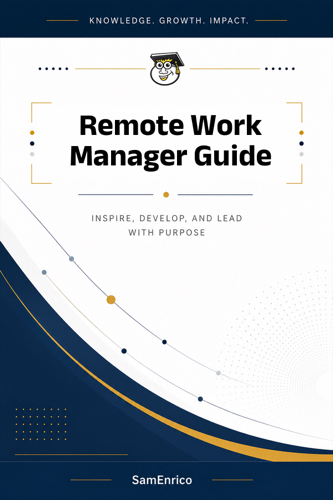
Remote Work Manager Guide eBook
Leads remote teams effectively.
by Vines Roxann
Leads remote teams effectively.
Formats
Free sample
Chapter 1: The Proximity Lie--–- Every morning, millions of managers open their laptops and commit the same mistake. They scan their team's Slack statuses, check who logged in early, note who appears idle, and feel a small wave of reassurance or anxiety based entirely on what they can see. This is the Proximity Lie—the deeply embedded belief that visibility equals productivity, that seeing someone work is the same as them working, and that a manager's job is to observe rather than enable.The problem is not that managers are lazy or controlling by nature. The problem is that the entire history of management has trained them to worship proximity. From the factory floors of the Industrial Revolution to the open-plan offices of the 2010s, the dominant model of leadership has been "management by walking around"—the idea that a good leader is present, visible, and available to observe, correct, and praise in real time.
This model worked reasonably well when everyone sat in the same building, on the same schedule, doing tasks that could be watched and measured by the naked eye.But remote work has shattered that model. And most managers are trying to repair it with duct tape and hope.This chapter is not a gentle introduction to remote leadership. It is a dismantling of everything you thought you knew about managing people. It will make you uncomfortable. It will challenge your instincts.
And if you let it, it will save your career from the slow death of micromanagement, burnout, and team failure.The Myth That Won't Die Let us name the enemy clearly. The Proximity Bias is the unconscious assumption that an employee you can see is working harder, better, and more reliably than one you cannot. It is the reason office workers are promoted faster than remote workers. It is the reason managers feel anxious when a team member's Slack icon turns yellow. It is the reason surveillance software—digital ankle monitors for knowledge workers—has become a billion-dollar industry.The data is brutal and consistent.
A 2023 study of over 10,000 remote managers found that 78 percent admitted to favoring employees they could see in person, even when objective performance metrics showed no difference. Another study revealed that remote employees receive 35 percent fewer promotions than their in-office counterparts with identical output. The Proximity Bias is not just unfair. It is actively destroying the careers of your best people while rewarding the ones who are simply most visible.Here is the truth that the Proximity Lie hides: visibility is not a proxy for productivity. It is a distraction from it.
A manager wandering the floor or scanning a dashboard of active hours is not managing. They are watching. And watching is not leading.The Great Unlearning To lead remote teams effectively, you must unlearn three habits that traditional management drilled into your bones.The first habit is the instinct to monitor activity. Your brain has been conditioned to feel secure when you see people busy. In an office, you hear keyboards clacking, see heads nodding in meetings, observe bodies moving between desks.
Each of these signals triggers a small dopamine release—the reward for "managing well." Remote work removes these signals, and your brain responds with anxiety. The solution is not to replace visual signals with digital ones (mouse trackers, screenshot monitors, Slack read receipts). The solution is to retrain your brain to value output over activity. This is not easy. It requires conscious effort and, initially, a great deal of discomfort.
But it is the only path forward.The second habit is the addiction to synchronous communication. In an office, everything happens in real time. You ask a question; you get an answer. You schedule a meeting; everyone walks to the same room. This immediacy feels efficient, but it is actually a tax on deep work.
Every interruption—every tap on the shoulder, every "quick question," every impromptu huddle—rips your team members out of focused flow and costs them up to twenty minutes to recover. Remote work offers an escape from this tyranny, but only if you reject the urge to recreate the office digitally. That means no mandatory "cameras on" policies. No expectation of instant Slack replies. No meetings that could have been an email.
This chapter will not solve this habit entirely—Chapter 3 is dedicated to the craft of asynchronous work—but you must accept now that your addiction to real-time communication is a liability, not a strength.The third habit is the fear of losing control. This is the deepest habit and the hardest to break. Most managers became managers because they were good at their individual contributor jobs. They knew the answers. They could solve the problems.
And when they see a team member struggling—or worse, when they cannot see them at all—their instinct is to jump in, take over, and fix things. This instinct is called micromanagement, and it is the number one predictor of remote team failure. Micromanagement flourishes in the absence of visibility. The manager, anxious and uncertain, begins asking for status updates, demanding documentation, checking in multiple times per day. Each check-in signals distrust.
Each demand for information steals autonomy. And slowly, methodically, the manager destroys the very thing they need most from a remote team: intrinsic motivation.The Three O's: A New Operating System This book is built around a simple framework that will appear in every chapter. The Three O's are not a checklist or a set of steps. They are a shift in consciousness—a new way of seeing your role as a manager.Results is the first O. It means shifting your focus from hours logged to work completed.
It means asking "What did you accomplish?" instead of "How long did you work?" It means trusting that your team members are adults who will manage their own time to achieve their goals. Results-based management is not laissez-faire. It is demanding. You still set clear expectations, hold people accountable, and intervene when results fall short. But you stop pretending that watching someone type is the same as them producing value.
This chapter introduces the concept of Results. Chapter 5 will give you the actual tool—the Output-Based Scorecard—to implement it. And Chapter 11 will warn you about the common mistakes that cause Results-based management to fail.Others is the second O. It means intentionally building trust and camaraderie without physical proximity. In an office, relationships form through osmosis—coffee breaks, hallway conversations, shared lunches.
Remote work has no osmosis. If you do not design relationships, they will not happen. This does not mean forcing awkward social hours or mandatory fun. It means creating rituals—reliable, predictable, low-stakes moments of connection—that make your team feel like a team. Chapter 2 will give you the playbook for building a Remote First culture.
Chapter 7 will show you how to onboard new hires into that culture. And Chapter 10 will teach you how to give feedback and recognition that strengthens, rather than weakens, relationships.Self is the third O. It means recognizing your own anxieties, biases, and triggers that lead to counterproductive behavior. You cannot lead others if you cannot lead yourself. Every time you feel the urge…
This is the end of the free sample. Get the eBook to keep going. Buy now
About this book
Details
- Author
- Vines Roxann
- Publisher
- SamEnrico
- Language
- English
- Genre
- Non-Fiction, Self-Help, Leadership
- Released
- 2026-06-08
- Pages (approx.)
- 139
- Available as
- eBook, Audiobook

Read better in the ZLOADR app
Your eBooks on your phone or tablet. Sign in with your SamEnrico account and start reading.
More by Vines Roxann
 Paraben Free Cosmetics ListVines Roxann$11.99
 Assertive Performance ReviewsVines Roxann$11.99
 The Retirement Housing Bridge Loan GuideVines Roxann$11.99
 The Foster Sibling BondVines Roxann$11.99
 Parent Loss Therapy OptionsVines Roxann$11.99
 Success Without Burnout for TeachersVines Roxann$11.99
 Quanah Parker ComancheVines Roxann$11.99
 The Raid of the Sea Wolves: Viking Mercenaries in the American RevolutionVines Roxann$11.99
 The Corsair of the Black Sea: Amiral Mikhail Lazarev and the Charge of the Russian FleetVines Roxann$11.99
 How to Produce LipstickVines Roxann$11.99
 A Collector's Handbook to the Metropolitan 1500Vines Roxann$11.99
 Opening Hook That Grabs ReadersVines Roxann$12.99
You may also like
 Hong Kong Handover 1997Dunn Johnnie$11.99
 Zumba For Postnatal Recovery CourseNeal Christian$11.99
 Zumba for BeginnersLadner Nikia$11.99
 YouTube Comment Mining GuideHumes Pandora$12.99
 Worry Box MeditationCarlin Rudy$11.99
 Workplace Stress MeditationNguyen Lynn$11.99
 Workplace Stress and Sleep RepairHawley Ivory$11.99
 Workplace Perfectionism CureDelaney Jeffry$11.99
 Workplace Injustice Anger GuideWallen Isabelle$11.99
 Work Addiction and Burnout LinkGreenwood Ester$11.99
 Women in Yoga and WellnessBeattie Galina$11.99
 Women in Stand Up ComedyChun Evangeline$11.99