
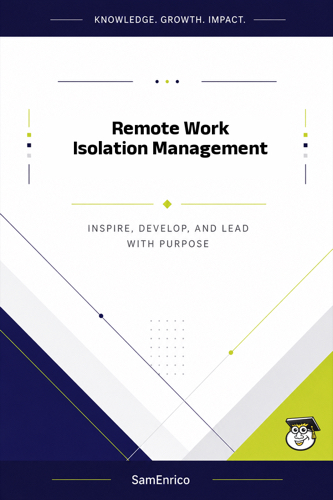
Non-FictionSelf-HelpRemote Work
Remote Work Isolation Management eBook
Combat loneliness and maintain team connection thr
by Pinto Mavis
Combat loneliness and maintain team connection through intentional check-ins and virtual co-working strategies.
Formats
Free sample
Chapter 1: The Invisibility Trap--The seventh Zoom call of the day ended at 4:47 PM. Maya closed her laptop, leaned back in her chair, and realized she had not laughed once in nine hours. She had spoken to fourteen people. She had exchanged forty-three Slack messages. She had answered seventeen emails.
And yet, as the silence of her home office settled around her, she felt utterly, completely alone.This is the paradox of modern remote work. Maya is not an outlier. She is a composite of every remote worker I have interviewed over the past three years—senior marketers, software engineers, HR directors, and customer success managers. They are all productive. They are all connected.
And they are all, in quiet moments they rarely admit to, lonely.The numbers bear this out. A 2023 study by the American Psychological Association found that remote workers report significantly higher rates of loneliness than their in-office counterparts—43 percent versus 27 percent. Another study from the University of Exeter found that remote employees experience "social disconnection" at nearly twice the rate of hybrid workers. And yet, paradoxically, these same workers report being busier than ever. More meetings.
More messages. More notifications.How can someone be surrounded by digital connection and still feel profoundly isolated?The answer is the subject of this chapter—and the foundation of this entire book. The problem is not that remote workers are alone. The problem is that they have become invisible. And invisibility, as we will explore, is far more dangerous than solitude.The Paradox of the Plugged-In Ghost Let us begin with a distinction that most books on remote work blur beyond recognition.
There is a fundamental difference between being busy and being connected. Busy is quantitative. It is measured in calendar blocks, unread messages, and completed tasks. Connected is qualitative. It is measured in inside jokes, spontaneous laughter, and the unspoken comfort of knowing that someone sees you—really sees you—as a person, not just a pair of hands on a keyboard.In her book Back to Human, Dan Schawbel introduces a concept she calls the "Isolation Paradox." The idea is simple but profound: digital communication tools have made us more reachable than ever before, but they have simultaneously made us less known.
We respond to emails within minutes. We react to Slack messages with emojis. We attend back-to-back Zoom calls where we perform attentiveness through carefully timed nods and smiles. And yet, at the end of the day, no one knows what we are worried about. No one knows what we are hoping for.
No one knows that we cried during lunch or that we haven't spoken to another human being in six hours.This is the condition I call the Plugged-In Ghost. You are present in every channel. You are responsive to every ping. But you are not seen. And being unseen, for human beings who evolved to live in tribes of 150 people where every face was familiar and every voice was known, is a form of psychological starvation.Consider the neuroscience.
When you interact with someone in person, your brain releases oxytocin—sometimes called the "bonding hormone"—within seconds of eye contact and shared laughter. Your mirror neurons fire, allowing you to unconsciously mimic the other person's posture and emotional state. This is called neural entrainment, and it is the biological basis of empathy. You quite literally feel what the other person is feeling.Now consider a Slack message. No eye contact.
No mirror neurons. No oxytocin. Just words on a screen, stripped of tone, stripped of timing, stripped of the thousand subtle cues that tell your brain whether someone is joking, worried, exhausted, or excited. You are communicating, yes. But you are not connecting.This is not an argument against remote work.
Remote work is here to stay, and for millions of people, it is a liberation from toxic commutes, rigid schedules, and office politics. But liberation comes with a cost. The cost of remote work is that connection no longer happens automatically. It must be designed. And most organizations have done a terrible job of designing it.Professional Isolation vs.
Social Isolation: A Critical Distinction Before we can solve the problem of remote loneliness, we must diagnose it correctly. And most organizations make a critical error at this very first step: they treat all loneliness as the same thing.They are not.Through my research and interviews with hundreds of remote workers, I have identified two distinct types of isolation that manifest in distributed teams. They have different causes, different symptoms, and—crucially—different solutions. Confusing them is like treating a broken leg with cough syrup. You might feel like you are doing something, but you are not addressing the actual problem.Type One: Professional Isolation Professional isolation is the feeling that no one knows what you are working on.
It is the quiet anxiety that your contributions are invisible, your accomplishments unrecognized, and your career trajectory stalled. It is the fear that when promotion time comes, the person in the office will get the nod simply because the manager sees them every day, while you—despite your superior output—will be overlooked.This is not paranoia. The data is stark. A 2022 study by the National Bureau of Economic Research found that remote employees are 22 percent less likely to be promoted than their in-office counterparts, even when controlling for productivity and performance. The researchers called this the "visibility penalty." It is not that remote workers perform worse.
It is that they appear to perform worse because no one sees them performing.Professional isolation often manifests as:Constantly wondering if your manager knows what you are working on Feeling anxious before performance reviews because you cannot point to visible evidence of your contributions Noticing that in-office colleagues get "face time" with leadership while you do not Feeling like you have to over-communicate or over-document just to prove you are working Experiencing a vague sense of career stagnation even when your skills are growing Type Two: Social Isolation Social isolation is different. It is not about work. It is about warmth. It is the absence of inside jokes, shared coffee breaks, and the casual, low-stakes conversations that transform a group of coworkers into a community. It is the feeling that you know what your colleagues are working on but not who they are—what they worry about, what makes them laugh, what they do on weekends.Social isolation is often harder to name than professional isolation because it feels less urgent.
You might tell yourself, "I don't need to be friends with my coworkers. I'm here to work." And you are correct—you do not need to be friends. But you do need to belong. The difference is subtle but critical.Belonging is not friendship. Friendship is deep, intimate, and reserved for a small circle.
Belonging is broader. It is the sense that you are part of a we. It is knowing that if you disappeared tomorrow, someone would notice—not just because your tasks would go undone, but because you would be missed.Social isolation manifests as:Not knowing personal details about your teammates (their kids' names, their hobbies, their stressors)Never receiving spontaneous messages that are not work-related Feeling…
This is the end of the free sample. Get the eBook to keep going. Buy now
About this book
Details
- Author
- Pinto Mavis
- Publisher
- SamEnrico
- Language
- English
- Genre
- Non-Fiction, Self-Help, Remote Work
- Released
- 2026-06-07
- Pages (approx.)
- 136
- Available as
- eBook, Audiobook

Read better in the ZLOADR app
Your eBooks on your phone or tablet. Sign in with your SamEnrico account and start reading.
More by Pinto Mavis
 The 30 Minute Deep Body ScanPinto Mavis$11.99
 Loneliness Complete Self Help GuidePinto Mavis$11.99
 Environmental Testosterone KillersPinto Mavis$11.99
 Seams of Power: How a Designer Dress Took Down a DictatorPinto Mavis$11.99
 The Maestro of Shadows: How a Forgotten Filmmaker Defied CensorshipPinto Mavis$11.99
 Understanding Chanarin DiseasePinto Mavis$17.99
 How to Start a Rice Farming BusinessPinto Mavis$11.99
 Subclass 491 Regional Visa GuidePinto Mavis$12.99
 Proposal for Secondary DataPinto Mavis$12.99
 Data Visualization DeveloperPinto Mavis$11.99
You may also like
 Hong Kong Handover 1997Dunn Johnnie$11.99
 Zumba For Postnatal Recovery CourseNeal Christian$11.99
 Zumba for BeginnersLadner Nikia$11.99
 YouTube Comment Mining GuideHumes Pandora$12.99
 Worry Box MeditationCarlin Rudy$11.99
 Workplace Stress MeditationNguyen Lynn$11.99
 Workplace Stress and Sleep RepairHawley Ivory$11.99
 Workplace Perfectionism CureDelaney Jeffry$11.99
 Workplace Injustice Anger GuideWallen Isabelle$11.99
 Work Addiction and Burnout LinkGreenwood Ester$11.99
 Women in Yoga and WellnessBeattie Galina$11.99
 Women in Stand Up ComedyChun Evangeline$11.99